
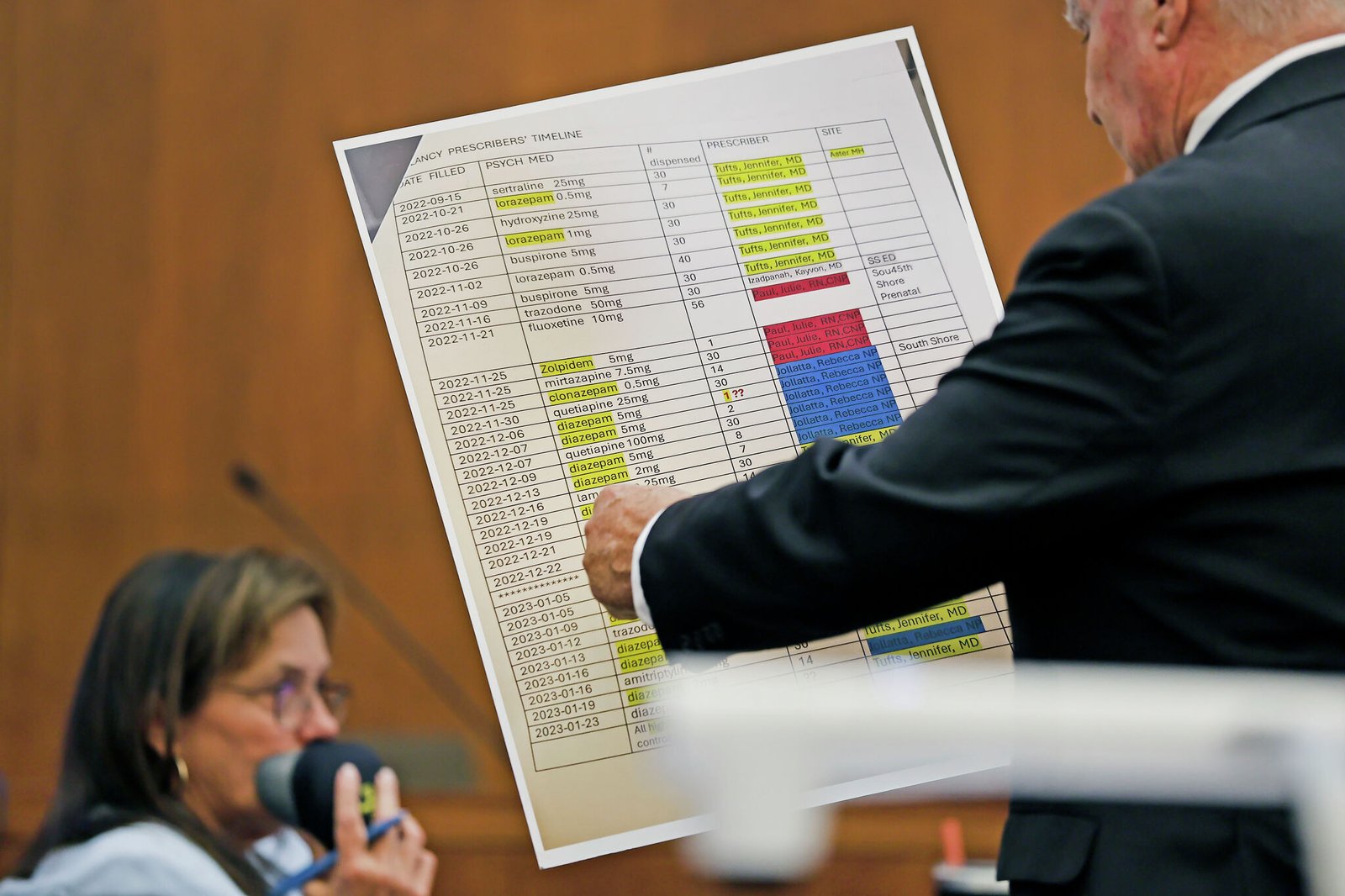

Defense attorney Kevin Reddington shows a list of medications prescribed to Lindsay Clancy to the jury on the opening day of her murder trial at Plymouth Superior Court July 27, 2026. Clancy is charged with killing her three children, Cora, Dawson and Callan, in their Duxbury, Mass., home in 2023.


Throughout the murder trial of Lindsay Clancy, a key question raised by the defense and prosecution is what mental health care the Connecticut native received before the killings of her three children in 2023.
Her lawyer, Kevin Reddington, has claimed Clancy was experiencing postpartum psychosis at the time of the killings. The condition can affect 1 to 2 in 1,000 mothers of newborns, and can include hallucinations, paranoia and a loss of touch with reality, among other symptoms. Reddington also has claimed Clancy has bipolar disorder and was improperly medicated, which contributed to her deteriorating mental state.
Article continues below this ad
Prosecutors, meanwhile, allege Clancy bears criminal responsibility for strangling 5-year-old Cora, 3-year-old Dawson and 8-month-old Callan Clancy with exercise bands in the basement of the family’s Duxbury, Mass., home on Jan. 24, 2023. They have described Clancy as controlling and manipulative.
Prosecutors have also pointed to the number of pills that were left in Clancy’s prescription bottles to argue that she wasn’t taking all of the medication that she was prescribed.
Clancy and her now-former husband, Patrick Clancy, have each sued her mental health treatment providers, alleging wrongful death and medical negligence. A motion filed in Patrick Clancy’s suit to oppose the lawsuit’s dismissal lays out details of his ex-wife’s medical treatment over the years. Many of Clancy’s providers have also been called to testify at trial by the prosecution, which has provided further detail about her medical history.
Article continues below this ad
Lindsay Clancy’s own lawsuit contends in an amended complaint filed in June the she was suffering from “auditory” hallucinations from Nov. 29, 2022, to Jan. 24, 2023, when the children were strangled.
Here’s a timeline of Clancy’s medical treatment over the years and leading up to the killings, according to court documents and testimony so far during the trial:
Nursing school: After graduating from Quinnipiac University in 2012 with a bachelor’s degree in biology, Clancy attended nursing school in Massachusetts. While in school, she was prescribed Prozac and Wellbutrin, both antidepressants, according to testimony.
Dec. 24, 2017: Lindsay and Patrick Clancy, have their first child, Cora. She experienced “some anxiety” after her first pregnancy, court papers in a lawsuit brought by Patrick Clancy said.
Article continues below this ad
Sept. 30, 2019: Lindsay Clancy gave birth to Dawson. She developed a “higher degree” of anxiety than after the birth of Cora, court papers said. She was offered Zoloft, but declined it, court papers from the lawsuit said.
May 26, 2022:
September 2022: After Patrick Clancy returned to work and she was facing her own return to work as a labor and delivery nurse, Lindsay Clancy began feeling “increasing anxiety,” in September 2022, the court papers said. She began to experience “insomnia, exhaustion during the day, and a lack of motivation to perform daily tasks,” the papers said.
Sept. 15, 2022:
Article continues below this ad
Clancy selected “no” on every question on a suicide risk assessment form that she filled out, including to questions about whether she had heard voices telling her to hurt herself or others, or having thoughts of killing or seriously hurting someone else.
Tufts testified that she recommended Clancy take sertraline, also known as Zoloft, and undergo individual therapy.
Mid-October 2022:
Oct. 20, 2022: One week after she began taking the medication and the prescribed dosage increase, she reported to Tufts that her anxiety had gotten worse, that she was experiencing racing thoughts overnight, and that she was “paranoid of getting suicidal thoughts, (of) something bad happening,” court papers in the lawsuit said.
Article continues below this ad
Tufts testified that she directed Clancy to stop taking the Zoloft.
Oct. 21, 2022: During a followup appointment the next day, Tufts and Clancy came up with a plan for her to begin taking Ativan, also known as lorazepam, as needed, Tufts testified. She also recommended Clancy see a therapist.
Nov. 16, 2022: Court papers in Patrick Clancy’s suit said that by mid-November, Lindsay Clancy was only sleeping three hours per night. On Nov. 16, 2022, she went to the emergency room where she was prescribed trazodone, an antidepressant. The medication was ineffective, the court papers said.
Nov. 20, 2022: Patrick Clancy’s mother contacted Julie Paul, a nurse practitioner with the The Perinatal Behavioral Health Program of South Shore Health, and asked her to reach out to Lindsay Clancy. The program focuses on caring for pregnant women and mothers of newborns with anxiety and postpartum depression. Lindsay Clancy reported the trazodone had not been effective, court papers from the lawsuit said.
Article continues below this ad
Nov. 21, 2022:
Nov. 25, 2022:
Late November 2022:
Nov. 29, 2022:
Article continues below this ad
Dec. 1, 2022: Clancy reported she was having “intrusive thoughts of harming herself and of harming her children,” to Tufts, the lawsuit papers said. Tufts noted she and Clancy discussed that Clancy could have undiagnosed bipolar disorder.
Dec. 2, 2022: Clancy reported to Latiesha Dukes, from whom she had been receiving therapy, that she had become addicted to Ativan and that was why she couldn’t sleep, the lawsuit papers said. She also reported having suicidal ideation and intrusive thoughts.
Dec. 5, 2022: Clancy told Dukes she had contacted ASPIRE Crisis support, an emergency service for people at risk of self-harm, the previous weekend, papers in Patrick Clancy’s lawsuit said. She was turned away again because she didn’t have a plan to harm herself, Clancy’s lawsuit said.
Article continues below this ad
Dec. 6, 2022:
Dec. 20, 2022: Clancy went to the emergency department at Massachusetts General Hospital
Jan. 1, 2023: Clancy admitted herself to McLean Hospital, a psychiatric hospital.
Article continues below this ad
Jan. 5, 2023: Clancy was discharged from McLean. Over the following weeks, she met with Tufts for 17-minute sessions, during which she “reported becoming desperate and that she was not bonding well with her baby,” the lawsuit papers for Patrick Clancy said. The court papers said Clancy also informed Tufts she was “suicidal and homicidal as to her children.” Within one week of leaving McLean the hallucinations returned, her lawsuit said.
Jan. 23, 2023: Clancy last saw Tufts.
Article continues below this ad
Her lawsuit also claims that she asked her husband to get takeout food and then looked up a map to see how long it would take because she was afraid of being alone and needed help. She “felt a force come over her” and the voice was saying “this is your last chance to kill the children so you can kill yourself,” her lawsuit said.
Clancy is accused of strangling her three children in the family’s Massachusetts home and attempted to take her own life.
Article continues below this ad