
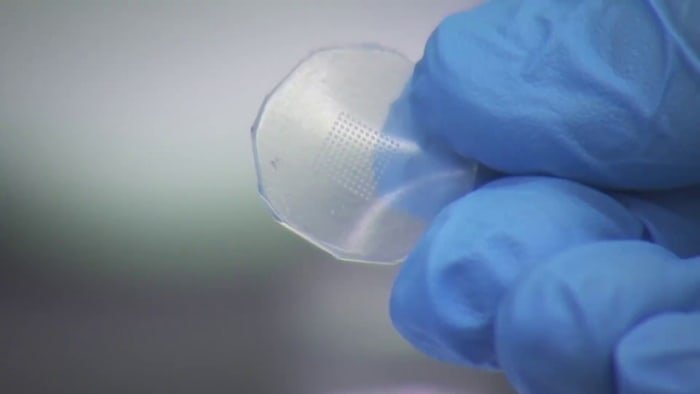
BLACKSBURG, Va. – Researchers at Virginia Tech are testing a small wearable patch that can detect fentanyl in a person’s system and automatically release naloxone — no bystander required.
The device, called the iNal patch, is smaller than a penny. It uses nanoparticles loaded with naloxone and embedded in 121 microneedle tips. When those nanoparticles sense fentanyl, they open and deliver the drug directly through the skin.
“When our nanoparticle detected the fentanyl, it will open the gate and release the naloxone inside,” said Penghui Zhao, a visiting instructor at Virginia Tech’s Academy of Integrated Science who helped develop the technology.
A solution for overdoses that happen alone
The patch addresses one of the most persistent and deadly realities of the opioid crisis: people often overdose when no one is around to help.
The CDC estimates nearly 70,000 people died from overdoses in the United States in 2025, and over half of those deaths were linked to fentanyl.
Wujin Sun, an assistant professor of biological systems engineering at Virginia Tech, said that reality shaped the project from the start.
“In a lot of the cases, overdose related deaths happen because there’s no one around,” Sun said. “What if we can engineer the smart device to watch the person all the time and save the person when needed? So, that’s the motivation.”
How the patch works
Naloxone — commonly known by the brand name Narcan — is the drug used to reverse an opioid overdose. According to the National Institute on Drug Abuse, it is only active for 30 to 90 minutes. Fentanyl can remain in the body longer, which means a single dose sometimes wears off before the drug does.
“In some cases, Narcan can wear off before fentanyl and then people may be overdosed again,” Sun said. “So, in our patch, we have the cyclic release pattern. That means after the initial life-saving dose, it can be released again.”
The iNal patch is currently being developed for a 24-hour lifespan, delivering multiple doses over that period. Researchers say that window could be extended significantly.
“Whenever it’s triggered by the fentanyl, it will release the naloxone from the nanoparticle from the iNal patch. So it totally could be multi-dosage for the fentanyl exposure,” Zhao said.
A first-of-its-kind direct detection approach
Sun said when the project began, no published research had combined an opioid sensor with a drug release device in a single wearable.
“When we started this project, there’s no such report, even in scientific literature, that people combine opioid sensor with a drug release depot. So, we are the first one at least starting this project,” he said.
Other emerging approaches monitor heart rate or breathing patterns as indirect signs of an overdose. The iNal patch is designed to detect fentanyl directly, which Sun said eliminates a layer of uncertainty.
Potential to treat more than fentanyl overdoses
The researchers say the patch’s sensing technology could be adapted to detect other opioids or even markers for different diseases, opening the door to broader medical applications.
“If we tune it to detect other signals, like different opioids or markers for other diseases, then we can monitor other diseases and then trigger the drug release accordingly,” Sun said.
The same design logic — a wearable that senses a condition and releases a drug in response — could reduce dependence on nearby healthcare workers for a range of patients, Sun added.
Early results and next steps
Lab and mouse trials have shown promising results, according to the researchers. The team is now seeking additional funding to advance testing to larger animals and, eventually, human trials.
“We want to definitely move it forward to further tests, like larger animals or even FDA approvals for even human tests for the future,” Sun said.
Virginia Tech’s College of Agriculture, engineering programs, and medical schools all offer resources that could support that development, Sun said.
Copyright 2026 by WSLS 10 – All rights reserved.