
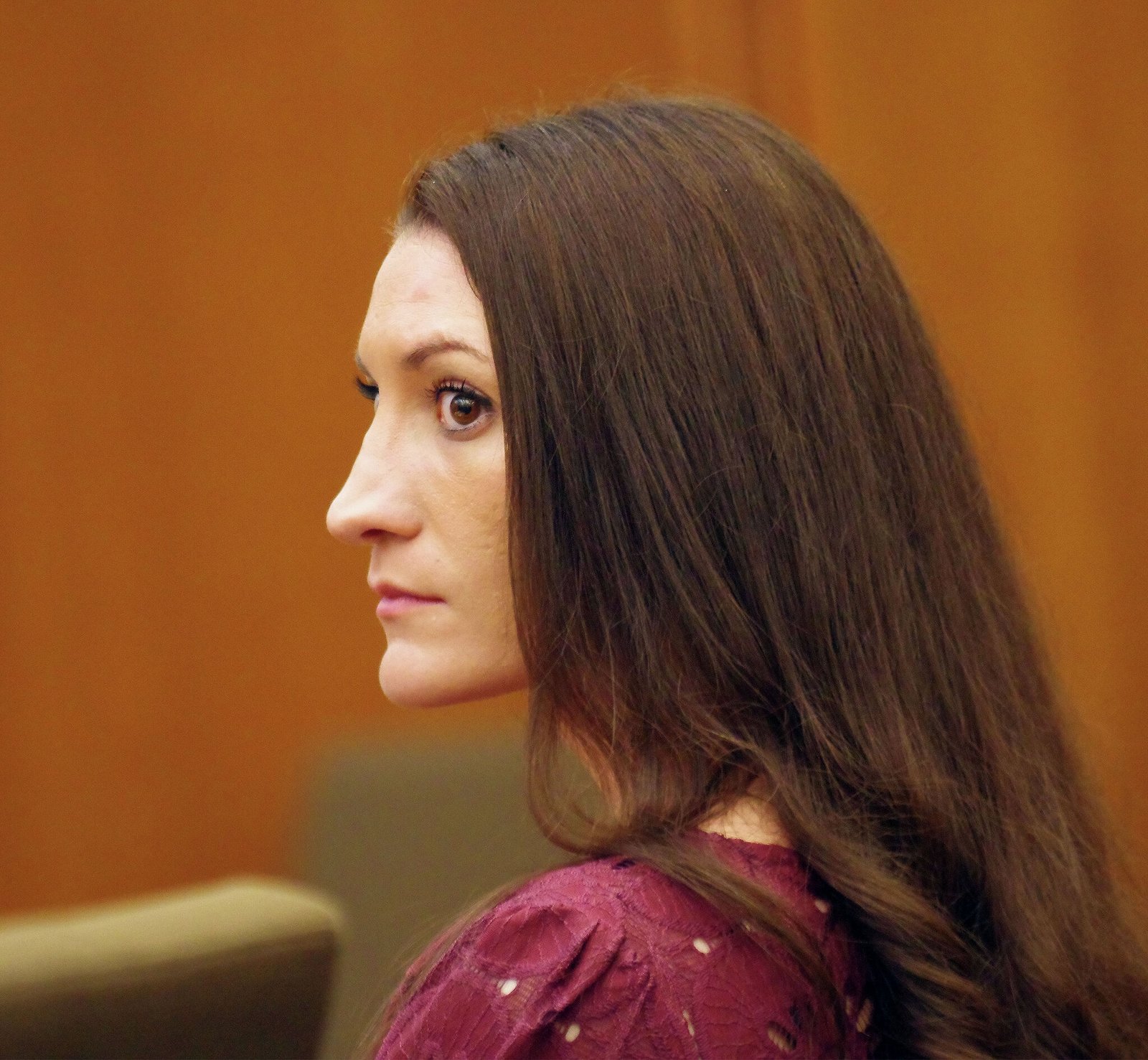
The prosecution began its rebuttal after the defense in the Lindsay Clancy.murder trial rested its case Friday morning.
The 36-year-old Connecticut native is accused of strangling her three children — 5-year-old Cora, 3-year-old Dawson and 8-month-old Callan Clancy — with exercise bands on Jan. 24, 2023.
Article continues below this ad

Lindsay Clancy during her murder trial in Plymouth Superior Court Aug, 21, 2026.


On Thursday, the jury heard testimony for the defense from a hospital chaplain who counseled Clancy after the killings. Thursday also saw more than 200 supporters of Clancy rally outside the courthouse.
Prosecutors argue Clancy bears criminal responsibility for the killings. Clancy has not argued through her attorney, Kevin Reddington, against evidence at trial that she killed the children. She instead has claimed that she was experiencing postpartum psychosis at the time. Reddington also has claimed that Clancy has bipolar disorder and was improperly medicated.
Clancy’s now-former husband, Patrick Clancy, testified that he returned home from picking up food and medication to find his wife injured in a suicide attempt and the children unresponsive in the basement.
Article continues below this ad
Friday marked the end of the fourth week of testimony and the 18th day overall. If convicted, Clancy could face life in prison.
Here are courtroom updates from WCVB, a Hearst TV station in Boston:
Here are more live updates as the trial resumes Friday:
Article continues below this ad
After Reddington questioned Mack for several minutes about the standards for determining postpartum depression and postpartum psychosis, arguing that the guidelines are decades old, the judge told the jury they were recessed for the weekend.
Mack’s testimony and any other rebuttal witnesses by the prosecution will continue Monday, the judge said.
They then will discuss jury instructions, he said.
Article continues below this ad
The judge also told jurors the trial is on track, due in part to their hard work.
Reddington aggressively questioned Mack on his background working with adults, since most of his experience is with teens, according to the attorney.
“Your focus was on adolescents who like to smoke weed and drink, right? Reddington said. “No,” Mack responded.
Article continues below this ad
Mack said he has treated 10 women with postpartum psychosis over the course of 25 years.
Reddington asked Mack about whether Clancy was diagnosed with postpartum depression. Mack said, “no.”
The attorney also asked Mack about Clancy’s medical records but said he couldn’t remember whether she had received a test for depression. She had scored high on the test, previous testimony from other witnesses said.
Reddington also brought out that Mack interviewed Clancy with another expert witness for the prosecution and that the two men worked for the same firm that lined up experts for court testimony.
Article continues below this ad
There was also a heated exchange as to whether Clancy was resistant to taking medications, with Mack saying she had been resistant to taking medications her whole life. Reddington challenged that statement, saying she was only resistant while breastfeeding.
Under cross-examination by Clancy’s attorney, Mack conceded that he didn’t speak to anyone about Clancy as he was “investigating” whether she was able to control her actions during the killings.
He also admitted that he is being paid by prosecutors to act as an expert, which drew a few laughs from the jury as Reddington pointed out that everyone in court is paid except for the jurors.
Article continues below this ad
Mack said he didn’t talk to coworkers or anyone else about whether Clancy was a good employee or a hard worker.
He told Reddington that he was retained in early 2025 by prosecutors.
Clancy was suffering from a mental disease or defect — major depressive disorder — yet had retained the capacity to control her behavior, according to Mack.
Article continues below this ad
He gave the examples that she acted normally when calling CVS and the restaurant, so she could control her actions that day, he said.
In the weeks prior to the killings, “she was aware that was wrong and she could be punished for the act,” Mack said
Clancy told him she heard a “loud” voice saying multiple times she should “kill” the children “so you can kill yourself,” according to Mack. She then killed Dawson while saying, “go to God,” which she said during all three killings, he said.
She said she took pills in her bedroom before cutting the screen to go out of the window, Mack said.
Article continues below this ad
As court broke for its one-hour lunch recess, about 20 people were already lined up outside the courtroom, hoping to get in for the afternoon session.
The trial has drawn large crowds in recent weeks, many of them women. Only about 50 public seats are available, and seats cannot be saved, meaning those who leave the courtroom must return to the back of the line.
Two women near the front of the line Friday morning said they had arrived around 6 a.m. and waited more than three hours to get inside.
Article continues below this ad
Mack said on the stand that he didn’t find any manic episodes that would lead him to diagnosis that she was bipolar. He also said that some of the odd thoughts she was having were normal such as the fear that someone would take away her children.
He also said that he understood why she would feel she was “damaged” by the medication and didn’t believe her irrational thoughts were “psychotic.” She had concerns that were rational because they “aligned with what she experienced,” he said.
“Is being suicidal a form of psychosis?” Assistant District Attorney Shanan Buckingham asked. “No,” Mack said. “She was suffering,” Mack said.
Article continues below this ad
Clancy identified that her mother and her children were protective factors from her committing suicide, he testified.
Court is recessed for lunch.
Mack said after interviewing her and examining her records, his diagnosis is that Clancy was suffering from a “major depressive episode,” which was likely part of a major depressive disorder. He also said she had obsessive thinking that is part of anxiety.
Article continues below this ad
He said he concluded there was no element of mania or hypomania from 2022 to 2023. He listed various symptoms of mania and that it requires four of the symptoms over a seven-day period. He said he didn’t find any evidence of mania.
Mack said Clancy’s family had no history of mental illness and that he based his diagnosis independently of her earlier bouts of mental illness.
He did not interview any other family members, but did review Patrick Clancy’s grand jury testimony, Mack said. Her family didn’t respond to the prosecution’s requests to speak with him, but he didn’t know that, he testified.
Dr. Avram Mack testified that he tries to independently review cases even if he’s an expert for the defense or the prosecution. He reviewed medical records, outpatient and inpatient records before and after murders and criminal files, he testified.
Article continues below this ad
He interviewed Clancy on April 10 and 12, he said. “Generally, she was friendly and cooperative,” he testified.
He observed that she maintained eye contact and her overall there were not very many abnormalities in her speech or thought, he said. “I would say at some point she seemed distressed at certain topics,” Mack said.
She is using a wheelchair, she seemed comfortable physically, he said. She was able to navigate her wheelchair one place or another, he added.
She described her general day at Tewksbury Hospital, saying mostly she stayed in bed or was on her own, he said. She didn’t interact with other patients, Mack said. Sometimes she was able to see family members and religious figures, a chaplain or priest, he added.
Article continues below this ad
To some degree, she interacted with staff and other patients, Mack testified.
She wasn’t very interested in her own hygiene or grooming, he said. Showering was embarrassing for her, Mack said on the stand.
She described feeling depressed, feeling miserable, not wanting to be alive, Mack said.
She said she was devastated by her situation, he agreed. She is taking Olanzapine, which he said was used to treat psychosis and mania. He believed she was also taking Trazadone and Wellbutrin, an antidepressant and medications used to help with sleep and anxiety, Mack testified.
Article continues below this ad
Under cross-examination, Resnick conceded that there was no written record of Lindsay Clancy crying every day after the children died. He had previously testified that nurses had told him she had cried every day.
Reddington rested his case after the cross-examination.
Prosecutors will present rebuttal witnesses.
Article continues below this ad
Resnick testified that Clancy committed “altruistic” murders, thinking they would be better off dead with her than struggling without her and that she was under the influence of a “command voice” while psychotic.
She did not kill the children because they were a burden or for revenge against her husband, Resnick said. She also didn’t shake or abuse the children, he said.
“She believed she was morally right” by protecting the children by killing them because if she died they would suffer, he said. “She had psychotic thinking about the children’s need for her,” Resnick testified. She was also under the influence of a “command hallucination,” he said.
Article continues below this ad
He is now being crossed-examined by Jennifer Sprague. She brought up that Andrea Yates who committed herself five times in an effort to not kill her children, Sprague said. But she finally gave into the voices and killed them, Sprague said.
Clancy only said twice to her husband she had thoughts to kill her children, but Resnick said under cross-examination that didn’t mean she wasn’t having more thoughts of killing her children.
Resnick diagnosed her with severe depression and mild mania leading him to believe that she suffered from bipolar 2, Resnick said.
Article continues below this ad
He testified that on the day of the children’s deaths, she was “frankly psychotic” and I would label that “postpartum psychosis” because it was postpartum and she was “psychotic on that day.”
She tried not to show her mental health issues to people outside the family, he said. Resnick also testified that she was not “frankly psychotic” all throughout that day. But she was “psychotic” when she heard a “command” voice that day, he said.
She “felt that her body was taken over by an external force,” Resnick added.
Earlier in testimony, he said testing done by the government’s doctors revealed that she tended to minimize her symptoms, not exaggerate them and that the tests “did not suggest any evidence of faking psychiatric symptoms.”
Article continues below this ad
Jurors were taking notes during his testimony.
Resnick resumed his testimony with the connection still a bit choppy. He became interested in forensic psychiatry 40 years ago and has worked on several nationally known cases, including the “Unibomber,” Andrea Yates who drowned her children, the Oklahoma bombing case, Jeffrey Dahmer’s case, Resnick said.
He was asked by Reddington to evaluate Clancy, interviewing her and her parents, he testified.
Article continues below this ad
Dr. Phillip Resnick, a forensic psychiatrist was sworn in to testify via Zoom but the connection wasn’t clear. Jurors, like the rest of the courtroom, struggled to hear Resnick as he testified over Zoom, staring blankly at the screen and glancing between defense attorney Kevin Reddington and the judge.
The court is now in recess while the issue gets fixed. The jury was sent out and the courtroom was cleared.
After a lengthy wait to set up technology and two sidebars, it appears the murder trial of Lindsay Clancy is about to start its 18th day.
Article continues below this ad
Judge William Sullivan said he would expect a longer day than earlier this week.
The next witness for the defense will be via Zoom, he said.
Judge William Sullivan said he anticipated closing arguments in the case may be held Monday or Tuesday of next week. “There’s been a lot of evidence, and there’s a lot of witnesses,” he said. “So if the parties feel that they need a day to kind of marshal their thoughts, we could talk about that.”
Article continues below this ad
Reddington indicated the defense still will call one doctor as a witness, and the prosecution has three doctors they wish to call.
Sullivan didn’t provide an explanation for jurors why they were let go early on Thursday.
Asked about the early dismissal after court, Reddington responded vaguely, but said it was “no big deal.”
Reddington noted after court that each individual juror was sworn in again Thursday morning to ensure that the support for Lindsay did not affect their ability to be impartial in this case.
Article continues below this ad
Jurors only sat for around 30 minutes of testimony Thursday before they were dismissed for the day.
The only witness to be called by the defense was Sheila Cavanaugh, a board certified chaplain at Brigham and Women’s Hospital. Cavanaugh recalled counseling Clancy in the wake of the killings.
Cavanaugh testified that she was able to talk with Clancy after she was extubated. At one point, Clancy told her, “I am so glad my children are safe,” Cavanaugh said. The hospital chaplain said she replied to Clancy “theologically.”
Article continues below this ad
“Your children are safe, they’re safe in heaven with God,” Cavanaugh said she told Clancy.
Cavanaugh said Clancy alluded to having heard a voice that told her if she did not follow its command, “neither she nor her children would be safe.”
On cross-examination, Assistant District Attorney Jennifer Sprague noted that Cavanaugh had not written about the voice in contemporaneous notes she took of her conversations with Clancy.
More than 200 supporters of Clancy gathered outside of the court Thursday, many of them wearing pink. Some supporters also gathered outside Tewksbury Hospital, about 90 minutes away, WCVB reported.
Article continues below this ad
Renee Kimball, who organized Thursday’s gathering, said she felt compelled to act after watching Clancy become distraught in court as prosecutors presented evidence about her children’s autopsies in recent weeks.
“It was 1 o’clock in the morning and I was still devastated for her, so I felt like I had to do something,” Kimball said.
Anyone who has thoughts of harming themselves, or seeks access to free and confidential mental health support, can call or text the 988 Suicide & Crisis Lifeline at 988 or 800-273-8255 (en Español: 888-628-9454; Deaf and Hard of Hearing dial 711 and then 988) or visit 988Lifeline.org. People in need can also text the Crisis Text Line by texting HOME to 741741.
Article continues below this ad