A Lifesaving Heart Pump for Critically Ill Heart Patients
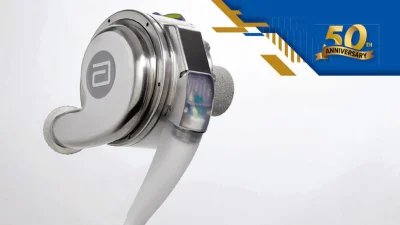
A unique collaboration between NASA, Dr. Michael De-Bakey, Dr. George Noon, and MicroMed Technology, Inc., resulted in a lifesaving heart pump for patients awaiting transplants. The MicroMed DeBakey VAD ® is a ventricular assist device that functions as a “bridge to heart transplant” by pumping blood throughout the body to keep critically ill patients alive until a donor heart is available.
The concept for the tiny pump grew from conversations between Dave Saucier, an engineer at Johnson Space Center, and Dr. DeBakey and Dr. Noon, famed heart surgeons at Baylor College of Medicine. They discussed creating a heart pump that would benefit patients with congestive heart failure. Saucier and a team of Johnson engineers joined with DeBakey, Noon, and colleagues at the DeBakey Heart Center at Baylor College to develop the initial design. The Johnson team built several versions of the device, based on the criteria and feedback supplied by DeBakey’s medical team.
During the initial development of the implantable axial rotary heart pump, engineers found two major concerns. Friction led to damaged blood cells, because the device created high shear flows through pump parts. Also, there were stagnant regions in the pump that caused blood clotting, a major problem with ventricular assist devices.
To solve these problems, help came from researchers Cetin Kiris and Dochan Kwak in the NASA Advanced Supercomputing (NAS) Division at Ames Research Center. Kwak, Chief of the NASA Applications Branch, explained that they were asked to help because of their “experience with simulating fluid flow through rocket engines.” According to Kiris, “The speed of fluid flow through a rocket engine is faster than blood flow, but very similar in many ways.”

Using NASA supercomputers and computational fluid dynamics technology, which models the fuel and oxidizer flow through rocket engines such as the Space Shuttle main engine, the Ames researchers analyzed blood flow through the battery-powered heart pump. Based on the results, they suggested design improvements that reduced red blood cell damage to an amount well below acceptable limits. The improved blood flow pattern also reduced the tendency for blood clots to form by eliminating the stagnant regions.

The road to commercial success for the VAD began in 1996, when NASA patented the heart pump and licensed it exclusively to MicroMed Technology, Inc., of Houston, TX. MicroMed, organized by President and Chief Executive Officer Dallas Anderson to further develop the pump for critically ill heart patients, faced the challenge of converting the engineering device into a medical appliance that could be implanted.
Within two years, MicroMed obtained international quality and electronic standards certifications, developed the ancillary components of the system, and received regulatory permission to begin clinical trials in Europe. In November 1998, a 56-year-old male was the first patient implanted with the MicroMed DeBakey VAD. According to Anderson, the pump functioned normally and to design specifications.
For more information, visit here .
Fully Implantable Next-Gen Artificial Hearts

NASA’s innovative technology enabled the transition from bulky, short-term pumps to compact, long-term life-support systems that saved thousands of individuals with heart problems and that are now redefining how heart failure is treated. Later-generation devices reduced the shear-driven hemolysis and clot-forming stagnation identified in the pump’s earliest design.
MicroMed was the first company to use a next-generation, miniaturized axial-flow device, pursuing U.S. pivotal trials for both bridge-to-transplant and long-term destination therapy (the DeBakey VAD received CE Mark approval for both indications in Europe in 2001). In the U.S., it received FDA approval in February 2004 through a Humanitarian Device Exemption for pediatric patients aged 5 to 16 as a bridge to a heart transplant.
The device presented several advantages for recipients. Weighing less than 4 ounces and measuring 1 inch by 3 inches, the MicroMed DeBakey VAD was approximately one-tenth the size of other currently marketed pulsatile VADs at that time. This made it less invasive and ideal for smaller adults and children.
A VAD is most often placed in the left lower heart chamber, called the left ventricle. When placed in this location, it’s called a left ventricular assist device (LVAD). Current LVADs send a constant flow of blood from the heart to the body and are used for patients who have reached end-stage heart failure.
By the early 2000s, VAD therapy had expanded significantly across transplant centers. In the U.S., several primary systems defined the field: the HeartMate and Novacor devices, which were implantable electrically driven systems for left ventricular support; the Thoratec system, which could support the left, right, or both ventricles; and the CardioWest total artificial heart.
The HeartMate 2, approved in the late 2000s, is a compact continuous-flow LVAD. This shift to continuous flow replaced the valved, pulsatile designs of earlier VADs with a simpler, single-moving-part rotor, shrinking pump size, reducing mechanical wear, and lowering infection risk. In 2017, the HeartMate 3 was approved by the FDA. It incorporates a fully magnetically levitated (maglev) centrifugal pump, representing a major technological advancement over the mechanical bearing system used in HeartMate 2.
The latest innovations are pushing heart pumps toward more fully implantable and intelligent systems. Most implanted VADs today are still powered through a percutaneous driveline that exits through the skin, a connection point that carries a persistent infection risk, which is the main problem the next generation of wireless power systems is designed to solve. Emerging designs include wireless LVAD technologies under development that aim to eliminate external cables, magnetically levitated total artificial hearts currently in early clinical trials, and bio-inspired pumps designed to restore more natural pulsatile blood flow. Combined with advances in implantable sensors and minimally invasive surgical techniques, these innovations signal a shift toward longer-term, more lifestyle-compatible mechanical circulatory support.

From wireless, fully implantable LVADs to bio-inspired pumps and artificial hearts, a new wave of startups and research labs are developing smaller, smarter, and more patient-friendly VADs.
BiVACOR
Huntington Beach, CA
BiVACOR’s total artificial heart (TAH) is a valveless biventricular rotary blood pump that uses magnetic levitation to replace both ventricles of a failing heart. It is conducting an FDA-approved, first-in-human Early Feasibility Study for safety of TAH.
CorWave
Clichy, France
Using its wave membrane technology, CorWave LVAS can restore blood flow while preserving a high-fidelity pulsatility. In 2025, it announced the first implantation in a patient of its LVAS, a heart pump based on its wave membrane technology.
Corvion
Webster, TX
By developing a highly efficient fully implantable rotary blood pump coupled with a robust and flexible transcutaneous (through the skin) charging technology, the company aims to dramatically improve patient outcomes.
Executive Vision

Marc Taub, Ph.D, is Vice President of Technical Operations for Abbott’s diabetes care businesses, leading global R&D, medical, and clinical affairs. Based in Alameda, CA, he has helped advance Abbott’s Libre portfolio and Lingo biowearable technology and is leading development of Abbott’s dual glucose-ketone monitoring system. Dr. Taub is a published researcher, inventor, National Academy of Engineering member, and graduate of Brown University and Stanford University.
Q1. As we mark 50 years of innovation, how have you seen medical devices evolve and which engineering advances have most fundamentally shaped that transformation?
Marc Taub: Over the past 50 years, the biggest shift has been from point-in-time measurements to continuous, real-time insights, and that’s fundamentally changed what’s possible for people and their healthcare providers. Just as importantly, advances in connected technologies like smartphones and web-based applications have made that data far more accessible, putting meaningful health information directly into people’s hands. You can see that evolution clearly in diabetes care. Earlier devices, like blood glucose meters, provided a single snapshot in time. Today, biowearables like continuous glucose monitors (CGMs) use small, on-body biosensors to continuously measure glucose levels and, through connected apps, deliver that data in real-time to people living with diabetes, their healthcare providers, and even their caregivers.
Q2. From an engineering standpoint, what were the most pivotal technical breakthroughs that enabled CGM to move from niche adoption to a mainstream?
Taub: People living with diabetes make dozens of decisions every day, and historically they had very limited visibility between glucose measurements. The shift to continuous glucose monitoring has really been about closing that gap, providing real-time insights that support management decisions. From an engineering standpoint, a few breakthroughs made that possible. First was miniaturization — making biosensors small, accurate, and comfortable enough to wear for a continuous length of time. Second was improving the overall system experience, including integrating connectivity and analytics to deliver real-time insights, and eliminating the need for fingerstick calibration, which improved usability. Third was a focus on affordability, designing systems from the beginning to be accessible and scalable globally so more people can benefit.
Q3. What are the most significant technical challenges in building fully integrated healthcare solutions?
Taub: People rely on these systems to make real, everyday health decisions, so the challenge isn’t just connecting technology — it’s making sure everything works reliably, securely, and in a way that people can trust. One of the biggest challenges is interoperability — getting sensors, apps, clinical systems, and cloud platforms to speak the same language. Healthcare data is often fragmented across systems, and when it doesn’t integrate seamlessly, it can limit insight or delay care. At the same time, you have to ensure data accuracy at the sensor level and maintain privacy and security as more information flows through connected systems. And in healthcare, all of that has to be done within a rigorous regulatory framework — meeting FDA requirements and clinical standards to ensure these technologies are effective and truly benefit people. Ultimately, the challenge is bringing all of that together into a seamless experience.
Q4. How are advances in signal processing, analytics, and AI reshaping the way medical devices deliver actionable insights to both clinicians and patients?
Taub: Historically, medical devices reported raw numbers, often captured at a single point in time and primarily reviewed in a clinical setting. Today, advances in signal processing and analytics filter, contextualize, and translate those numbers into meaningful trends and predictions, that are shared not only with clinicians but directly with patients through smartphone and web-based applications. You’re now seeing AI extend that further into everyday decisions.
Q5. Which emerging technologies will have the potential to redefine how we think about chronic disease management beyond diabetes?
Taub: People living with chronic conditions are making decisions every day, often with limited visibility into what’s happening inside their body. That’s why I see biosensing as the foundation for the next era of care. What’s changing now is how biosensing is evolving and integrating with other technologies. Next-generation biowearables will move beyond single metrics to track multiple biomarkers — like glucose, ketones, and lactate — providing a more complete picture of metabolic health. That will allow us to replace point-in-time testing with continuous monitoring, identify risks earlier, and support both chronic disease management and acute care. At the same time, AI and analytics will translate that data into personalized guidance for individuals and actionable insights for clinicians, creating a continuous feedback loop. Ultimately, this shift will enable more proactive, personalized care — anticipating issues rather than simply reacting to them.
Q6. If you were advising the next generation of medical device design engineers, what skills will matter most in shaping the next 50 years of innovation?
Taub: I would tell them the next 50 years will not be defined by better technology alone. It will be defined by the ability to combine engineering excellence, human understanding, data intelligence, and social responsibility. First, never forget you are designing for a person. That means prioritizing quality, usability, and trust, and focusing on optimizing outcomes, not just features. Building that trust also requires a strong commitment to privacy and data security, because people need confidence in how their information is stored and used. Second, develop the ability to collaborate across disciplines. The most impactful engineers will be those who can think in systems, bring together hardware, software, data, and user experience, and work effectively across teams to solve complex problems. Finally, bring the right mindset. Build resilience and stay adaptable. And always keep people at the center of everything you do.
For more information, visit here .
var GAM_breakpoint=window.getComputedStyle(document.querySelector(‘body’),’:before’).getPropertyValue(‘content’).replace(/”/g,”);window.googletag=window.googletag||{cmd:[]};googletag.cmd.push(function(){googletag.pubads().setTargeting(‘sitepage’,[‘NTB/Medical/Articles’]).setTargeting(‘site’,[“NTB”]).setTargeting(‘menu_route’,[“tb/features/articles”]).setTargeting(‘menu_topics’,[“”]).setTargeting(‘menu_tags’,[“”]).setTargeting(‘article_topics’,[“Medical”]).setTargeting(‘article_navs’,[“Articles”]).setTargeting(‘article_category’,[“Articles”]);googletag.pubads().enableSingleRequest();googletag.pubads().collapseEmptyDivs();googletag.pubads().setCentering(true);googletag.pubads().setForceSafeFrame(false);googletag.enableServices();});$(function(){function ntb_google_ad_manager_build(item){item_div=$(‘#’+item.div_id);if(item.display_sizes.includes(GAM_breakpoint)){googletag.cmd.push(function(){var item=this;var item_div=$(‘#’+item.div_id);size_mapping=[];if(item.size_mapping.length){size_mapping=googletag.sizeMapping();item.size_mapping.forEach(function(size_map){size_mapping.addSize(size_map.view,size_map.map);});size_mapping.build();}
var targetSlot=googletag.defineSlot(item.slot,item.slot_ad_sizes,item.div_id).setTargeting(‘pos’,[item.target_pos]).defineSizeMapping(size_mapping);if(item.slot_ad_empty===’default’){targetSlot=targetSlot.setCollapseEmptyDiv(true);}
if(item.slot_ad_empty===’collapse’){targetSlot=targetSlot.setCollapseEmptyDiv(true,true);}
if(item.slot_ad_empty===’expand’){targetSlot=targetSlot.setCollapseEmptyDiv(false);}
targetSlot.addService(googletag.pubads());googletag.pubads().addEventListener(‘slotRenderEnded’,function(event){if(event.slot===targetSlot&&event.isEmpty){item_div.parents(‘.ad-position’).addClass(‘d-none’);googletag.destroySlots(event.slot);}});googletag.enableServices();}.bind(item));}
else{item_div.parents(‘.ad-position’).addClass(‘d-none’);}}
function ntb_google_ad_manager_display(item){if(item.display_all||item.display_sizes.includes(GAM_breakpoint)){googletag.cmd.push(function(){item=this;googletag.display(item.div_id);}.bind(item));}}
for(let i=0;i
const modifyButton=input.parentNode.querySelector(‘.input-password-modify’);if(modifyButton){modifyButton.addEventListener(‘click’,()=>{const lock=!modifyButton.classList.contains(‘locked’);if(lock===true){modifyButton.classList.add(‘locked’);input.value=””;input.setAttribute(‘disabled’,”);modifyButton.innerText=Joomla.Text._(‘JMODIFY’);}else{modifyButton.classList.remove(‘locked’);input.removeAttribute(‘disabled’);input.focus();modifyButton.innerText=Joomla.Text._(‘JCANCEL’);}});}});}
document.addEventListener(‘joomla:updated’,togglePassword);document.addEventListener(‘DOMContentLoaded’,togglePassword);})(document);
/*! inlined from /media/plg_content_ntb_tagsbot/js/tagsbot.min.js by ntb_minifier */
$(document).ready(function(){var currentTagLinkID=0;$(‘#ntb_cluster_’+$(“#ntb_cluster”).children(“:selected”).attr(“value”)).show(‘fast’);$(“#ntb_cluster”).change(function(){$(‘.ntb_cluster_div’).hide(‘fast’);$(‘#ntb_cluster_’+this.value).show(‘fast’);});$(“.currentTagLinks”).mouseenter(function(){if(currentTagLinkID!=this.id){currentTagLinkID=this.id;$(‘.ntb_cluster_div’).hide(‘fast’);$(‘#’+currentTagLinkID.replace(‘_link’,”)).show(‘fast’);}});});$(function(){olytics.fire({behaviorId:’5013J3562790A3O’,category:”articles”,tag:”Medical,Implants & Prosthetics,Design,Patient Monitoring”,pageType:”content”,contentType:”feature”})});!function(f,b,e,v,n,t,s){if(f.fbq)return;n=f.fbq=function(){n.callMethod?n.callMethod.apply(n,arguments):n.queue.push(arguments)};if(!f._fbq)f._fbq=n;n.push=n;n.loaded=!0;n.version=’2.0′;n.queue=[];t=b.createElement(e);t.async=!0;t.src=v;s=b.getElementsByTagName(e)[0];s.parentNode.insertBefore(t,s)}(window,document,’script’,’https://connect.facebook.net/en_US/fbevents.js’);fbq(‘init’,’240802493731265′);fbq(‘track’,’PageView’);!function(s,a,e,v,n,t,z){if(s.saq)return;n=s.saq=function(){n.callMethod?n.callMethod.apply(n,arguments):n.queue.push(arguments)};if(!s._saq)s._saq=n;n.push=n;n.loaded=!0;n.version=’1.0′;n.queue=[];t=a.createElement(e);t.async=!0;t.src=v;z=a.getElementsByTagName(e)[0];z.parentNode.insertBefore(t,z)}(window,document,’script’,’https://tags.srv.stackadapt.com/events.js’);saq(‘ts’,’3GYZ_Va41jnx_uqfPcLCuQ’);$(function(){$(‘#cb-form’).on(‘shown.bs.modal’,function(){$(‘#inputUserName’).focus();})});
/*! inlined from /templates/tb_cmo_2017/js/custom.min.js by ntb_minifier */
$(window).scroll(function(){if($(document).scrollTop()>50){$(“nav”).addClass(“shrink”);$(“.logolarge”).addClass(“tb-logo-closed”);$(“.logosmall”).removeClass(“d-md-none”);$(“.add”).hide()}else{$(“nav”).removeClass(“shrink”);$(“.logosmall”).addClass(“d-md-none”);$(“.logolarge”).removeClass(“tb-logo-closed”);$(“.add”).show()}});_linkedin_partner_id=”3077140″;window._linkedin_data_partner_ids=window._linkedin_data_partner_ids||[];window._linkedin_data_partner_ids.push(_linkedin_partner_id);(function(l){if(!l){window.lintrk=function(a,b){window.lintrk.q.push([a,b])};window.lintrk.q=[]}
var s=document.getElementsByTagName(“script”)[0];var b=document.createElement(“script”);b.type=”text/javascript”;b.async=true;b.src=”https://snap.licdn.com/li.lms-analytics/insight.min.js”;s.parentNode.insertBefore(b,s);})(window.lintrk);
Source Link