
As longer lives reshape the global burden of disease, researchers reveal why preventing conditions that increase with age may be very different from tackling diseases earlier in life.
Study: Reframing the epidemiological transition as increasing returns to tackling aging-related diseases. Image Credit: Hyejin Kang / Shutterstock
A recent study in the journal Nature Aging reframed the epidemiological transition using global data to statistically group diseases according to their impact across the life cycle.
Demographic Shifts in Longevity and Age Structure
Between 1973 and 2023, global life expectancy at birth rose from 58 to over 73 years, reflecting a consistent average gain of 3 years per decade. Although the rate of progress varied by country, the upward trend was universal. For example, Andorra had the highest life expectancy in 1973 (75 years), while Monaco had the highest in 2023 (at over 86 years). Conversely, Mali had the lowest in 1973 (35.1 years), and Nigeria had the lowest in 2023 (54.5 years).
With old age defined as 65 years and above, projections indicate that nearly three-quarters of those born in 2023 will reach at least this age, ranging from 90% in high-income countries to about 67% in lower-income countries.
Approximately two-thirds in high-income countries and one-third in lower-income countries are projected to reach 80, assuming unchanged mortality rates. In 1973, no country had a life expectancy above 80 years; by 2023, 42 countries had surpassed this threshold. These longevity trends, combined with declining fertility, are reshaping the global age distribution.
An epidemiological transition is underway, characterized by a shift in disease burden from infectious to degenerative and chronic conditions. The share of chronic diseases in the global disease burden increased from 42% in 1990 to 64% in 2023. Simultaneously, the ratio of healthy to total life expectancy declined modestly across all income groups, indicating that longer lifespans are accompanied by more years lived in poor health and expanded morbidity.
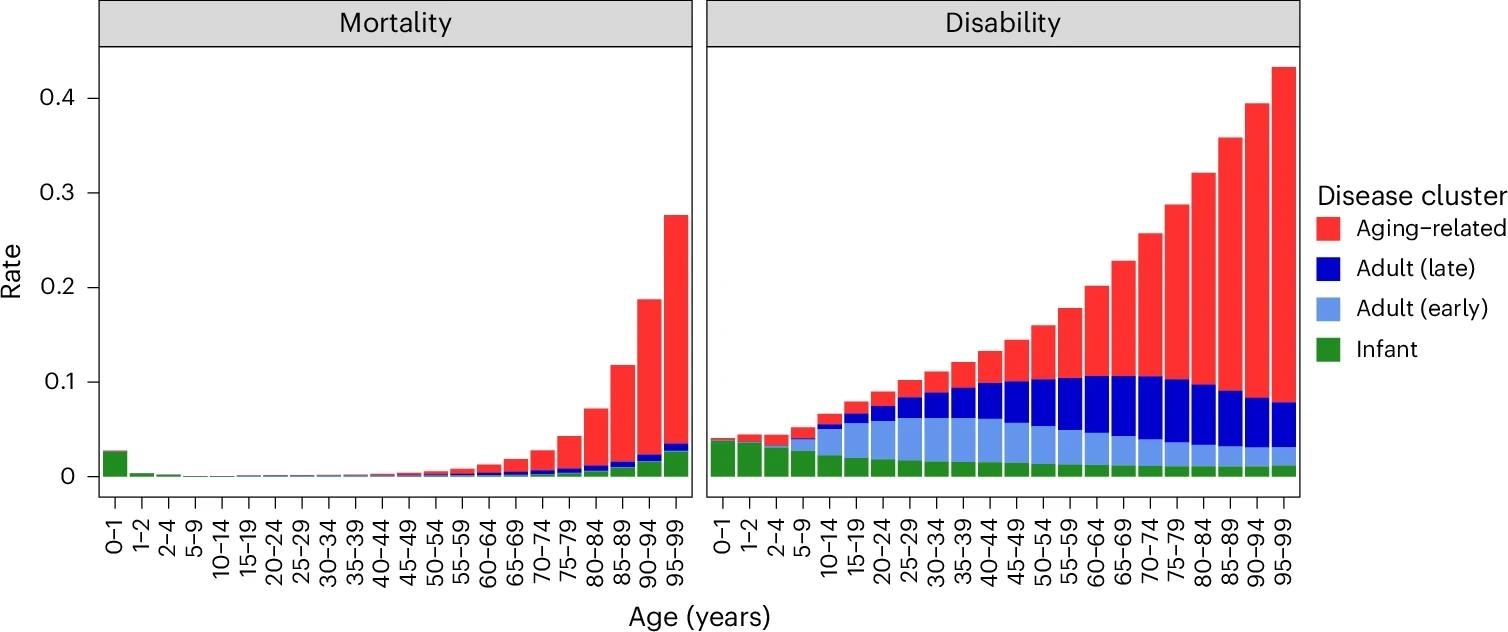
Mortality and disability burden by cluster, 2023. Mortality rates (left) and disability rates (right) for disease clusters calculated using the GBD. These rates are taken directly from the global age-specific death and YLD rates for each cause, as provided by the United Nations, and are expressed as deaths/YLDs per person for that year due to each cause. The cluster-level rates are the sum of these rates across all causes assigned to that cluster.
Examining the Epidemiological Transition Through Disease Clustering
The epidemiological transition was assessed by grouping diseases based on similarities in how their DALY burden changed across age groups, using Global Burden of Disease (GBD) data. Researchers examined disease burden across the life course to link changes in disease patterns with changes in population age structure. This approach was motivated by shifts in disease patterns associated with population aging, uneven declines in specific diseases that altered life expectancy, and the increasing role of aging as a primary determinant of health at older ages.
Alternative methods for identifying aging-related diseases have used disease incidence, electronic health records, or shared molecular mechanisms. Here, the researchers instead used a purely epidemiological classification based on how disease burden changes with age. Expected lifetime disease burden was calculated by weighting age-specific burden by the probability of surviving to each age, then analyzed by income group and disease cluster.
The researchers constructed a population-health measure that combines age-specific disability with the number of people alive at each age, with future benchmarks based on GBD mortality, United Nations population estimates, and fertility projections. Scenarios with 25%, 50%, or 100% reductions in disease cluster prevalence were modeled to illustrate the dynamics of the epidemiological transition, rather than to forecast specific outcomes.
Global Shift Toward Aging-Related Disease Burden
Four main disease clusters shaped global health: infant, early adult, late adult, and aging-related. K-means++ clustering of standardized disability-adjusted life years (DALYs) for 304 diseases and injuries using data from 204 countries (1990–2023) grouped diseases according to the shape of their global age-specific DALY profiles. Aging-related conditions such as cardiovascular and kidney disease, type 2 diabetes, certain cancers, Parkinson’s disease, and dementia accounted for the greatest current global burden.
Aging-related diseases were predominantly noncommunicable, although noncommunicable diseases were not predominantly aging-related. Nearly half of noncommunicable diseases fell within the aging-related cluster, with the remainder distributed across the late-adult, early-adult, and infant clusters. Some cancers and neurodegenerative disorders cluster in late adulthood due to a later-life peak burden.
From 1990 to 2023, the disease burden shifted by income group. Across income groups, disease-burden patterns increasingly resembled those of higher-income regions, indicating a narrowing of differences between income groups alongside demographic change. Between 1990 and 2023, infant diseases declined from over half to under a third of the global burden, while aging-related diseases increased from a quarter to over 40%. This shift, especially in middle-income countries, signaled convergence toward high-income patterns.
Demographic change is projected to continue narrowing these differences, with low- and lower-middle-income countries seeing the fastest future increases in the share of aging-related diseases. High- and upper-middle-income countries are projected to account for around 60% of the aging-related burden, while modeled economic growth accelerates these trends.
As infant mortality fell, aging-related diseases became the largest single disease cluster worldwide, while future increases are projected to be fastest in lower-middle- and low-income regions, defining the core of global disease pattern transitions. They were also the largest expected lifetime disease burden for a newborn in every income group, although only narrowly ahead of infant diseases in low-income countries. In the model, completely eliminating aging-related diseases would increase global life expectancy by 17.4 years (to over 90 years), compared with gains from eradicating infant (3.3 years), early-adult (0.8 years), or late-adult (1.2 years) diseases, highlighting the impact of reducing late-life mortality. The authors stressed that these complete-elimination scenarios were illustrative rather than realistic forecasts.
Even under this extreme scenario, average lifespans would not increase without limit, since the clusters identify when disease burden tends to peak rather than restricting diseases to particular ages. Older adults remained vulnerable to conditions assigned to other clusters, keeping mortality risk above zero and limiting population-level lifespan extension.
Aging-related diseases were especially significant because they affected the largest and fastest-growing segment of the population and included many major conditions. They also showed unusually strong complementarity between morbidity and mortality, meaning that reductions in their prevalence could improve health and survival in mutually reinforcing ways. High rates of coexisting illnesses and competing risks in this group amplified the modeled health gains. Unlike the other disease clusters, the modeled benefits also showed “increasing returns”: by 2050, a 50% reduction in aging-related disease prevalence produced about 2.2 times the gain of a 25% reduction, while a 100% reduction produced about 5.9 times the gain. In other words, further progress became more valuable as progress increased.
Conclusions
Aging-related diseases now represent the primary global health challenge, impacting populations in both high- and low-income countries as life expectancy increases. The findings support greater emphasis on preventing and delaying aging-related illness throughout the life course, alongside disease-specific treatment. However, the authors stress that “aging-related” is a statistical classification based on how disease burden changes with age, not evidence that these diseases share a single biological aging mechanism or that such mechanisms are modifiable. Prioritizing healthy aging could help extend healthy life expectancy while reducing years spent in poor health, making it an increasingly important consideration for future health policy and research.