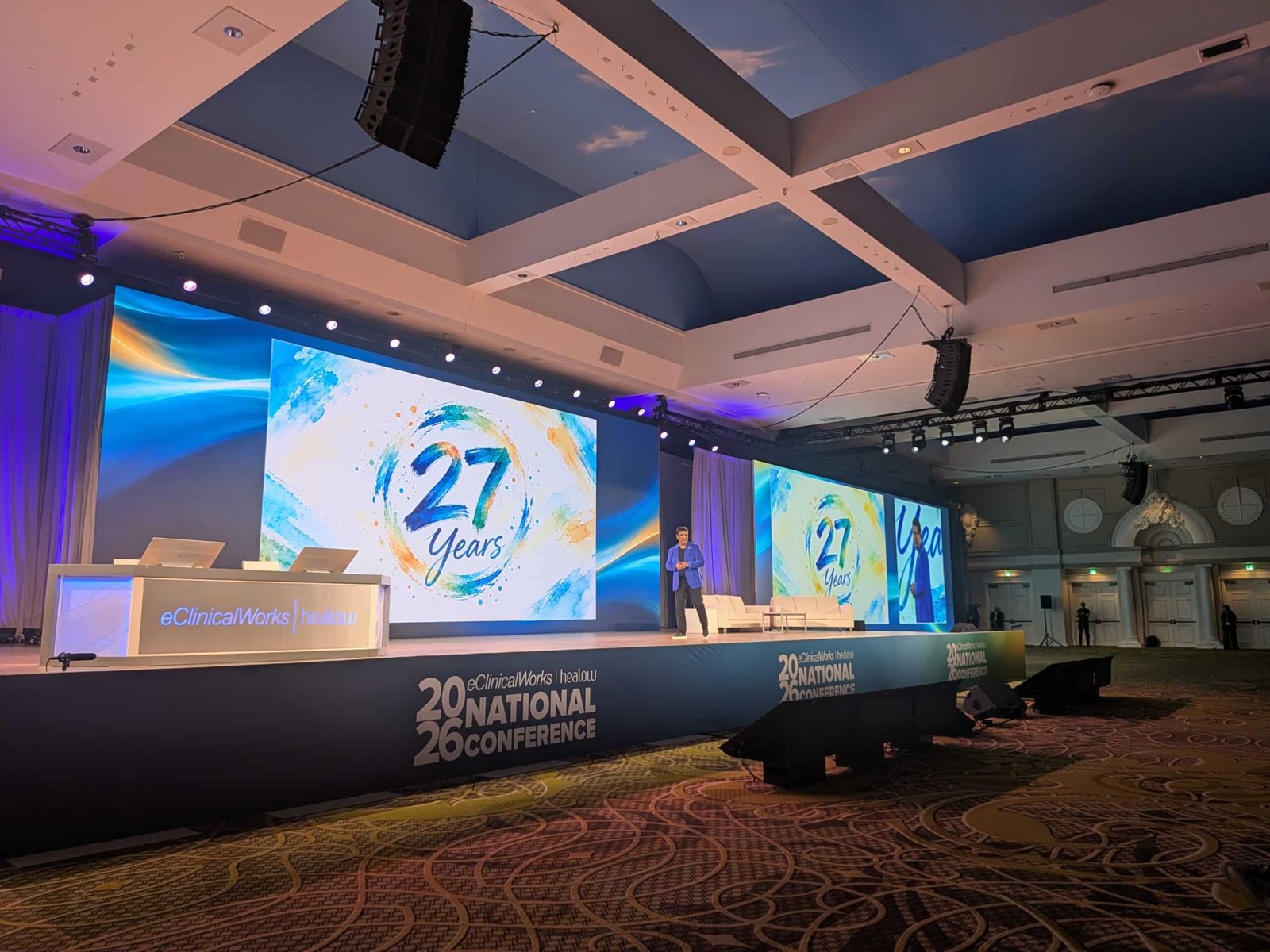
This was the 4th year in a row that Healthcare IT Today attended the eClinicalWorks National Conference. At the conference, eClinicalWorks brings together their users to announce what’s coming in their software, learn from their users, and allow users to share best practices. Plus, we were able to capture a number of videos with their users which we’ll be sharing over the next few months.
What’s cool about going to a user conference this many years in a row (Plus, we get to attend their Health Center and Enterprise Summits) is that you can see the trajectory of the company in a different way. As I was considering what was presented this year, I felt like eClinicalWorks had finally packaged many of the AI and UI projects they’d been working on into one place. I also saw an increased effort to share more of what they were doing to improve their EHR and practice management along with their newer healow Genie and Sunoh.ai solutions that layer on top of and integrate nicely with the eClinicalWorks EHR.
I shared most of the announcements, statistics, and perspectives that were shared on the keynote on social media. I’ve embedded them below with some additional commentary for those that missed it.
Congrats to Girish and the team on 27 years. I love that he shared that he wasn’t nervous to go on stage, but was excited for another user event.
I think the stats kind of speak for themselves. Although, the stat that really stood out to me was how many new customers they landed last year. That kind of growth in a pretty saturated market is pretty impressive. eClinicalWorks is positioned to be around for a long time to come.
I’d say that these were the big announcements at the conference. Although, we’d kind of already heard about most of them. I was a little surprised by how well they’d been doing internationally. Plus, as I mentioned in the post above, the fact that they have 4 hospital customers is big and the first FQHC pharmacy is live. I’ll be really interested to see where that goes. Live customers is where the rubber really meets the road.
In case you weren’t sure if eClinicalWorks was really committed to their hospital solution, this graphic shows you the depth of solutions that they’re building into the solution. I don’t think most people appreciate the number of solutions that are needed to compete in the hospital market, but this slide does a pretty good job of showing much of what’s required. The volume of software needs is pretty amazing to consider.
I was pretty fascinated by this promise from Girish during the keynote. I think most practices would like to be “faster, smarter, and more profitable.” As you’ll see below, there are a number of things they’re working on to help medical practices achieve just those results.
This slide was really fascinating to me. It didn’t include my favorite examples of technology making healthcare better: legibility of notes and finding a patient’s chart. When have you last heard a joke about doctor’s handwriting? How many times have you called medical records to pull the paper chart for you? That’s right, EHRs literally solved being able to read what’s in the chart and you can search the patient’s name and have the full chart at your fingertips instantly. The list in this image are other great examples of ways technology has improved healthcare.
Of course, once those improvements are commonplace, we take them for granted.
I thought this was a really incredible way to describe what’s happening with AI. The size of the investment is massive. Hard to say if the impact will match the investment, but what is clear is that better solutions will come to healthcare from all of this investment. In fact, they already are. I’d also argue that you can resist it all you want, but it’s coming either way.
We’ve long talked about the value of being a system or record. There’s a power in that positioning. I’ve often called the EHR the “database of healthcare.” I imagine Girish and many other EHR vendors would not like that positioning. Working to not just be a system of record, but being a System of Intelligence is a good way to suggest you’re moving beyond just being a database of healthcare information.
When I talk about eClinicalWorks working on how they’re “packaging” all of the various work they’ve been doing, the Smart Canvas is the best example. I’d describe it as the new UI layer for eClinicalWorks users with AI powering the interface in really interesting ways.
We’ve talked for a long time at Healthcare IT Today about how the EHR’s UI was going to morph so that the UI for each doctor would be different. We’ve also mentioned how each patient should have different information pushed to the doctor in the UI. I feel like Smart Canvas is bringing these ideas and more together into the eClinicalWorks UI.
I’m really interested in seeing where the battle for GenAI clinical knowledge goes. It seems like UpToDate will be the big winner since they’re largely powering the backend of most of the solutions out there. However, healow IQ within eClinicalWorks is pretty compelling because it has access to the clinical information for a patient. That feels different than the standalone solutions to me. I’ll be interested to hear what others think.
I generally don’t share a lot of the detailed updates that they show at EHR user conferences. However, their reaction to new features is always fun. This is particularly true at eClinicalWorks where they encourage the crowd’s reactions. In some ways, I describe it more like a pep rally with a lot of applause and cheering. It’s easy to forget how much time healthcare spends in the EHR. A great new feature can improve their work lives in really significant ways.
I’ve never understood the complaints about too many clicks in the EHR (think about how many times I had to click for this article). However, time spent in an EHR is worth tracking. Amazing to see eClinicalWorks made their new interface 43% faster.
It’s not sexy to talk about some of the practice management solutions like forms designers, RCM, and document and image AI solutions. However, they end up being some of the most impactful.
If you’ve read Healthcare IT Today for a while, you’ve heard Amy’s story of her daughter before. Although, she keeps finding cool new ways to reframe the impact healthcare has on her daughter and how technology can help.
I also love “the status quo has risks too.” I usually say that doing nothing can be even more damaging than the risks of technology and AI. That’s an important concept.
It’s easy to go back to old habits for how to configure the EHR software. It was impressive that eClinicalWorks was leveraging similar voice AI that’s helping doctors and nurses is also being used to help those who are building and configuring the software.
They didn’t have as much focus on healow Genie at this year’s keynote, but I definitely heard good things about it from a lot of the users at the event. It’s really cool that Genie is now being leveraged for CCM conversations. Makes total sense to leverage the technology this way.
In the past I wouldn’t have celebrated these device integrations the same way. However, now the devices available to consumers have become so much more clinically relevant. This is cool that device data can be shared with your doctor this way.
Last year I proclaimed the AI Workbench as one of the coolest new efforts from eClinicalWorks. It still is one of the most exciting. I can’t wait to see what solutions medical practices build using this technology. There are so many mundane things we do in healthcare that is outside the EHR, but needs info and/or access to the EHR and this solution can help. They had a hackathon type event where people came with their ideas and the team being the AI workbench showed them how it could be done. I can’t wait to see at the next eCW event the most popular ways AI workbench is being used by medical practices.
Girish kind of ran out of time to really dive into these concepts in depth. I was kind of disappointed because I think it would have been very educational. However, his list of what a healthcare AI agent should have is useful to consider as you look at AI agents for your organization.
Also, the agent store is interesting. I’ll be really interested to see how that develops over time and who they allow to put products in the store.
The above items really have stuck with me. The first is a culture shift that healthcare organizations need to consider. Where am I (and some will say, can I) allow technology to do something without human intervention? That’s a big leap, but is where we’re heading.
I also loved that Girish pointed out that technology alone can’t solve the problems. This largely goes back to a company culture too. If a medical practice resists the latest technology, then you’re going to miss out on a lot of the benefits. It’s worth acknowledging that change is hard and comes with certain costs (time, pride, and money). However, it does take an organizational effort to adopt technology and adapt processes to what the new technology can do if they want to reach the results of a faster, smarter, and more profitable practice that Girish talked about.
There was certainly a lot more that was talked about and shared at the eClinicalWorks National Conference, but those are some of the big highlights. What do you think? What’s your reaction to all these announcements? Let us know on social media.
Get Fresh Healthcare & IT Stories Delivered Daily
Join thousands of your healthcare & HealthIT peers who subscribe to our daily newsletter.