

From citrus fruits to aromatic herbs, scientists are investigating how naturally occurring plant compounds interact with inflammatory pathways and the intestinal lining. But how closely do laboratory experiments reflect what happens when we consume these compounds in everyday foods?
Study: Gut anti-inflammatory potential of dietary-relevant terpenoids: a critical overview. Image Credit: Roman3dArt / Shutterstock
In a recent review published in the journal Food & Function, researchers examined published experimental and clinical evidence concerning the gut anti-inflammatory potential of dietary-relevant terpenoids.
The researchers incorporated data from cellular assays, animal models, and clinical trials evaluating low-molecular-weight monoterpenes and sesquiterpenes to map their physiological mechanisms in relation to intestinal inflammation and epithelial barrier dysfunction.
Their findings indicated that selected aromatic compounds found in fruits, vegetables, culinary herbs, and volatile plant oils can suppress inflammatory signaling and improve gut barrier function in experimental models, but comparable benefits in humans have not been established.
The authors cautioned that translational hurdles, poorly characterized human gut microbiota metabolism, and scarce data from human clinical trials currently limit the widespread therapeutic application of bioactive terpenoids, highlighting areas for future investigation.
Background
Decades of clinical research and public health records have established chronic gastrointestinal inflammation as a major global health concern, with inflammatory bowel disease (IBD; chronic inflammation of the digestive tract) affecting millions of people worldwide.
Chronic gastrointestinal inflammation is an umbrella term for several gastrointestinal (GI) tract disorders, including IBD (which itself includes Crohn’s disease [CD] and ulcerative colitis [UC]). Irritable bowel syndrome (IBS) is a distinct disorder of gut-brain interaction that can involve low-grade immune activation. The mechanisms underlying these conditions vary, and their clinical management differs.
Conventional treatments include anti-inflammatory pharmaceuticals and immunosuppressants, which can control intestinal inflammation but may carry adverse side effects during long-term use, alongside biologic therapies designed to induce or maintain remission. Treatment responses also vary between patients.
Recent advances in microbiome and molecular research have expanded scientific understanding of intestinal inflammatory processes, prompting researchers to increasingly study dietary secondary plant metabolites (naturally occurring defensive phytochemicals) as potential nutritional adjuncts, though evidence that they improve drug efficacy or reduce treatment-related adverse effects is lacking.
Among these, volatile terpenoids, aromatic compounds found in fruits, vegetables, culinary herbs, and volatile plant oils, including limonene, myrcene, citral, and geraniol, occur in foods and drinks such as citrus fruits, herbal infusions, and culinary spices, but their effects on mucosal injury in humans remain uncertain.
About the review
The present review aimed to address these translational knowledge gaps and inform nutritional gastroenterology by evaluating preclinical and clinical literature identified through a targeted search of English-language studies indexed in PubMed from database inception through May 2026.
The review focused on studies investigating four chemical groups of dietary terpenoids: hydrocarbon and oxygenated monoterpenes, and hydrocarbon and oxygenated sesquiterpenes. The selected compounds included limonene, myrcene, perillyl alcohol, linalool, geraniol, citral, alpha-bisabolene, valencene, alpha-bisabolol, and nootkatone. Nanoencapsulation was examined separately as a formulation approach for delivering these compounds.
Data on phase I cytochrome P450 (CYP450) enzymes and phase II conjugation enzymes (e.g., UDP-glucuronosyltransferases [UGTs]) were scrutinized to assess how metabolic clearance may influence bioavailability.
Finally, the review analyzed outcomes from investigations of cellular cascades, including nuclear factor kappa B (NF-κB), mitogen-activated protein kinases (MAPKs), peroxisome proliferator-activated receptor gamma (PPARγ), and tight junction proteins involved in epithelial barrier integrity, assessed using transepithelial electrical resistance (TEER).
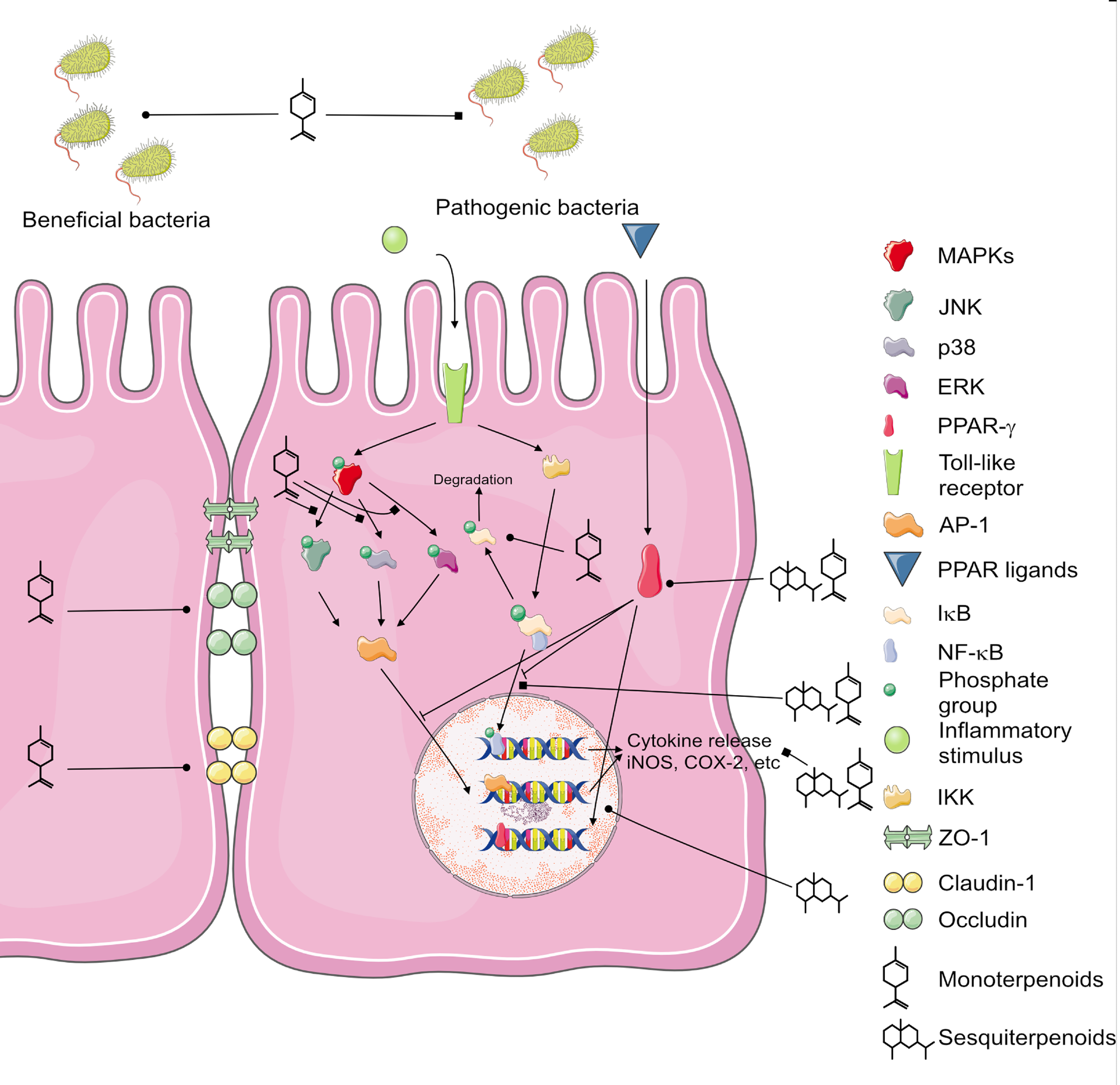
Main targets affected by dietary terpenoids. Upon binding of an inflammatory stimulus, cells can activate the NF-κB pathway, leading to the nuclear translocation of p65 and inducing the expression of inflammatory markers. In addition, cells can activate p38, ERK and JNK pathways, culminating in the activation of AP-1, which also triggers the expression of inflammatory markers. PPAR-γ counters the inflammatory response by inhibiting AP-1 and p65 nuclear translocation or by migrating itself to the nucleus and inducing the expression of anti-inflammatory markers. Circled arrows indicate that terpenoids can induce activation, while squared arrows indicate an inhibitory effect.
Review findings
The review summarized evidence that several commonly consumed dietary terpenoids can exert multifaceted anti-inflammatory actions across cellular and rodent colitis models.
In experimental cell models, compounds such as alpha-bisabolol and citral demonstrated anti-inflammatory activity, reducing selected pro-inflammatory cytokines (including interleukin-1 beta [IL-1β], interleukin-6 [IL-6], and tumor necrosis factor-alpha [TNF-α]) and, in particular models, lowering expression of inducible nitric oxide synthase (iNOS) and cyclooxygenase-2 (COX-2).
In experiments involving intestinal epithelial cells, (S)-(-)-limonene and citral were shown to improve barrier function through changes in different tight junction proteins. Limonene increased zonula occludens-1 (ZO-1) and occludin protein levels in unchallenged cells, and increased occludin and claudin-1 gene expression under inflammatory conditions, while citral increased ZO-1 and claudin-3 expression. Both compounds increased TEER and decreased paracellular permeability (movement of substances between adjacent intestinal cells) in their respective cell models.
Preclinical investigations (rodent models of dextran sodium sulfate [DSS]-induced colitis) demonstrated that oral administration of myrcene, perillyl alcohol, and geraniol improved selected measures of disease severity, including colon shortening or tissue damage, and reduced inflammatory activity. Perillyl alcohol also reduced splenomegaly (abnormal spleen enlargement), and several treatments lowered myeloperoxidase (MPO; a biomarker of neutrophil infiltration and mucosal injury) activity compared to untreated controls. The authors cautioned that many laboratory and animal studies used exposures beyond typical dietary intake, and the intestinal concentrations achievable from ordinary foods remain uncertain.
Human data remain exceedingly scarce, with the review identifying only two small trials evaluating geraniol-based interventions in IBS. The first was an uncontrolled study involving 19 patients; the second was a double-blind, placebo-controlled trial involving 56 patients. In the latter trial, 52% of treated participants achieved at least a 50-point reduction in irritable bowel syndrome symptom severity score (IBS-SSS) with a geraniol-rich palmarosa oil formulation containing ginger root; the responder proportion differed significantly from placebo.
Participants also reported less abdominal bloating and fewer days with pain compared to controls. Because the formulation contained additional constituents, its effects cannot be attributed to geraniol alone. The controlled trial also found no significant between-group changes in circulating pro-inflammatory cytokines. Neither trial measured geraniol metabolites, leaving their potential contribution to symptom changes unresolved. Improvements in IBS symptoms do not establish reduced intestinal inflammation in humans.
Conclusions
The present review synthesized experimental evidence suggesting that dietary terpenoids may help reinforce epithelial barrier integrity and suppress gut mucosal inflammation in laboratory and animal models, without demonstrating that ordinary dietary intake produces the same effects.
The authors also discussed emerging nanoencapsulation techniques using lipid nanocarriers or chitosan polymers as possible ways to overcome these biomolecules’ poor aqueous solubility (water solubility of approximately 0.037 to 0.22 mM for hydrocarbon terpenes) and losses linked to volatility and degradation during food processing. Clinical benefits of these delivery systems have not yet been demonstrated.
Future research will require large-scale clinical trials and rigorous metabolomic profiling exploring human gut microbiota biotransformation alongside realistic dietary dosing, pharmacokinetic measurements, and long-term safety assessments to translate dietary terpenoids into evidence-based nutritional strategies for gastrointestinal health.
Source:
Journal reference: