
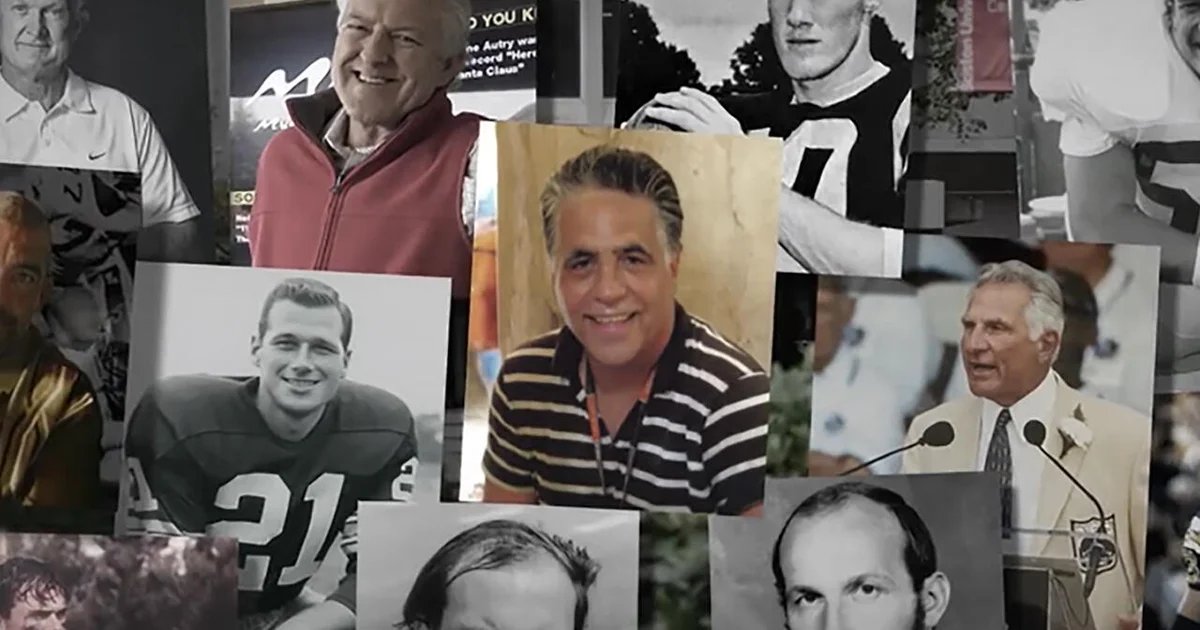
“I hate to say it, but when I knocked people out – and I did knock people out – I did consider that an accomplishment, unfortunately, as I look back on it,” said Jim Musuraca. “It’s just a very violent sport, and that’s an example of violence at its height, knocking somebody out.”
His face and name may not be familiar, but Musuraca, a New York City lawyer, was once a star lineman for the “Fighting Irish” at the University of Notre Dame, a dream that began in Catholic grammar school.
“They had a trophy case, and in that trophy case was a football signed by Knute Rockne, and I was just fascinated by that,” he said. “And for some reason, I just, like, latched onto the notion that I wanted to go to Notre Dame no matter what.”
His statistics are listed in the USA Today College Football Encyclopedia, but co-editor Paul Guido – who interviewed Musuraca in 2016 – says the numbers don’t tell the full story of what playing football meant for working-class families. “Italians and Irish were still moving up in society in the ’60s,” Guido said. “In some ways, they hadn’t made it yet.”
Musuraca, the fourth of six children, grew up in Southeastern Ohio, where his father worked as a foreman in a steel mill. Winning a college scholarship was a chance for a different life. “That was your way to sort of be the Big Man in town,” said Guido. “But it was also his ticket to get out, because it was either mining, factory, or steel mill.”
Like many boys at that time, Musuraca started playing tackle football at age nine, and he continued to play for the next 12 years. The trophies began piling up, he says, and so did injuries. “I remember in ninth grade in an all-star game, I got hit, and I played the whole game, and I don’t remember anything about the game,” Musuraca said.
In college, Musuraca (who at 6 feet, 220 pounds was smaller than most lineman) felt he had to prove himself: “When practice started, I was just like a maniac because I thought I had to be, just to, like, keep up. And I was noticed for hitting hard and doing things at full-go. But it was really because I was scared to death of these huge guys I was playing with.”
By the time he graduated from Notre Dame in 1973, football had taken a toll. “I think at that time that I just about had it with football,” Musuraca said. “I was all beat up. My body’s a wreck. I just don’t want to beat it up anymore.”
Instead of heading to the NFL, Musuraca went to law school, and went on to practice law. But as the years passed, he couldn’t escape the damage left from football. He said, “I don’t remember exactly when it occurred, but my brain just started to get foggy. I was just forgetting all sorts of things, so it was getting worse and worse and worse.”
At the time of this interview, Musuraca – then 65 years old – feared he had Chronic Traumatic Encephalopathy, or CTE. He said, “I actually am in the process of retiring, because I just can’t remember things.”
CBS News 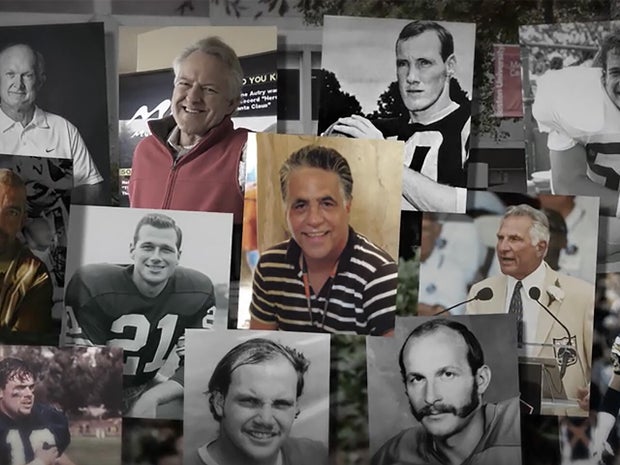
CTE, a neurodegenerative disease caused by repetitive hits to the head, was once thought to only affect boxers. But in 2002, an autopsy done on a 50-year-old former professional football player, Mike Webster, revealed he had CTE. Since then, there has been a succession of alarming scientific studies. One of the most recent, published in October, found that nearly 75 percent of former NFL players likely had CTE at the time of their deaths.
“It’s a tough disease,” said Chris Nowinski, who played football at Harvard in the late 1990s. “We know it causes dementia. We know it causes serious problems with cognition.”
Nowinksi founded the Concussion and CTE Foundation. “What we’re learning is that, if you get hit in the head hard enough, it can start a small lesion that will just spread for the rest of your life, until you start changing who you are.”
That seemed to be happening to Jim Musuraca, but Nowinski says, because there is no test that can detect CTE in the living, college and even high school athletes who never played in the NFL are often overlooked. “The problem we have is that the college players aren’t as famous as the NFL players,” he said. “They’re sort of quietly suffering.”
This is not an easy story to share. I didn’t know Jim when he played football; I met him after law school, when we were both studying for the Ohio Bar exam. He was my fun and funny husband, a great father to our son, Nick. And so, when the Jim that we knew and loved started fading away, we went looking for answers.
Musuraca said, “I went to a neurologist, and he basically just kind of blew me off. ‘A slight cognitive impairment,’ he called it.”
Things only got worse, and in 2019, Jim joined a study at the Boston University CTE Center that included nearly two dozen other former football players. [Some of their families gave us permission to show their photos.] These men had agreed to not just undergo testing in life, but to also donate their brains for research.
“If we can tell someone accurately that they have CTE, then we can really start to open the doors to treatment,” said Dr. Michael Alosco, co-director of clinical research at the CTE Center. He has spent more than a decade trying to design a test that can diagnose CTE.
“Think about your heart; problems with your heart, you get an EKG,” Alosco said. “It is a little bit harder to get access to the brain – right? – through these tests. But that’s what we want, a biomarker that provides insight into what’s going on in the brain.”
The study involved regular blood draws and brain scans, including, as difficult as it is to view them, my husband’s. MRIs clearly revealed the damage that led to Musuraca’s memory loss and confusion. Something was destroying his brain cells.
CBS News 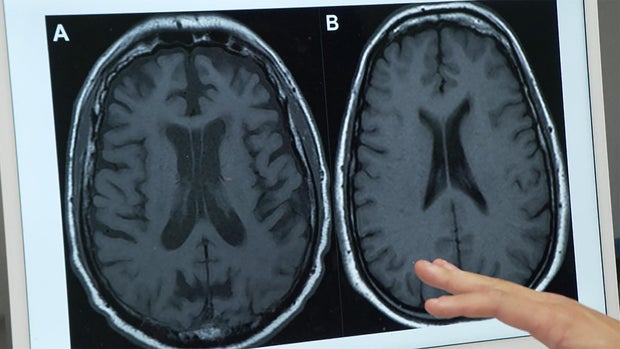
After more tests ruled out Alzheimer’s, Alosco and others suspected Musuraca likely did have CTE, but there was only one way to confirm it: an autopsy.
On January 8, 2026, my husband died. He was 74 years old.
Dr. Thor Stein, a neuropathologist at the VA Boston Medical Center, examined his brain. “When I saw Jim’s brain, I assumed that he had played football at a very high level,” he said. “We staged the disease from a one-to-four scale. He had the most severe form – Stage 4 CTE.”
Stage 4 CTE; Jim had been right all along. The autopsy revealed toxic tangles of a protein called tau – tangles that form in the brain after years of repetitive head hits.
Stein said, “When we looked under the microscope, the reason that he had lost that brain tissue was because of the tau pathology of CTE. And so, he had this accumulation of tau tangles in these regions of the brain in the very particular pattern that we see in CTE.”
The answers came too late for Jim Musuraca, or any of the other men in the study. But something amazing, maybe even miraculous, came from their sacrifice. Dr. Alosco says the data collected from blood draws done during the course of the study may have finally provided the key to a diagnostic test for CTE: “We saw the marker all the way up here for the people who had high-stage CTE, and then the marker all the way down for the people who had no stage or low-stage,” he said. “And we’re like, ‘Oh my gosh, we haven’t seen this before.'”
What the research team discovered is that, of the 21 men, 16 had stage 4 CTE, the most severe form of the disease – and most important, their blood contained a protein known as eMTBR-tau, a distinct marker of CTE.
Alosco called it a game-changer: “We were able to get the blood while they were still living. We were able to get the brain, so we know that CTE is there or not. And it’s kind of the best way to develop these tests. And that’s what we did.”
Musuraca wasn’t the only former college player in the study diagnosed with severe CTE; there were a total of four. Another played only in high school.
More studies and FDA approval are needed before a diagnostic blood test becomes available. It could be the crucial step doctors have been looking for to someday treat people with CTE.
CTE took away the Jim Musuraca we knew. And yet, he and his “teammates” – the other 20 former athletes in the study – proved they had one last big play in them.
Alosco said, “Their legacy will live on not only with this study and this discovery, but so many different research experiments as we move on. So, this is a big discovery with their brains. But I’m also sure it won’t be the last with them, either.”
Story produced by Kay Lim. Editor: George Pozderec.
For more info:
See also: