
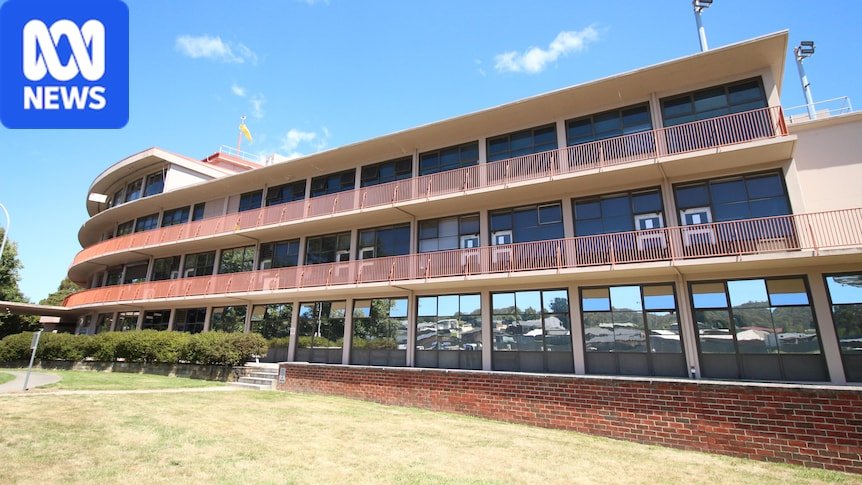
Paramedics have been told to transport complex cardiac patients in Tasmania’s north-west to the Launceston General Hospital (LGH) rather than the local Mersey Community Hospital.
Robbie Moore from the Health and Community Services Union (HACSU) said paramedics were notified by email of the new policy, which took effect on June 29.
“It’s having a significant impact on the ambulance service because they’re now having to travel an extra 2 hours return,”
he said.
“That’s meaning that ambulance response times are further delayed and we know that the LGH is not in a position to cope with the extra influx of these patients.”
Robbie Moore says the diversion adds 2 hours to ambulance travel times. (ABC News: Kelsey Reid)
Mr Moore accused the health department of not communicating properly with staff about the directive or the reasons for it.
“It was done very secretly to ambulance and communications staff to tell them to bypass the Mersey, even the Mersey hospital staff weren’t told this was happening,” he said.
Pilot aims to improve patient care
A document from Ambulance Tasmania (AT) and the Tasmania Health Service, obtained by the ABC, said it was conducting the six-month pilot because the Mersey did not have definitive cardiac care, meaning complex patients often had to be transferred to another hospital.
“Data and clinical reviews have highlighted cases where patients experienced prolonged waits at MCH before transfer, resulting in less-than-ideal outcomes, including delayed treatment for arrhythmias, acute coronary syndromes, and heart failure,” it states.
The Launceston General Hospital only had three beds available last Tuesday evening. (ABC News: Luke Bowden)
The document states the LGH is the preferred hospital for complex cardiac patients, with the North West Regional Hospital in Burnie a secondary option.
“This pilot aims to improve both patient and system outcomes by allowing AT clinicians to identify complex cardiac patients who will benefit from conveyance directly to a facility that can provide early definitive care,” it states.
“The attending AT clinician retains the ability to utilise clinical judgement to determine the most appropriate destination decision, and patient safety is always the governing principle.“
Paramedics can also take complex cardiac patients to the North West Regional Hospital in Burnie. (ABC News: Mackenzie Heard)
The document acknowledges the pilot would reduce the availability of ambulances in the north-west and increase the risk of paramedic fatigue.
“Longer transports to LGH increase the potential for crew fatigue, particularly on back-to-back shifts or during periods of high demand,” it states.
As part of the pilot, Ambulance Tasmania and the Tasmania Health Service will monitor ambulance availability and response times, staff fatigue, impacts on the emergency departments and whether the pilot is achieving its clinical objectives, among other metrics.
“Where a direct transport to LGH would reduce [north-west] coverage to an unsafe level, rendezvous arrangements can be coordinated to ensure that patients receive appropriate clinical care during transfer without extending a single crew’s unavailability,” it states.
In a statement, the Health Department said the pilot meant patients were directed to the most appropriate facility from the outset, avoiding secondary transfers.
Launceston General Hospital already under strain
Labor’s health spokesperson, Sarah Lovell, is concerned about the pilot.
She said it could result in increased pressure on the LGH, which only had three beds available across the entire hospital last Tuesday evening.
“At a time when the LGH is under such enormous strain, you would think the government would be doing everything they can to keep patients away from there and accessing health care in other facilities,”
he said.
Sarah Lovell is worried about more patients being sent to the Launceston General Hospital given its capacity issues. (ABC News: Ebony ten Broeke)
She questioned the benefits of a policy that led to ambulances spending longer on the road, and the removal of patients from their local area.
“It’s a one way service, so if you call an ambulance from Latrobe for example and end up at the Launceston General Hospital and are then discharged, you have to find your own way home from there.”