
During the recording, several members of the jury fought back tears and others appeared shaken. The recording was so graphic that Plymouth Superior Judge William F. Sullivan previously took the extraordinary step of prohibiting its release to the public, allowing only those present in the courtroom to hear it.
Lindsay Clancy, paralyzed by her suicide attempt, sobbed uncontrollably in her wheelchair as jurors were led out of the courtroom for a break after the playing of the 911 call. Her lawyer, Kevin Reddington, placed his hand on her shoulder.
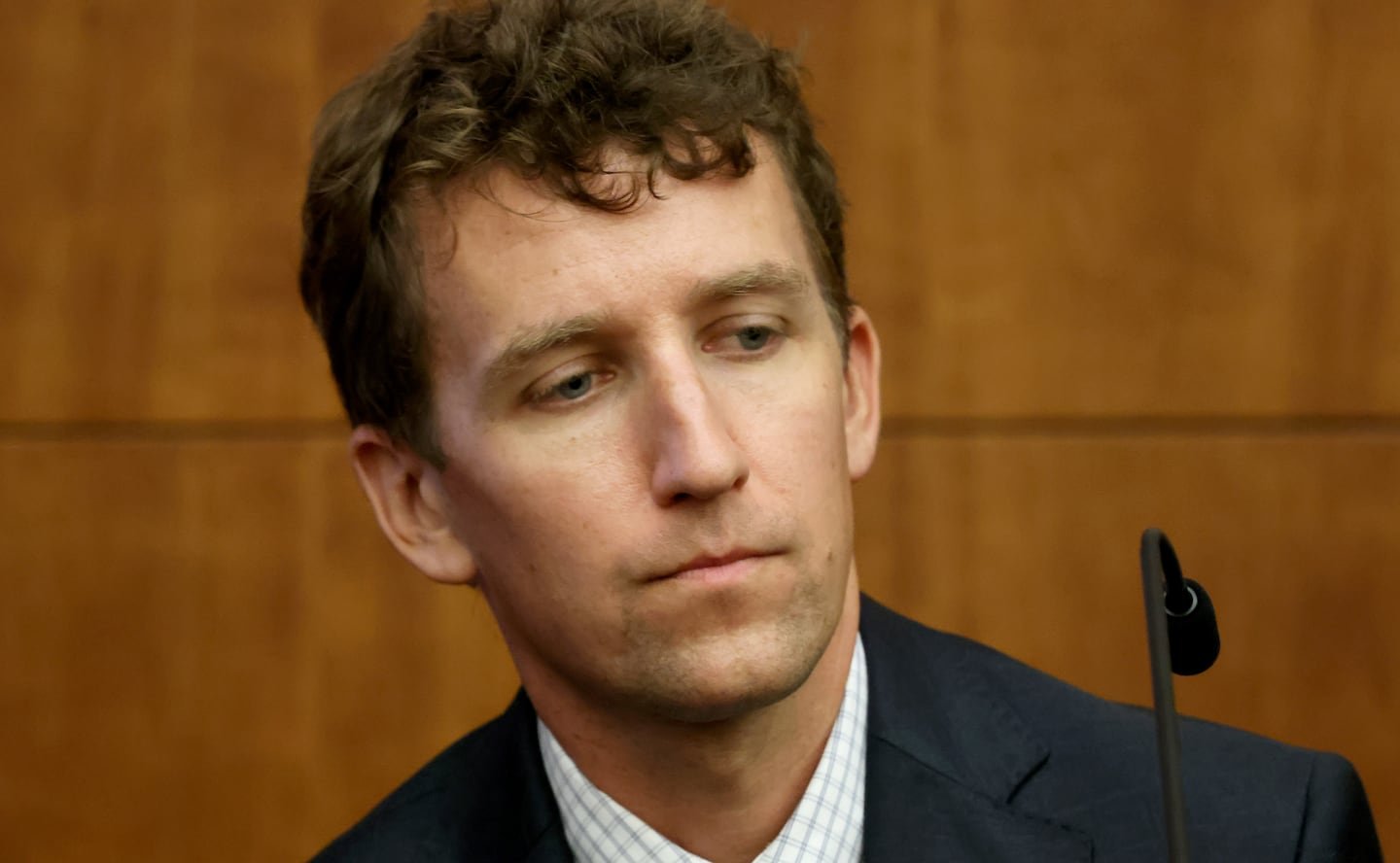
It was Patrick Clancy’s second day on the stand at Lindsay Clancy’s first-degree murder trial for the slayings of 5-year-old Cora, 3-year-old Dawson, and 8-month-old Callan.
The session Wednesday focused heavily on horrific details, including evidence shown to jurors of the killings, and also featured a sharp rebuttal of a previous assertion by prosecutors that Clancy wasn’t taking medications she had been prescribed for postpartum depression and anxiety.
Clancy, 35, has admitted she killed her children, but has pleaded not guilty under what’s commonly known as the insanity defense. Her attorney maintains she was so deeply in the throes of post-partum depression and psychosis at the time that she lacks criminal responsibility for her actions.
Patrick Clancy, 38, testified that he left their home that evening at Lindsay’s request to pick up medicine for their daughter at a nearby pharmacy and then dinner from a restaurant in Plymouth.
At CVS, he called Lindsay to ask whether a generic version of the medication was acceptable.
Lindsay Clancy didn’t pick up, but called right back and said it was. It seemed as if she’d been “in the middle of something,” Patrick Clancy recounted, but was otherwise normal. He said he guessed she was giving the kids a bath.
He picked up their takeout and returned to their Duxbury home, about a 10 or 12 minute drive from the restaurant.
When he opened the door into the home, only silence greeted him, he said. He went upstairs and found the door to his and his wife’s bedroom locked.
“That’s when I knew something was wrong,” he said.
He unlocked the door to an empty room. But, he testified, there was blood “everywhere,” the window was open, and their bed was pushed away from it, he said.
Patrick Clancy told jurors he ran downstairs and outside, where he found Lindsay Clancy lying face-up on the ground in the backyard. She had cuts to both wrists and her throat.
The prosecution called her wounds “superficial” and cast doubt on the seriousness of them. Reddington, her attorney, sharply criticized that, noting her injuries from leaping out the window left her paralyzed.
Patrick Clancy called 911 as he remained with his wife, and first responders arrived in what he guessed was about four or five minutes. As they tended to her, he headed inside to the basement, he said. There, he discovered the three children, strangled with exercise bands. The two oldest were pronounced dead that night, and the baby died several days later.
Patrick Clancy was then allowed to leave the courtroom ahead of the playing of the 911 call. First, though, the judge reiterated some of his instructions to jurors: that it’s natural to feel emotions like horror or empathy when faced with horrific facts, he said, but ultimately their decision must be made on the evidence.

After an extended recess following the recording, the jury heard testimony from two women who had brief phone conversations with Lindsay Clancy on the day of the killings. One was a manager at the CVS who spoke to her about a substitute brand for her daughter’s medicine, the other a hostess at the restaurant where Lindsay Clancy ordered the takeout meal.
Both described the conversations as “normal”; Clancy seemed to understand what they were saying and was not slurring her words.
The prosecution has argued Clancy was in control when she killed her children, and did so in a calculated and meticulous manner.
Her attorney says she was having a psychotic episode. Reddington said Clancy was overmedicated by a system that can often fail to treat post-partum mental-health issues correctly, and on that night experienced a “command hallucination” of a male voice telling her this was her only chance to kill her children and then herself.
On Wednesday, Patrick Clancy testified he spoke with his then-wife by phone about a week after the killings and she told him she heard a man’s voice telling her that if she didn’t “do it now, she would lose her chance,” or words to that effect.
He said she had not spoken of hallucinations before. In previous months, she had talked about killing herself, he said, and at one point, harming the children, though she said at the time she had no plan to do so. He said none of the medical professionals they’d spoken with had said he shouldn’t leave her alone with the children. In fact, he’d left her with them multiple times, and nothing bad had happened.
Patrick Clancy has said he’s forgiven Lindsay, and asked others to do the same. (The couple have since divorced and Patrick has remarried.)

During one point under cross-examination, Reddington asked Patrick Clancy to let him know if he was coming on too strong with his questions.
In his questioning, Reddington sought to paint a picture of a loving mother who would not harm her children if she was in her right mind.
“She was very dedicated,” Patrick Clancy said of his ex-wife. She did everything for them, he said, reading them books, taking them to music lessons, caring for them, putting their little artworks all over the house.
Reddington introduced several photos of the walls of the home showing colorful drawings. In one, a string of photos of their son, Dawson, stretch across the top of the wall, each documenting a month of his life.
“Did she resent him?” Reddington asked. Patrick Clancy responded, “No.”
He said the family had an excellent summer in 2022. Then Reddington’s questioning shifted to that fall.
“Lindsay’s mental health started to deteriorate,” Patrick Clancy said. She was more stressed and anxious, he said.
She began seeing medical professionals who prescribed her medication, Patrick Clancy said. But it didn’t seem to help; she got worse through December, but then seemed better following a stay at a mental hospital in earlier January 2023.
On Monday, prosecutors suggested Clancy was not taking some medications she’d had prescribed, as only a few pills were missing from some of the bottles.
But on Wednesday, Reddington asked Patrick Clancy about those bottles, which he described as “discontinued prescriptions,” meaning she was prescribed a new dose or given a different medication.
“Without that context, it paints a different picture,” Patrick Clancy said.
After that, Reddington held up what Patrick Clancy said was a drawer from Lindsay Clancy’s nightstand and pulled multiple pill bottles from it onto the witness stand. Those, Patrick Clancy said, were the medications that hadn’t been discontinued.
Meanwhile, Assistant District Attorney Jennifer Sprague attempted to bolster her claim Lindsay Clancy killed her children because she was a controlling mother who didn’t believe anyone else could care for them after she killed herself. She peppered Patrick Clancy with questions about detailed notes she gave a baby-sitter about caring for their baby.
But on cross-examination, Reddington noted the baby-sitter had only worked for the family briefly and asked, “Fair to say Lindsay was a concerned mother who gave instructions to people who cared for her children?”
“Yes,” Patrick Clancy said. “I would have done the same.”
Shelley Murphy can be reached at shelley.murphy@globe.com. Follow her @shelleymurph. Sean Cotter can be reached at sean.cotter@globe.com. Follow him @cotterreporter. Travis Andersen can be reached at travis.andersen@globe.com.