|
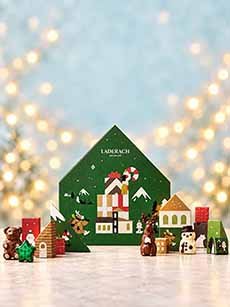
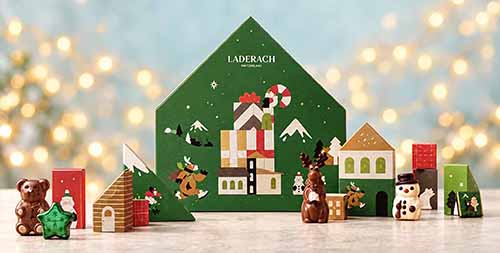
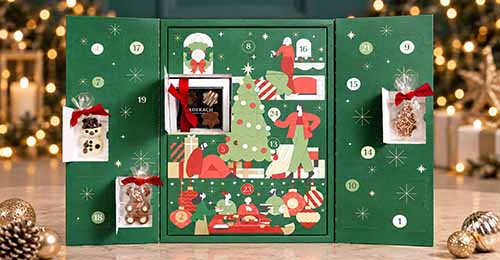
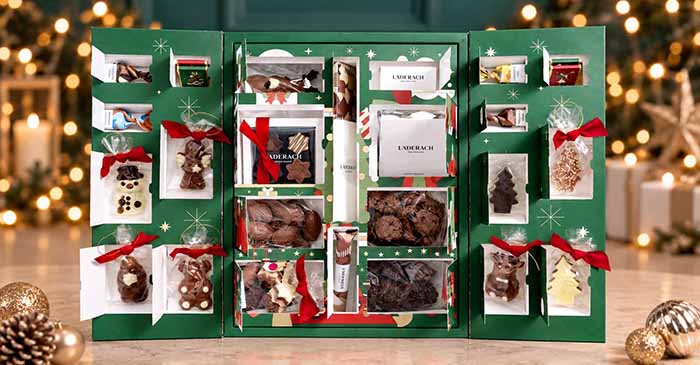
[1] Läderach’s winter village (all photos are composites by The Nibble; original photography from Läderach).
|
We love Advent calendars—both giving them and receiving them. But they’re not a last-minute gift: You need to give them to the recipients before December 1st so they can begin the 24-day countdown to Christmas. That’s why for the past few years, we’ve turned to giving them to our family and friends at Thanksgiving dinner. We spend hours poring over websites to find the right calendar for each person. This year, Läderach, one of our favorite chocolatiers, has made it easy for us. Not only does everyone we know love fine chocolate, but in addition to conventional formats, they have created a unique calendar configuration that forms a little village you can keep when the chocolate is gone. Why are we addressing Advent calendars before the Halloween candy has been given out? Because the best ones sell out early. Do you have to celebrate Christmas in order to receive an Advent calendar? We opine that most chocolate lovers wouldn’t refuse a daily, delicious piece of chocolate for 24 days. Below:
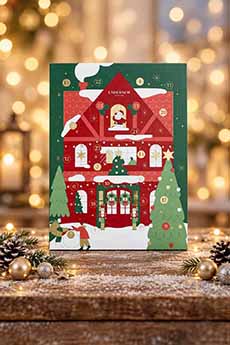
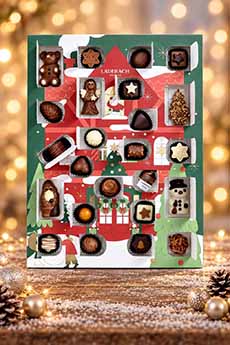
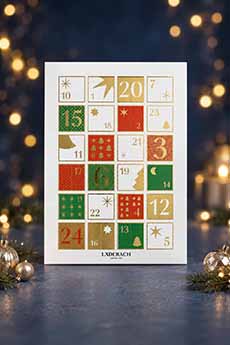
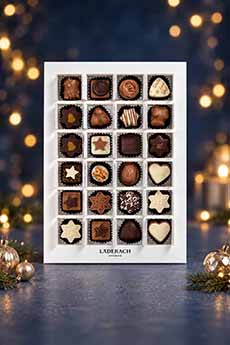
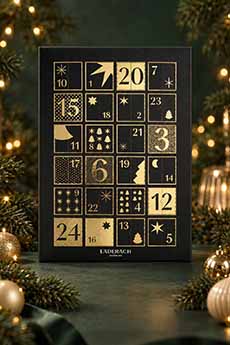
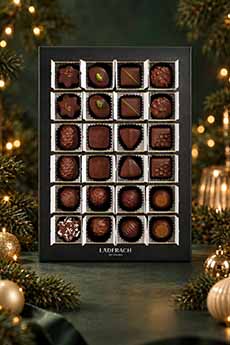
One of our favorite chocolatiers, the Swiss company Läderach makes five different Advent calendars:
Our favorite—because we fancy setting up our own little winter village on the kitchen windowsill—is Advent Calendar House. The lucky recipients can save the village for next year’s holiday decorations, or enjoy it on a shelf all year long (photo below). The evolution of what became Advent calendars unfolded across the 19th and early 20th centuries in Germany. The idea of marking the days to Christmas began at the beginning of the 19th century, when German Lutherans made chalk marks on doors, lit candles, or hung religious pictures to count down the days to Christmas. They began on the fourth Sunday before Christmas and continued each day through Christmas Eve. The first-known commercial mention of what would later be known as an Advent calendar is from 1851, appearing in a children’s book by Elise Averdieck. In 1902, the Reichhold & Lang printing company in Munich published a “Christmas clock” (Weihnachtsuhr), followed in 1903 by a calendar titled “Im Land des Christkinds” (In the Land of the Christ Child). Gerhard Lang of Reichhold & Lang is widely credited with creating the first officially recognized, commercially printed calendar featuring small pictures behind doors. In 1904, Lang was inspired by a Christmas calendar that his mother had made for him as a child: 24 cookies (some say candies) sewn onto the lid of a box. He was allowed to eat one of them every day during the Advent period. Other parents created their own handmade versions. Remembering mom’s cookie countdown, Lang created a pilot calendar in 1904. He printed calendars with small colored pictures that children could attach to a cardboard backing—one picture per day. The first printed, commercially distributed calendar debuted in 1908 [source]. It was published under the title “Münchener Weihnachtskalender — Im Lande des Christkinds” (Munich Christmas Calendar — In the Land of the Christ-Child). At the time, publishers and the public typically referred to these creations as Weihnachtskalender (Christmas calendar) or Christkindl-Kalender (Christ-child calendar). The calendars were a commercial success and were made with both religious and non-religious themes. The now-familiar format with little doors that open for the reveal was introduced by Lang in the 1920s.
These first calendars-with-doors were called “Nicholas calendars” (Nikolauskalender), since they were given out on December 6th, St. Nicholas’ Day. They were 19-day calendars, ending on December 24th, Christmas Eve. They stemmed from a European tradition where St. Nicholas distributed treats, small gifts, or educational prints to children on his feast day. Over time, as commercial publishers sought to lengthen the holiday anticipation period, the timeline shifted backwards to encompass all of December, merging the concept with the broader Christian season of Advent. Later, calendars were made that began on December 1st and were called “Christmas calendars.” These typically didn’t follow the full four-week period of Advent, because the date varies in any particular year (it can range from November 27th to December 3rd). Instead, the calendars marked the 24 days leading up to Christmas, December 1st through December 24th. |
|
|
3. THE ADVENT CALENDAR GETS ITS NAME Advent, from the Latin word adventus, means “coming.” It’s a time of waiting and preparation for the celebration of the Nativity of Jesus, on Christmas Day. The term Adventskalender (Advent calendar) began appearing gradually in the 1910s and 1920s as commercial publishers expanded their offerings and the product became popular throughout Germany and Central Europe. Because in early 20th-century Germany, the word Advent retained strong, formal religious connotations associated with the church calendar, publishers initially preferred titles featuring Weihnachten (Christmas) or the Christkind (Christ child) to emphasize the holiday magic and festive countdown for children. Standardization began in the 1920s, as Lang’s company (Reichhold & Lang) and other printing houses developed new variations—including the 1920s introduction of doors/windows (Türchen). The name Adventskalender became the standard, everyday German word for the item. After World War II, the tradition spread beyond Germany. In the 1950s, a man named Richard Sellmer began mass-producing Advent calendars and exporting them internationally, helping to popularize them worldwide. The tradition was largely popularized in North America after national newspapers published a photograph of President Dwight D. Eisenhoweropening a calendar with his grandchildren, in 1953. The direct English translation—Advent calendar—became fixed worldwide. The 1950s also saw the introduction of chocolate-filled calendars, which became hugely popular. The fun of modern Advent calendars is opening each of the 24 closed windows/doors, that mark each day until Christmas. Young or old, opening the daily window brings anticipation and surprise. For most of its history, the Advent calendar was targeted to children. The surprises behind the window were a piece of candy, a charm, a mini toy, or a holiday-themed image (Santa, Rudolph). Inspirational versions are still made. The calendars can be basic or very elaborate. In recent years there’s been a trend to adult-appropriate Advent calendars, that focus on not just fine chocolate, but bottles of beer or wine, coffee and tea, hot sauce, and even beef jerky. Beyond food, there are calendars for crafting, crystals and minerals, fishing lures, mystery puzzles, pet treats, seed bombs for gardening, skin care, and votives/tea candles. No doubt, there are yet others. We love these non-candy ideas for kids:
If none of these is what you’re looking for, just search online. *About Läderach Chocolate Suisse. Läderach was founded in 1962 in a small village in the central-eastern part of Switzerland. Founder Rudolf Läderach Jr. came from a local family of bakers. In 1970, Rudolf patented a revolutionary process for manufacturing thin-walled, hollow chocolate balls to be filled for truffles. Chocolate truffle shells were difficult and messy to produce. His invention enabled chocolatiers to fill the premade shells efficiently, fundamentally changing professional truffle production. For decades, Läderach operated primarily as a B2B supplier, providing the shells and other high-quality chocolate products to pastry shops and hotels. In 1981, Läderach expanded to Dillenburg, Germany and began to export overseas. It wasn’t until 2004, following the acquisition of a retailer of premium chocolates, pralines, and confectionery—the Swiss confectionery chain Merkur Confiserie AG—that Merkur’s chain of retail chocolate boutiques enabled Läderach to become a global consumer brand, rebranded with the Läderach name. Twenty years later, by 2024, Läderach employed some 2,000 people in 20 countries. The company has 220 boutiques, 100 of which are located in Europe; and as of early 2026, 40 to 45 boutiques across the U.S. It also sells online. CHECK OUT WHAT’S HAPPENING ON OUR HOME PAGE, THENIBBLE.COM. |
||
Subscribe to Updates
Get the latest creative news from FooBar about art, design and business.
Laderach Advent Calendars: The Finest Swiss Chocolate Inside