
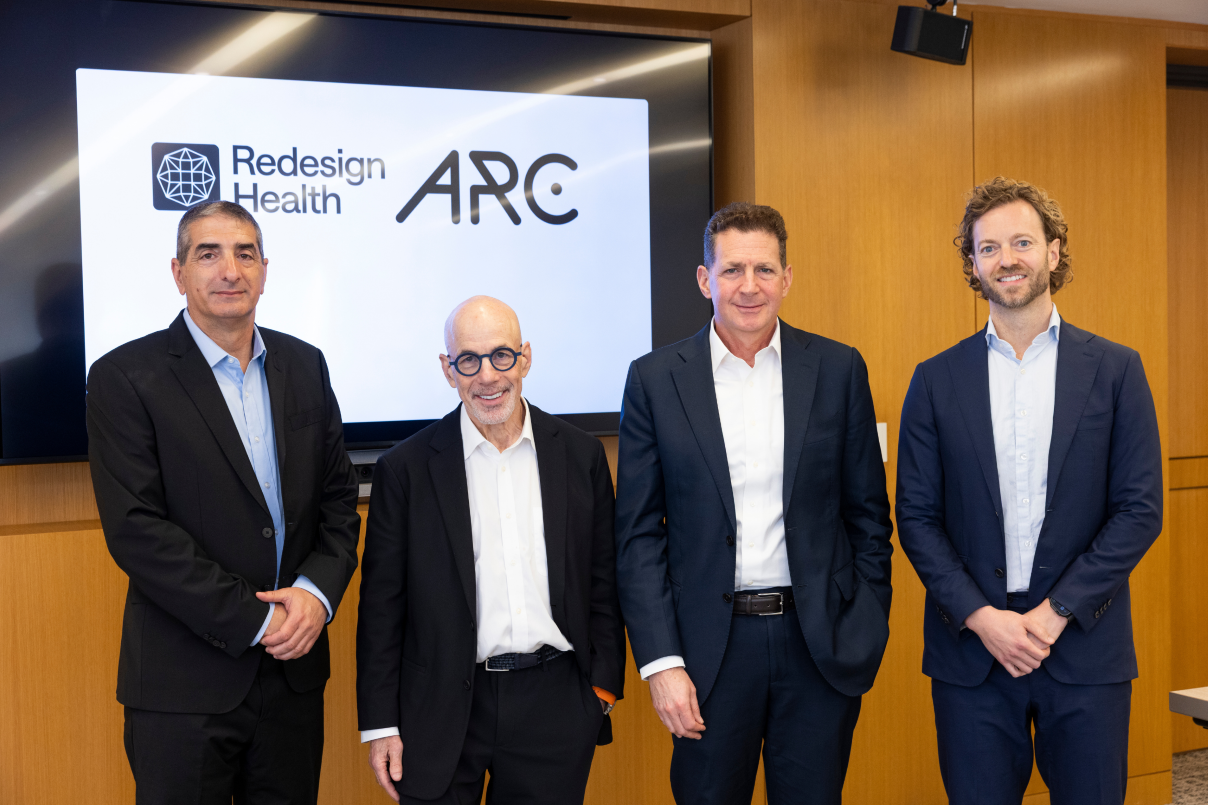
Redesign Health is making a major push deeper into health system-led innovation, merging with Sheba Medical Center’s innovation arm ARC Global.
Together, the organizations want to create an end-to-end platform that helps health systems turn ideas originating with their own clinicians and operators into technology products and standalone companies that can then be scaled across a global network, company executives said. The deal was announced Thursday.
The combined company is valued at approximately $2 billion, according to a source with knowledge of the deal.
Brett Shaheen will lead the combined company as CEO. Stephen Klasko, M.D., former CEO of Jefferson Health, who grew the system from a regional player into a nearly $10 billion academic medical enterprise, will serve as chairman of the board. Professor Eyal Zimlichman, M.D., the founder and president of ARC Global, will join Redesign Health as vice chairman.
The combined business will launch with founding health systems, to be named in the coming months, executives said. The founding systems “will be instrumental in shaping our combined business and long-term activities, aligning with our objective of being ‘for healthcare by healthcare’,” Zimlichman told Fierce Healthcare.
Redesign Health and ARC Global also agreed to acquire AVIA, a strategic advisory and intelligence firm that works with health systems to select, validate and implement digital health technologies. Collectively, the organizations say they work with more than 100 health systems across five continents, while products and companies developed across their networks have reached more than 100 million patients.
ARC (Accelerate, Redesign, Collaborate) Global contributes a clinician-led innovation model developed at Sheba Medical Center and a network spanning 31 health systems and more than 300 hospitals across 12 countries. Redesign Health brings its company-building infrastructure, capital, engineering and AI capabilities, including its proprietary AI operating system. AVIA, assuming the acquisition receives final approvals, adds more than a decade of digital transformation work with U.S. health systems and an intelligence platform used by more than 90,000 health system leaders and staff to evaluate over 7,000 digital solutions, according to the company.
Health systems are under pressure from rising costs, workforce shortages and growing demand for care, but often lack the infrastructure and resources to scale AI beyond pilots. The combined company aims to fill that gap by embedding engineering, AI expertise and capital directly within health systems to develop and scale solutions safely and effectively.
“AI will do more good in healthcare than in any other industry, but realizing that potential requires building from inside healthcare itself,” Shaheen said in a statement.
The combined company’s strategy aims to shift healthcare innovation inside health systems rather than developing technology externally and then selling it back to providers.
“We expect much of the next generation of healthcare technology to be developed within the institutions that deliver care. Our embedded engineers bring frontier AI into the hands of frontline clinicians and operators, helping them become builders of the technologies they rely on,” Aron Szanto, head of technology at Redesign Health, told Fierce Healthcare. “Take a nurse manager who notices avoidable delays in patient discharge. They know the workflow and have an idea for improving it, but the hospital’s IT team has to balance that request against many competing priorities, and an existing vendor’s product may not fit.”
The combined company will embed AI engineers and technologists inside health systems to help clinicians and operators turn frontline problems into working technology, Szanto said. Redesign, ARC and AVIA will work with hospital IT teams to integrate and test those tools.
“But technology is only part of the equation,” Szanto noted. “The rest is deeply human: changing how people work and what they see themselves as capable of creating. We want to build a durable culture of innovation and entrepreneurship that draws on the untapped brilliance and expertise of the healthcare workforce, giving clinicians and operators the tools and support to redesign the systems they work in. As they find better ways to handle the administrative tasks around care, they can give more of their time and attention to the patients who need them.”
Redesign Health and ARC Global can use their broader health system network to identify opportunities to scale successful solutions elsewhere.
If a solution has broader commercial potential, the newly combined company can help license it, form partnerships or launch a new company, providing capital, company-building expertise and founder support. “Health systems can reinvest those returns in further innovation. Ultimately, the businesses and jobs created in the process will make better care an engine of economic growth for the surrounding community,” Szanto said.
Through the ARC model, healthcare systems hold a significant role in the companies they help establish, including owning equity, Zimlichman said. “This is inherent to our vision of turning hospitals from cost centers to economic engines of growth,” he noted.
Launched in 2018, Redesign Health is a global venture and applied technology firm. It has launched more than 60 companies, touching the lives of more than 15 million patients, and the company has raised more than $1.5 billion from institutional, sovereign and strategic investors.
For the past eight years, Redesign Health’s core business has been building next-generation healthcare companies and helping founders navigate healthcare’s difficult sales, integration and regulatory environment. Partnerships with Mayo Clinic, UPMC Enterprises and Cedars-Sinai began bringing healthcare institutions directly into that company-building process. The company also has expanded its global footprint, launching hubs in Saudi Arabia and India last year.
Redesign Health will continue to invest in and build healthcare companies through its venture capital and buyout strategies, backing founders and management teams with capital, technology and healthcare expertise, executives said.
“This builds on what Redesign already does. Bringing ARC Global and AVIA together with Redesign Health makes us one of the most connected healthcare investors in the world. Our venture strategy gains a network of more than 100 health systems, which gives our founders design partners, anchor customers, and international reach from day one. Our buyout strategy gains a proven operating methodology that combines embedded engineering and workforce enablement, and it serves health systems and our portfolio companies alike,” Sheheen told Fierce Healthcare.
He noted that ARC’s model has supported more than 130 startups over the years, including three unicorns. Those companies continue to operate independently with their existing investors. ARC’s health system network, its programs and the ARC team become part of the combined company, and Sheba remains the flagship site, Shaheen said.
The merger comes as the healthcare industry rapidly adopts AI solutions, and health systems could play a critical role in developing healthcare AI, as well as benefiting from its financial value.
“Part of ARC Global’s philosophy is to tap into the huge talent pool that exists within healthcare systems around the world. Frontline employees have capacity to understand the pain points of their industry and understand what’s needed to build solutions, adopt them into workflows, and scale for wider deployment. Each healthcare system should be able to train its workforce on building solutions and adopting them into workflows. The aim is not to make healthcare AI-ready but make AI healthcare-ready, so it can be effectively, responsibly, and safely embedded into health systems,” Zimlichman told Fierce Healthcare.
ARC, which has been running since 2019, brings an established global network and experience helping clinicians turn ideas into deployed products, while Redesign brings expertise in turning healthcare ideas into scalable, sustainable businesses.
“What we’re doing now is connecting the pieces, so a clinician’s idea at one ARC site has a path to becoming a company, and that company has a path into every health system in the network. Each of us was strong alone. Together we’re stronger. We’ll measure adoption, clinical and operational outcomes, financial impact, and the value each institution shares in creating. ARC and Redesign have already demonstrated that companies built within health systems can scale,” Shaheen said.
“What’s new is the ability to scale capabilities. When clinicians and technologists at one hospital build an AI tool, redesign a workflow, or develop a new operational capability, the next hospital in the network should be able to adopt and adapt it rather than start from scratch. That’s the opportunity we’re unlocking. Success means making the process repeatable across institutions, so innovation developed in one hospital can deliver value across the entire network,” he added.
“Healthcare has consultants who diagnose, vendors who sell and investors who fund, but there has never been one player inside the hospital that can pinpoint the problem, build the solution and share in the result,” Klasko said in a statement. “I’ve sat in the health system CEO’s chair, and good ideas were never the shortage. When the people delivering care can act on them, innovation stops being a cost to manage and instead becomes a source of growth. Our opportunity is to make that cycle strong enough that health systems control how they serve their communities for decades to come.”