
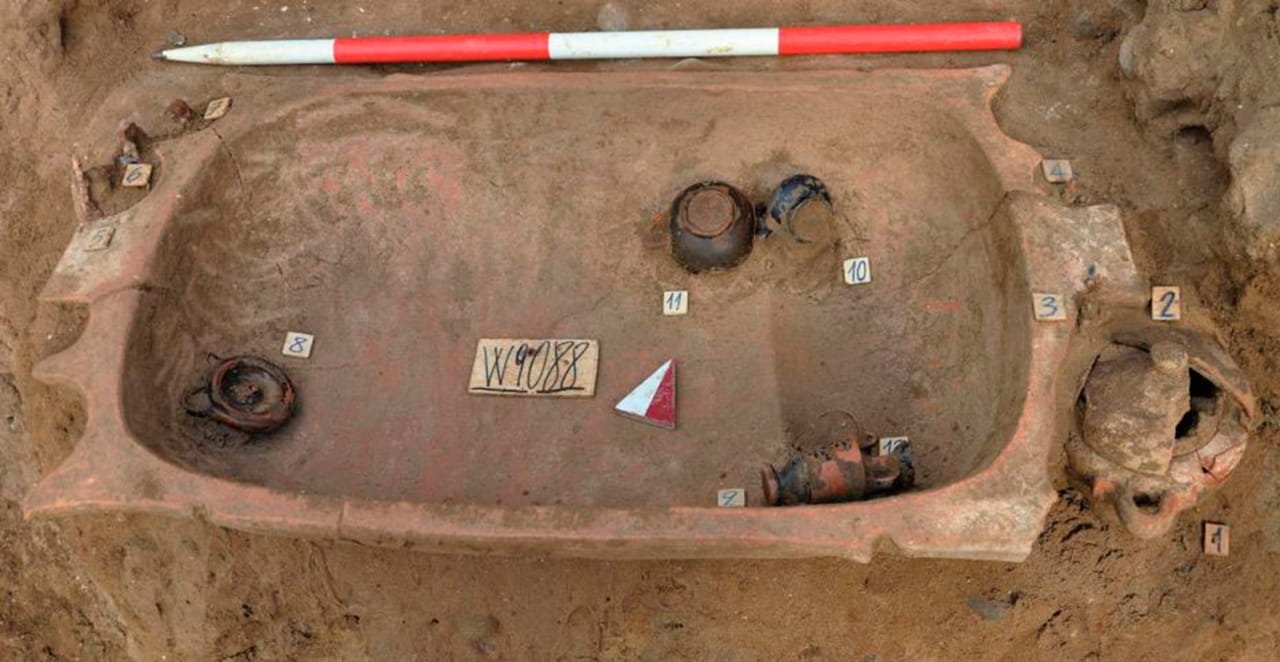
Babies in the Greek colony of Himera on Sicily began eating solid food within months of birth, yet most kept nursing until age three or four. Laurie Reitsema of the University of Georgia and her colleagues reached this finding by testing bones from children buried in two of the city’s burial grounds. The study appears in the European Journal of Archaeology.
Himera flourished from the seventh to the fifth century BCE as a large city shaped by Greek, Phoenician, and local Sicilian influences. Excavators have studied more than 13,000 graves there, but work on children hasn’t gone far yet. Reitsema and coauthors Abigail Gancz, Stefano Vassallo, and Britney Kyle wanted to know how families in such a mixed place fed their youngest members.
The team measured nitrogen and carbon in bone collagen from 58 children and teens, along with 27 adult women. Nursing babies carry more heavy nitrogen than their mothers do, about 1.7 parts per thousand more at Himera. As solid foods replace milk, the number falls until the child matches an adult, and a computer model turned these numbers into ages.
Every baby under six months old showed the milk signal, so all infants in the sample were breastfed. Milk-only feeding ended early, around three to four months, though the range stretched to 2.2 years. Total nursing ended near 3.8 years, with a range of 3.0 to 4.7, so weaning as a whole ran about three and a half years.
Medical writers Soranus and Galen, active in the second century CE, urged six months of milk alone and total nursing of one and a half to three years. Himera mothers added solid food sooner and nursed their children longer than these writers advised. Nearly 500 baby bottles turned up in the graves, but adult burials hold them too, so the authors treat them as symbols.
Weaning foods at Himera held slightly less nitrogen than adult diets, 9.6 against 10.3, which points to more plant foods. Soranus listed bread, honey, goat milk, eggs, and cereal porridge as first foods, and most of these fit the pattern. Children’s meals stayed different from adult meals until around age ten, when every young person in the sample fell within the adult range.
The authors link the short milk-only phase to the many demands on women’s time outside the home. Texts describe an ideal of women kept at home, yet poorer women worked in fields, markets, and wool shops, and enslaved women often nursed other people’s babies.
Himera families followed shared habits and still made their own choices, because the nitrogen curve falls with age while the points scatter and feeding times varied. The graves likely hold rich and poor, free and enslaved, Greek and local people, and all show a broadly similar path.
Apollonia Pontica, a Greek colony on the Black Sea, looked much the same, with total nursing near 4.3 years. Roman sites didn’t match as closely, and at Isola Sacra in Lazio, Italy, nursing ended around age 1.2.
An earlier study of 2,865 child burials found low child death rates at Himera next to other ancient European sites, and the authors see long nursing as a possible reason. The team plans to study teeth from people who lived past childhood to test the link.