
For decades, a lucrative international trade route has moved an elusive root from Indiana’s forests overseas. Why is it starting to disappear?

Hunting for Indiana’s disappearing wild ginseng
Indiana hunters search the woods for wild ginseng, a valuable root with a centuries-old medicinal history and a shrinking natural habitat.
- Indiana’s elusive ginseng population has long contributed to a lucrative international industry.
- But the industry is changing. As ginseng becomes harder to find, fewer diggers are heading to the woods.
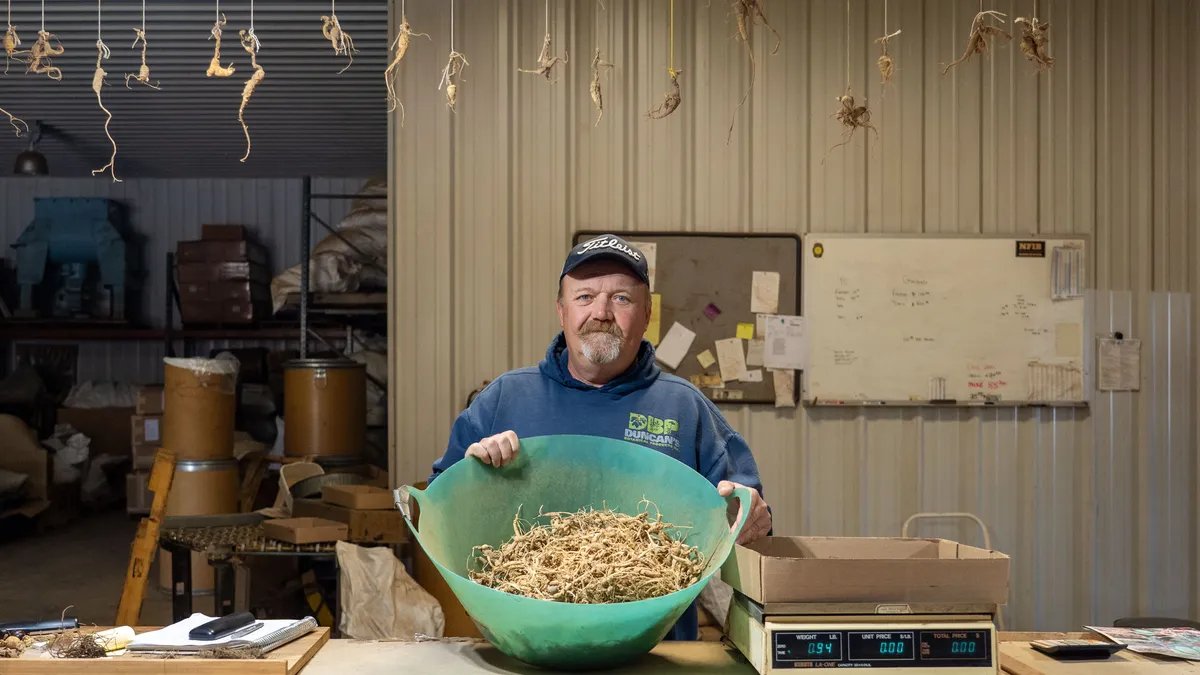
The folks who show up to Brent Duncan’s warehouse after foraging in the woods come bearing herbs, leaves and other wares of the gnarled, vegetal variety. Duncan, a Bloomington-based herb dealer, buys and sells nearly 50 different botanical products to customers around the world.
His flashiest specimen is a leafy plant found only in the eastern half of North America, including Indiana’s forested hill country.
Diggers sometimes call this herb ‘sang.’ Duncan uses its more formal name: American ginseng. Regardless of the nomenclature, diggers and dealers alike are in the business for the same reason: Ginseng is surprisingly lucrative.
Duncan is one of the middlemen in the United States’s ginseng industry. He helps American ginseng make its way from the woods of rural Indiana to homes across East Asia, where ginseng’s legacy of medicinal properties drive a high price. From now until late November, Duncan will see an influx of visits from local ginseng diggers, who provide the roots he’ll sell.
For years, brokers like Duncan, who inherited the business from his father in 1994, have made a comfortable living profiting off a wild crop once abundant in this country. But the industry is starting to wane.
Once prevalent enough to offer rural Hoosiers a profitable side hustle, American ginseng is proving harder and harder to find. The plant is considered endangered by a major international trade treaty, and population growth is hampered by its slow-growing nature and unusually specific habitat preferences. Digging ginseng on public land is prohibited, and as more private property gets developed, there are fewer places for ginseng to grow and for harvesters to find it, according to the Indiana Department of Natural Resources.
Duncan has processed hundreds of ginseng transactions since Indiana’s ginseng season opened in September, but year after year, fewer diggers arrive at his door. When they do come, some transactions involve the transfer of only a few dollars. Other diggers bring in several pounds of ginseng and leave with several thousand dollars.
Watching the industry shrivel provides Duncan with a painful reminder of how Indiana’s once-wild areas where people like his dad used to hunt, trap and forage are rapidly disappearing.
“It’s sad. You’re losing a culture,” Duncan said. “People want to go out and dig ginseng, but they don’t have access to land.”
Wait, what is ginseng?
American ginseng (Panax quinquefolius) is a small, finicky plant that grows in the forests of the eastern United States. Ginseng plants can reach over a foot tall, sprouting clusters of shiny green leaves and red berries. Reaching maturity can take years and requires a perfect recipe of soil moisture, temperature and shade.
After harvesters dig under and pry up a ginseng plant, many discard most of its leafier features to concentrate on the roots. Underground, ginseng plants push out a dense root network that resembles those of other taproots like carrots and parsnips.
Ginseng has long boasted a medicinal, almost mythical, reputation. For centuries, people in some Asian countries, particularly China, consumed Asian ginseng (Panax ginseng) in tea, pills, extracts and soups. Traditional Chinese medicine considers the herb to be a potent revitalization tonic. While research studies remain inconclusive on claims that ginseng can support immunity, lower blood sugar and reduce inflammation, the herb remains a popular supplement and is sold in drugstores and grocery stores across the United States.
American ginseng is similar enough to its Asian relative that it could readily step in to supply Asia’s ginseng fix after overharvesting and extraction left the continent devoid of enough to meet demand. And so, an international trade system erupted.
American ginseng has been traded overseas since at least the early 18th century, and the industry has long provided rural Americans, especially those living near the Appalachian mountains, with a way to make money close to home.
Like its Asian counterpart before it, American ginseng has seen declines from harvest pressure. To protect the resource from extinction, the species was placed on the Convention on International Trade in Endangered Species of Wild Fauna and Flora (CITES) list in 1975. And until recently, the industry has thrived.
From American hillsides to the markets of Hong Kong
Several Indiana ginseng dealers said their product travels to countries like Taiwan, South Korea and, primarily, China. But it all starts in the Indiana hills.
Despite Indiana’s shrinking ginseng trade, the state documented more than a thousand diggers last year who contributed more than 1,000 pounds of exported Indiana ginseng. On average, the plant sold for about $600 a pound.
Ginseng might be one of the most lucrative wild plants in the Indiana backcountry, but many diggers warn the price per pound sounds better on paper. Acquiring a pound of ginseng is no easy feat and digging is not exactly a get-rich-quick scheme.
“What it comes down to is about $1.84 per plant,” said Detective Seargent Trent Stinson, who enforces ginseng regulation through the Indiana Department of Natural Resources’ Law Enforcement division. “Which doesn’t seem very impressive right?”
When new diggers express an eagerness to cash in on the endangered species, he suggests they try recycling aluminum cans instead.
Some small-scale dealers sell their ginseng to bigger dealers across Indiana, but before any of it can be sold out of state, it must be certified by the DNR.
Terry Manley, one of Indiana’s 16 registered dealers, is paying around $700 a pound for dry ginseng, $200 for wet this season. Manley sends his ginseng to a broker in Pennsylvania, who ships it directly to Asia. Duncan used to export his ginseng directly to Hong Kong, but he stopped in 2016. He wasn’t a fan of the paperwork. Now, he ships his ginseng to a broker in New York, who then flies it to Hong Kong, where a network of dealers disseminate it.
In all, the United States exports tens of thousands of pounds of ginseng each year, mostly to China. In 2015, the U.S. Fish and Wildlife Service estimated that the country annually exported nearly $30 million worth of ginseng; recent estimates from trade firms and market researchers suspect that number has ballooned over the last decade.
An industry (and a lifestyle) in decline
While Indiana’s ginseng population isn’t under immediate risk of extinction, the future of digging and dealing in Indiana is bleak.
Land access is becoming an acute issue. Ginseng diggers aren’t allowed to harvest the plant on public land, where the population is healthy, said Laura Minzes, Indiana’s state ginseng coordinator. Digging on private land can be equally challenging. Diggers must have permission to dig on private land and those who are caught can face fines or prosecution.
In addition, private land is increasingly devoid of ginseng. Large tracts of forest that used to grow pockets of ginseng have been carved up, sold or developed. Sixteen Indiana counties that likely once had the herb have reported no ginseng harvest for at least two years.
With fewer places to dig, ginseng diggers can inadvertently overharvest familiar forests, leaving nothing behind for future seasons. Duncan thinks some diggers are taking years off and others have given up the hobby altogether.
“They’re either bringing less or they’re not coming in at all,” he said. “We haven’t had a really good ginseng season since probably 2019. That’s when things really started to tail off.”
In 2024, Duncan moved around 600 pounds of ginseng through his warehouse. Last year, it was closer to 400.
The state has noticed the decline of harvesters, too, Minzes said. She also traces the change back to 2020, when an unusually low statewide harvest total prompted her to start keeping track of how the industry was changing.
“Not nearly as many people were digging,” Minzes said. “The harvester population, in general, is getting older. And foraging is not as popular as it used to be.”
In 2021, Minzes recorded 2,121 harvesters across the state. Last year, there were only 1,186. The number of dealers has dwindled by more than 50% since 1998.
Those who have stuck with the industry seem to be in it for the long haul: Manley is in his 80s, and he has no plans to stop dealing, despite recent health challenges.
“Mother Nature will get us one of these days, probably… But in the meantime, we just keep going,” Manley said.
Duncan, however, said this will be his last year trading herbs out of his warehouse. He already has plans for retirement: Next fall, he plans to spend a lot more time in the woods, looking for ‘sang.
Sophie Hartley is an IndyStar environment reporter. You can reach her at sophie.hartley@indystar.com or on X at @sophienhartley. IndyStar’s environmental reporting is made possible through the generous support of the nonprofit Nina Mason Pulliam Charitable Trust.