
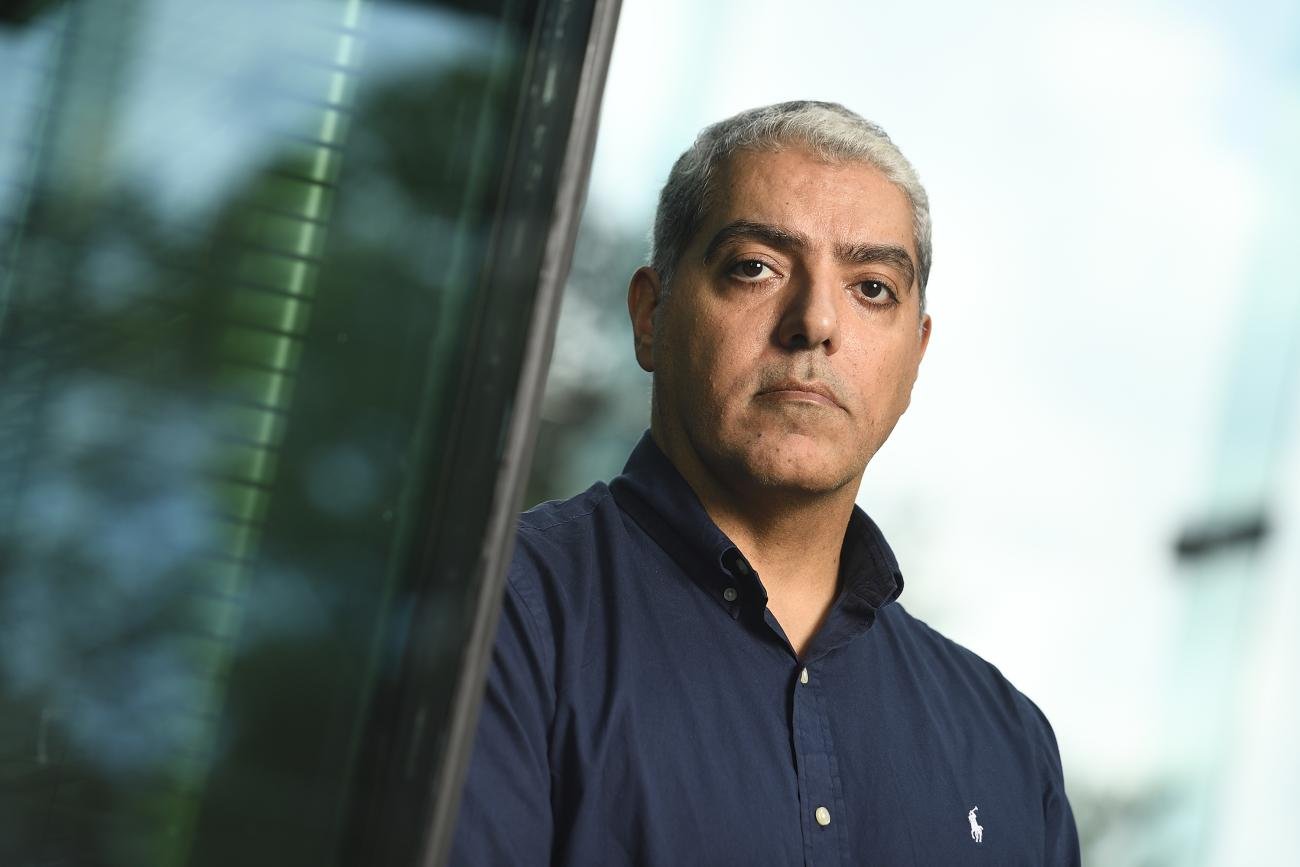
Easily one of the top moments in Ahmed Hassoon‘s career, if not his whole life, was when he got his career development award. It took years of preparation and then three tries—or as he puts it, “It was extremely, extremely, extremely difficult.”
The award set him up with five fully funded years to study why some lung cancer patients have a hard time getting diagnosed and then, using artificial intelligence, he was going to figure out how to improve the system. But a year in, the funding from the Agency for Healthcare Research and Quality (AHRQ) abruptly stopped; this summer he learned his project was among dozens that federal agency cancelled nationwide, including three others at Johns Hopkins.
“We’re losing science studying what makes our health systems work well or poorly. That’s really important work. Everybody cares about making healthcare safer and reducing errors.”
Nancy Kass
Professor, Bloomberg School of Public Health
“I’m working on lung cancer and trying to give people a chance to live longer,” Hassoon said. “I still hope it’s a mistake.”
AHRQ is a small agency focused on improving American healthcare. It funds research on how to make the system safer, more efficient, and more affordable. The agency stopped funding many grants in 2025 and in July informed those investigators that the projects no longer aligned with federal priorities.
At Johns Hopkins, in addition to the lung cancer work, the cancelled grants included a long-standing training program in health research; work to improve emergency care for older adults before they get to the hospital; and a training program where early career clinicians study ways to improve everything from the organ transplant donation system to how patients are screened for disease. All of the cancelled awards supported the work of young researchers, a loss that jeopardizes not only their critical work but also the pipeline of talent interested in pursuing scientific research in the United States.
Johns Hopkins’ training program in health services research had been funded for nearly 40 years straight when it was cancelled. It had become one of the most desirable and competitive programs for PhD students in the university’s Bloomberg School of Public Health, training the next generation of researchers interested in learning things like how to make healthcare systems work better, why medical errors happen, and what causes inequities in the costs of procedures. It wasn’t unusual to see more than 200 applications for nine or 10 available slots.
The Department of Health Policy and Management, which ran the program, covered the students currently enrolled when the money stopped coming in last year, along with help from the university. But it has remained a significant financial hit for the department’s operating budget. More worrisome is the prospect of being able to accept fewer promising students in coming years.
“Short term it’s a financial loss for our department,” said Nancy Kass, who was interim chair for the department. “Longer term we’re losing science studying what makes our health systems work well or poorly. That’s really important work. Everybody cares about making healthcare safer and reducing errors.”
Matt Eisenberg, the department’s new chair, said this is yet another blow for students who thanks to more than a year of federal research cuts already are questioning the feasibility of pursuing a career in health services.
“They’re saying this is what I wanted to build my career on but the federal government no longer values it,” Eisenberg said.
A cancelled training program in the School of Medicine offered 10 young clinicians a year-long bootcamp to learn how to use research and data to improve their own corners of the health system. When the end came, program directors were left with piles of unpaid invoices, and the trainees had no way to pay for data analysis critical to their work.
Christina Mejia, an assistant professor who focuses on kidney disease and transplantation, was trying to figure out a better system for organ donations. But she was only half-through collecting data when the money stopped.
“Choosing to stop funding research means people will receive worse care. Nobody wants worse care.”
Courtenay Holscher
Vascular surgeon
“I was just starting to have momentum, and then I had to worry about funding,” she said. “It’s a little disheartening if this is your first endeavor. It makes me wonder if I really want to do this if this is how vulnerable we’ll be in the future.”
Courtenay Holscher, an early career vascular surgeon, was trying to improve how people are screened for peripheral artery disease, a condition that increases the risk of lower extremity amputation. She had promising initial data but no means to see the project through.
“Choosing to stop funding research means people will receive worse care,” she said. “Nobody wants worse care.”
Hassoon, an assistant research professor in the Bloomberg School, was trying to figure out what’s going wrong so often with lung cancer diagnosis. Delayed diagnosis in this type of cancer harms thousands of American patients every year.
He wanted to comb through the records of 5,000 cancer patients using data analytics and AI. He’d interview patients and doctors and match those reports with the data to try to triangulate problem areas and then design solutions.
“Was the cancer difficult to detect for a biological reason? Was it technology issues in the X-rays or scans? Was it electronic records not designed well for following up on test results?” he asks. “I wanted to understand what went wrong.”
One year in, he had to stop everything.
He lost all the funding for the study and most of his own salary. He was left helping other researchers on their projects instead of pursuing the work that would have launched his career, even as it likely saved lives.
Hassoon’s cancelled grant was a K-08, a highly competitive Mentored Clinical Scientist Research Career Development Award.
“Researchers want a K award because it shows that a federal agency believes in your chance to become a national leader,” he said. “They are investing in you, and everything after that is much easier—you’ll get other important grants, all doors will open for you. I thought it was all set and I could just focus on delivering the best possible research and fixing issues in the system.
“But it’s gone and there’s nothing I can do. Who do we contact to ask are you sure you made the right choice here?”