
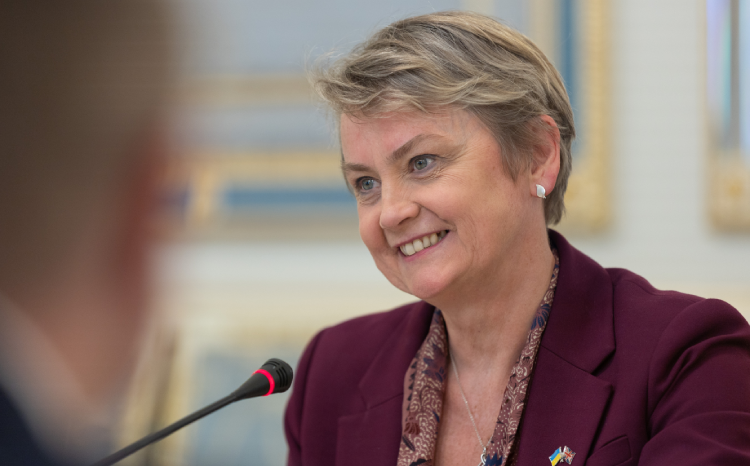
Yvette Cooper, Secretary of State for Health and Social Care (Credit: Shutterstock.com)
Prime minister Andy Burnham this week revealed his new Cabinet, including the appointment of Yvette Cooper as Secretary of State for Health and Social Care.
The MP for Pontefract, Castleford and Knottingley, who previously served as foreign secretary from September 2025 to July 2026 and home secretary from July 2024 to September 2025, is now the UK’s tenth health secretary since January 2018.
Figures from across the health sector have reacted to the appointment of yet another health secretary and what it may mean for technology in the NHS. Here’s what they had to say:
Layla Moran, chair, Health and Social Care Committee:
“We welcome Yvette Cooper to this incredibly important role and urge this government to prioritise adult social care. We have long argued that kicking this issue into the long grass itself has a great cost to the economy, carers and families.
“You cannot achieve reform of the NHS while sidelining social care. Patients cannot be discharged from hospital beds if the right care isn’t available, and that means treatments are postponed and longer waits in A&E.
“We stand ready to work with the government and Baroness Casey, as soon as her proposals are presented, to make reform a reality. And we look forward to discussing these issues with the new Secretary of State at an early stage.”
Hassan Chaudhury, chair, National Council, The Data Observatory CIC:
“Cooper has a real opportunity to reshape the future of health and care, but only if she focuses on five priorities.
“First, stop the endless reorganisations. Stripping organisational memory from NHS England and ICBs will be felt for years.
“Second, remember it’s the Department of Health and Social Care: both deserve equal attention.
“Third, pay people fairly. Without competitive pay across health and care, we won’t solve the workforce crisis in an increasingly competitive global market.
“Fourth, remove the barriers that make it so hard for technology partners, especially SMEs, to work with the NHS. Innovation shouldn’t be this difficult.
“Finally, end vendor lock-in. Open, interoperable data is the foundation for better care, faster innovation, greater productivity and long-term value. If we get these five things right, the NHS will be in a far stronger position to meet the challenges ahead.”
Nick Wilson, chief executive, System C:
“Following Burnham’s record of devolution in Greater Manchester, this approach should mean going further with the devolution of health and care.
“We all know that nationally driven tech programmes have always struggled to deliver which is why we believe a more local approach is most likely to deliver connected care.
“In this scenario it is crucial that local health and care systems are connected by technology and that shared data standards are in place to prevent IT systems becoming fragmented.”
Steve Wightman, managing director, Access Health and Integrated Care:
“By appointing such an experienced minister and putting social care at the centre of Yvette Cooper’s agenda, Andy Burnham is sending a positive signal about integration-focussed change.
“For it to be successful, social care can no longer be treated as separate to the NHS. Delayed discharges and patient flow are one of the clearest examples of this disconnect – costing billions a year – and sitting at the interface between the two systems.
“Yvette Cooper has the mandate to tackle these challenges. But to do so, we need to avoid unnecessary disruption elsewhere.
“The focus needs to be on building the neighbourhood health model already underway, along with scaling joined-up technology and shared data that connect these services, rather than ripping up and starting again.
“This would only delay the progress in social care and health that patients and staff need to see.”
Barry Mulholland, chief executive and founder, MBI Health:
“The new Secretary of State has an opportunity to make digital transformation synonymous with operational improvement, and one of her most valuable legacies could be ensuring operational data confidence is a national priority.
“Every investment in AI, automation and electronic patient records ultimately depends on clinicians and operational leaders having complete, trusted and usable information to make decisions every day. Without that information, even the best digital systems struggle to deliver value.
“I hope to see building operational data confidence prioritised, ensuring digital investments translate into helping staff and shorter waits for patients.”
Dr Ryan Samuels, director, Eolas Medical:
“Yvette Cooper’s appointment lands at a pivotal moment. With the NHS currently working through another major reorganisation, the priority has to be continuity and momentum, not starting from scratch.
“There’s a huge opportunity for the new secretary of state to back the proven, home-grown technology solutions already working on the ground, and to help the NHS move beyond endless pilots to scaling what demonstrably works.
“Clinicians do not need more proofs of concept; they need trusted tools in their hands today. This is particularly true when it comes to AI, something that the previous PM and government had committed to scaling across the health service.
“ICBs and other NHS organisations can then hit the ground running on the problems that matter most: safer care, faster clinical decisions and a workforce that is properly supported. The hope is that Yvette Cooper will recognise this and drive it forward.”
Dr Anas Nader, co-founder and chief executive, Patchwork Health:
“The first thing NHS staff will want to see from the new health secretary is a workforce plan that reflects the reality they’re facing on the ground and sets the NHS on a path to a more sustainable future.
“This has to include tangible commitments to improve on issues like the lack of training posts, and a concrete plan to stem the flow of talented clinicians leaving our health service.
“Whatever else the health secretary wants to achieve, lasting change will only be possible if the NHS has a workforce ready to deliver it.
“There will understandably be a lot of speculation around what the change in leadership means for the role of technology in our NHS.
“What’s important is that concerns over individual contracts or tech providers don’t hamper progress in the wider mission to digitise our health service.
“Creating an environment that makes it easier for home-grown innovators to scale their technologies and support NHS staff and patients will be crucial to building more secure, sovereign health infrastructure.”
Sarah Woolnough, chief executive, The King’s Fund:
“Unlike many of her predecessors, Yvette Cooper has been given a very clear mandate. The new prime minister, Andy Burnham, has said that his government must have the courage to fix the big things that politics has neglected, including social care.
“Given this new focus, long overdue need for action and the prime minister’s personal commitment to fix social care, social care reform should be at the top of Yvette Cooper’s in-tray.
“The new prime minister has already spoken about his desire for social care to operate on an ‘NHS principle’ and pointed to the billions, as our recent work highlights, that delayed discharges cost to the health service a year. To deliver this, the new Secretary of State will have to move at speed.
“Alongside this, there will be a host of challenges and live issues. Reviving the promised ‘health mission’, will be one of these.
“The prevention revolution has for the most part stalled since the historic Tobacco and Vapes Act but action across government to consider the implications for health in all policies would signal a step change.
“Steering through the largest NHS reorganisation in over a decade in the form of the Health Bill, alongside implementing a sweep of plans and strategies already set in motion such as the 10 year health plan, life sciences sector plan, capital plan, cancer plan and upcoming workforce plan, will all need Yvette Cooper’s immediate attention.”