
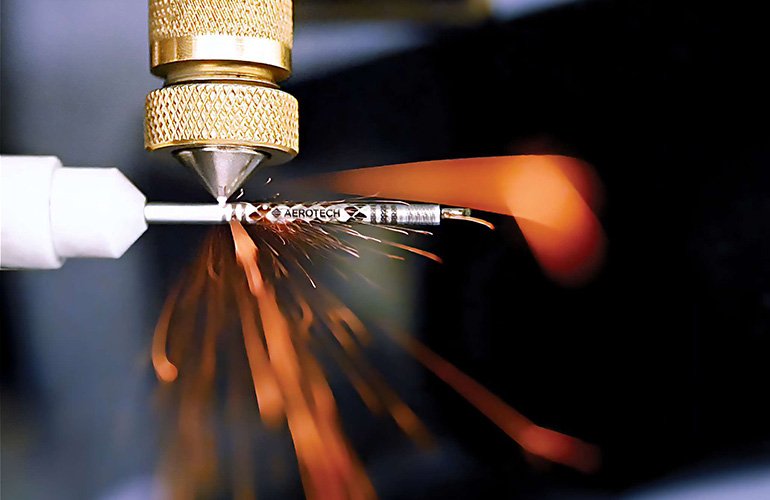
Laser-cut cylindrical components find copious use in medical devices — in coronary and neurovascular stents, structural heart components, peripheral vascular implants, and instruments for minimally invasive procedures.
The new Aerotech LaserTurn280 is a motion platform for high-volume laser machining of these cylindrical medical-device components.
The LaserTurn280 is Aerotech’s new motion platform for cylindrical laser machining. Based on the PRO280LM linear table design and available with a choice of three different rotary stage drives, the system can process tube diameters from 0.3 to 30 mm. Shown here is a prototype as exhibited at Medtec Live in Stuttgart. [Image courtesy of Aerotech]
Previously displayed in prototype form at medical-technology tradeshows, the LaserTurn280 is based on Aerotech’s PRO280LM linear-stage design. Three versions have different rotary-stage drives — the ASR1400, ASR1100, and ACS150 — to machine tube diameters from 0.3 to 30 mm. Clamping systems abound and include TF20 and W12 collets as well as dead-length and ER16, ER25, and ER40 precision collets. Linear travel is to 300 mm and speed to 1,000 mm/sec.
Collet chucks with dead length minimize axial movement of the tube and reduce the risk of stitching errors during feed. This is particularly important when machining longer workpieces such as hypotubes. The clamping mechanism is pneumatically actuated and is designed for operation with dry oil-free nitrogen or compressed air.
Tube laser processing is key to the manufacture of cylindrical medical devices as found in coronary and neurovascular stents, hypotubes, and instruments for minimally invasive procedures. [Image courtesy of Aerotech]
“The LaserTurn280 is the result of direct feedback from the market,” said Aerotech product manager Brian Fink. “Engineers need platforms that can be quickly integrated into their existing production lines while enabling higher throughput. The LaserTurn280 was developed precisely to meet these requirements.”
According to the manufacturer, the platform’s high rigidity allows calibrated accuracy to ±1 µm (linear) and ±30 µrad (rotary) with bidirectional repeatability of ±0.4 µm and ±15 µrad respectively. The system is driven by ironless linear motors sporting noncontact optical encoders. Seals protect internal components from contamination — especially important for wet-cutting applications. The LaserTurn280 can be supplied in either a dry or wet cutting configuration; the latter features an integrated fluid handling system.
Integrated cable management and an open aperture for tube passage keeps integration simple and tidy; Optional pneumatic grippers at the front and rear enable automated workpiece handling. Mounting is via eight M8 fixing points.
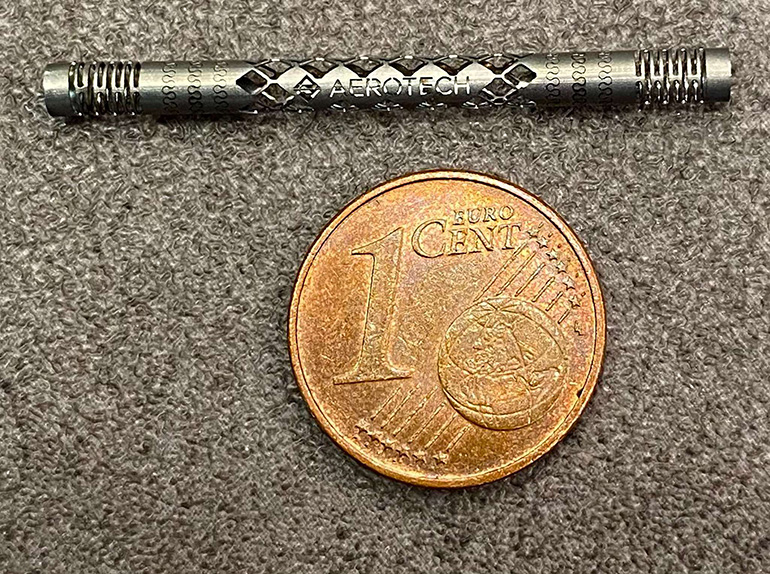
Shown here is a laser-cut vascular implant only made possible with modern tube-laser platforms able to impart intricate structures with tight tolerances. [Image courtesy of Aerotech]
“The platform [makes for] minimal tube scrap, reproducible part quality, and series production,” added Fink.
The platform works with Aerotech’s Automation1 motion controller that (among other things) supports a position synchronized output (PSO) function for precise synchronization of the laser pulse and axis movement. Meanwhile, enhanced tracking control (ETC) reduces path errors during the machining of fast and complex contours. Both technologies are particularly relevant for stent manufacturing, for which tight geometric tolerances and short cycle times are key.
Workpieces range from a few millimeters to lengths of over one meter. With its selection of rotary stage drives and collet options, the LaserTurn280 is designed for a wide range of these applications.
“The demands of medical device manufacturing [include] smaller structures, tighter tolerances and higher production volumes,” said Fink. “The LaserTurn280 supports this and enables integration without complex adjustments to individual components.”