
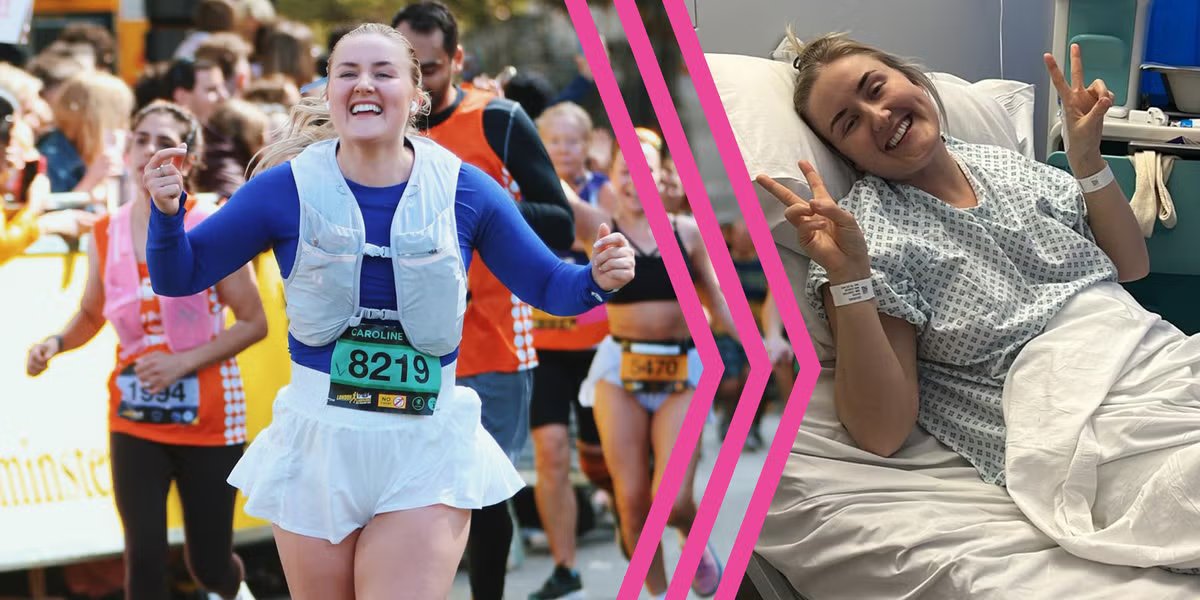
In my mid-20s, I started running as a form of therapy. I was struggling with my mental health, and at a time when so much in my life felt out of my control, exercise became something steady that I could rely on. But one day, when I was 28, I felt a sudden, sharp pain shoot through my left hip, knee, and groin while casually walking down the street. I figured I stepped in a weird way and pulled a muscle. But a few weeks later, when the excruciating pain in my hip hadn’t gone away and I could barely walk, I knew something was wrong.
At first, I was misdiagnosed with bursitis (inflammation of the small, fluid-filled sacs that cushion the hip joint) and, months later, a torn labrum (the ring of cartilage that lines the outside rim of the hip joint socket). I could barely walk, let alone run, so my doctor advised me to stop exercising to help the pain subside. But unfortunately, resting didn’t help, and my symptoms were debilitating—I couldn’t stand for more than a few minutes, relied on crutches to walk, and depended on others for basic tasks like carrying groceries and taking out the trash.
Over the next two years, I experienced chronic pain and continued to be misdiagnosed by multiple doctors. Finally, I saw a hip specialist and learned that I was born with hip dysplasia, a condition where the bones in my hip joint don’t fit together. My hip socket wasn’t providing enough coverage for the joint, and the recommended treatment was a surgery to reposition the socket and better support my hip.
I was shocked that I’d gone my entire life without knowing about this diagnosis, but I was also relieved to finally understand the source of my pain. A few months later, I underwent a periacetabular osteotomy (PAO), one of the most complex hip preservation surgeries. It involved cutting and repositioning the bone around my left hip before securing it back to my pelvis with screws.
The procedure was intense and recovery was painful, but I was determined to come back stronger than ever.
After spending six weeks navigating life in a wheelchair and on crutches, I was ecstatic to be cleared by my doctor to exercise again. So, I began working with a physical therapist multiple times a week to rebuild strength in my lower body. Exercises like leg lifts, glute bridges, and clamshells were my bread and butter, and I spent lots of time on hip mobility to improve my range of motion.
I also focused on rebuilding my mind-muscle connection, actively focusing on the specific muscles being worked in particular exercises. After surgery, it took time for my lower-body muscles to fully, properly activate, but by concentrating on engaging them, I gradually retrained my body to move the way it was supposed to. Little by little, I began feeling stronger, steadier, and more confident in my body’s abilities.
After years of struggling to walk without pain, I wanted to prove to myself that running could be part of my life again—so, I signed up for a half-marathon.
Five and a half months post-surgery, and with my doctor’s approval, I started training with a run coach. My goal was to run three times a week while continuing to strength train with my physical therapist.
I chose to run for time instead of chasing mileage, which made the training process feel more manageable. At first, I could only run for a few minutes at a time, but over the next six months, I gradually built up my endurance and strength. I steadily progressed up to 35-minute easy runs, 40-minute interval runs, and long runs that eventually reached two and a half hours—although some days I felt sore and needed to scale back. Having a run coach who understood my limitations, listened to my concerns, and encouraged me without pushing my body too hard helped me rebuild my strength and confidence safely.
Eleven months after surgery, I completed my first half-marathon. Running 13.1 miles after everything I’d been through was nothing short of powerful. It was a true testament to my resilience, and with every step, I felt so proud of what my body had overcome. My life had been on pause for more than two years while I dealt with pain and misdiagnoses, but when I crossed the finish line, I felt strong, capable, and more like myself than I had in a while.
Unfortunately, two months later, my right hip started causing serious pain, and I had to undergo another PAO surgery. After finally feeling strong and confident again, it felt like my right hip was betraying me, but I knew that just like the first time, I’d come back stronger, and I did.
A little over a year after my second surgery—and lots more physical therapy, strength training, and running—I finished my second half-marathon with a seven-minute personal best. In a lot of ways, this race felt even more meaningful because every mile represented the setbacks, surgeries, long rehab days, and the moments when I wasn’t sure I’d ever feel like myself again. But crossing the finish line proved that I was unstoppable and capable of much more than I ever thought was possible.
I hope to complete another half-marathon in the future, but for now, I’m taking things a bit slower. I still run and strength train three times a week, though my runs are shorter and less structured. I also take a reformer Pilates class a few times a week, which has been a great low-impact way to improve my flexibility, mobility, and core strength.
Fitness Products I Can’t Train Without

Humantra Electrolytes
I used to feel dehydrated after my runs because I wasn’t drinking enough water throughout the day, but Humantra Electrolytes have made staying hydrated much more enjoyable.
These three factors were key to my recovery success:
1. I worked with experts who helped me safely reach my goals.
Getting back into running felt intimidating after undergoing both of my PAO hip surgeries, but working with a physical therapist and run coach made all the difference.
Instead of feeling pressured to bounce back immediately, I felt supported through every step of my journey. My coaches tweaked my training plan based on how I felt during certain weeks and spent extra time with me in the gym to rebuild my strength. In doing so, they gave me peace of mind that I was training in a way that protected my hips while still making progress toward my fitness goals. I’m a firm believer that the people you surround yourself with play a huge role in your success, and I’m incredibly grateful to have such an amazing team.
2. I focused on progress, not perfection, taking recovery one day at a time.
When I was in the recovery stages, it was easy to get caught up in thinking about how far I had to go to heal. But I learned that focusing on the small wins along the way made the process feel much more manageable and rewarding. Some days, progress looked like running for an hour pain-free, and other days it meant listening to my body and giving myself time to rest. Either way, I knew every step, no matter how big or small, was bringing me closer to my goals.
3. I learned that resilience isn’t about never struggling—it’s about continuing despite the struggle.
There were moments after my surgeries when I didn’t know if I’d ever walk pain-free again, let alone complete two half-marathons. At times, progress felt painfully slow, but I kept reminding myself why I started in the first place. I chose not to get discouraged on the days when I couldn’t complete a run. Instead, I focused on the progress I had already made and reminded myself that setbacks were a normal part of the recovery process. I was determined not to let my surgeries define what I was capable of, and proved to myself that I could return to doing what I loved.
Over time, I’ve learned that recovery isn’t always about huge breakthroughs or dramatic milestones. More often, it’s about showing up consistently, trusting the training process, and continuing to move forward even when things feel hard or uncertain. For me, it was the combination of determination, support, and perseverance that carried me through. After everything I’ve been through, I’m so proud that running has become a constant in my life once again.

Andi Breitowich is a freelance writer who covers health, fitness, relationships, beauty, and smart living. She is a graduate of Emory University and Northwestern University’s Medill School of Journalism. Her work has appeared in Women’s Health, POPSUGAR, Food & Wine, What To Expect, Cosmopolitan, Men’s Health, and elsewhere. As a former collegiate pole vaulter, she loves all things fitness and has yet to meet a group workout class she doesn’t like.