I’ve always strived to live well. Growing up, my family ate healthily and I was encouraged to stay active. I participated in sports and spent most of my young adult life as a recreational runner, enjoyed yoga and martial arts, and started strength training in college. For a long time, I felt like I was the picture of a healthy, balanced lifestyle. But that all changed when I was 22.
Out of nowhere, I became incredibly sick and was diagnosed with sarcoidosis, a rare inflammatory condition that causes lumps to form all over the body. I also had constant joint pain, chronic headaches, frequent nose bleeds, swollen eyes, and overwhelming fatigue. Additionally, the disease attacked my organs, causing me to lose 40 percent of my lung function. Doctors didn’t know what caused my sarcoidosis or have a cure. But they managed my inflammation and symptoms with medication, and I stayed in remission for more than a decade. During that time, I was able to rebuild my endurance and run again.
Then, at 34, I began experiencing shortness of breath during activities like climbing stairs and running, and constant fatigue. A series of tests revealed that I had a congenital condition that caused a malfunctioning valve and hole in my heart—and had nothing to do with sarcoidosis. So, I had open heart surgery to repair the hole and replace the faulty valve with an artificial one.
It took over a year to fully recover, and out of concern for my healing heart, I stopped running. But my commitment to movement never wavered, so I turned to other forms of exercise, including hiking, yoga, martial arts, and dance. Over the next 25 years, exercise stayed a constant in my life; it kept me grounded, reminded me of my strength, and provided a sense of balance through every season of change.
Then, when I turned 60, my mother passed away and I felt drawn to the sport I loved again. Returning to running felt like a meaningful way to honor her spirit and carry forward the values around health that she had instilled in me.
Around the same time, I came across an ad to run the New York City Marathon with Team for Kids, a running group that raises money for New York Road Runners’ youth and community programs. When I reached out, I learned that participants received structured training and coaching support. That made the idea of running—especially my first marathon—feel much more doable. So, with my doctor’s approval, I took a leap of faith and signed up to run the 2020 New York City Marathon.
With just 60 percent of my lung capacity, marathon training was challenging—but I rebuilt my endurance with the run-walk-run method.
My first few workouts were humbling since I could barely run for more than a minute at a time. I quickly started to question whether my goal of running a marathon at 60 with compromised lungs was realistic.
Thankfully, one of my coaches from New York Road Runners introduced me to the run-walk-run method created by runner Jeff Galloway. It involved alternating between timed running and walking intervals, and at first, I spent more time walking than running. But as my endurance and confidence grew, I gradually extended my running intervals and started to believe I might be able to do it.

Unfortunately, a few weeks into training, the COVID-19 pandemic hit and the marathon was cancelled. But after finally finding my rhythm, I wasn’t just going to quit. So, I continued training and in 2021, ran the virtual Boston Marathon, tracking my mileage on a real-time GPS tracking app.
Completing 26.2 miles after experiencing several serious health diagnoses was terrifying, yet powerful. It represented my resilience, and with every step, I was deeply thankful for the heart and lungs that carried me forward. When I crossed the virtual finish line, I broke down in tears of joy and appreciation for the journey that had led me there. I realized how far I’d come, not just in distance, but in strength, perseverance, and renewed trust in my body.
Today, at 66, I’ve run a total of 14 marathons—including seven of the eight Abbott World Marathon Majors—and I don’t see myself stopping anytime soon.
I officially caught the marathon bug after my first race, so I continued working with a running coach who created a personalized training plan for me. My usual marathon training block consisted of running four days a week—including long runs, easy runs, and interval work—plus taking aqua aerobics and swimming for extra cardio. Additionally, I strength trained at Orangetheory Fitness four days a week to build power and muscular endurance. Plus, I practiced yoga two to three times a week to stay mobile and reduce my risk of injury.
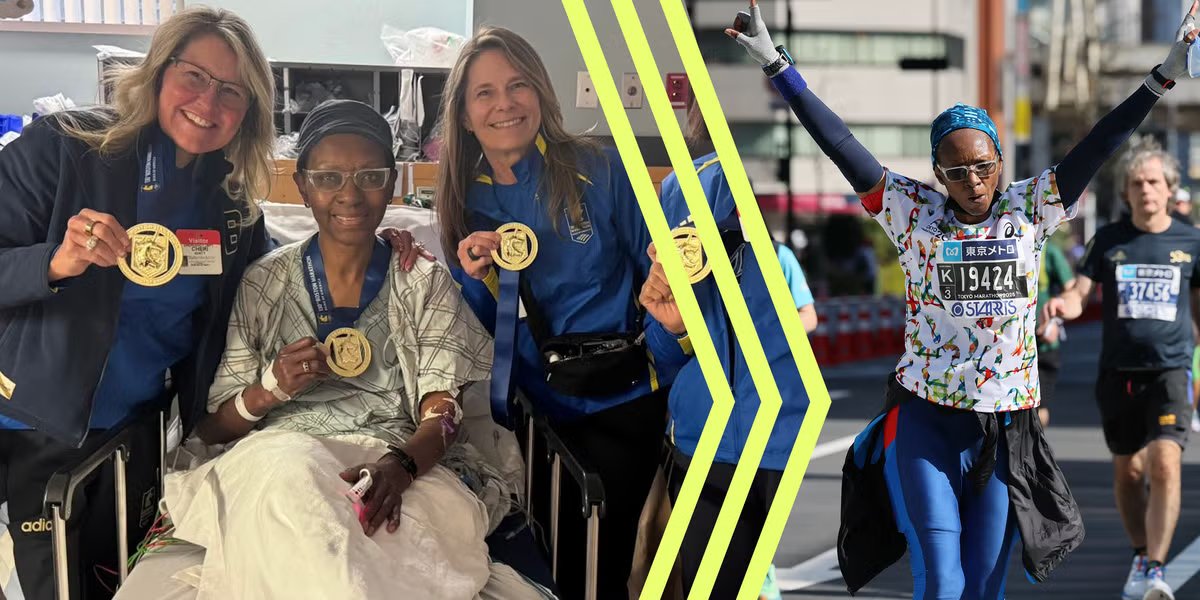
Most recently, I ran the 2026 Boston Marathon as part of Team Abbott, a community of runners who have faced health challenges but choose not to be defined by them. Unfortunately, the race didn’t go as planned—I ended up with rhabdomyolysis, a rare, life-threatening condition where the muscles break down and send toxins into the bloodstream. During the last few miles of the race, I was in and out of consciousness, but thanks to the help from my running coach and a member of the race’s medical staff, I crossed the finish line.
Afterward, I spent three days in the intensive care unit at Tufts Medical Center, and I’m so grateful for their team—they acted swiftly to save my life. According to the doctors, the cause could’ve been any number of things, like a genetic disposition, underlying health condition, medication, extreme overexertion, under- or over-training, or dehydration.

While I’ve since recovered, I’ve scaled back my training over the past few months. I’m mainly focusing on low-impact exercise like yoga and water aerobics to give my body the time it needs to fully heal. I also returned to Boston last month to run a 10k with my doctor’s permission, which was a cathartic way to overcome my fear of rhabdomyolysis. My goal is to continue racing this summer.
My life has had its fair share of health scares and setbacks. But each time, I’ve found my way through them. This time is no different—I’m staying patient, trusting the process, and focusing on rebuilding strength so I can come back stronger than ever. I’m grateful for the support I have received from my family and friends, the running community, my doctors, and Team Abbott. I’ve had some doubters, and even doubted myself at times. But those who believe in me are a big part of why I keep striving to be the healthiest version of myself.
These factors are key to my recovery and athletic success:
I train intentionally.
Instead of chasing intensity or trying to prove what I can push through, I make sure my routine is centered around consistency, balance, and longevity. Whether it’s a slow recovery run to shake out muscle soreness, structured strength training to build power, or a restorative yoga flow to maintain mobility, every workout has a clear purpose.
This approach has taught me that my fitness routine isn’t about doing the most—it’s about doing what I can sustain and what supports my health and progress in the long run. Over time, this mindset has allowed me to keep building endurance safely, stay connected to movement, and continue showing up for training in a way that strengthens me rather than depletes me.

I respect my limits but never give up.
Between facing sarcoidosis that permanently reduced my lung function, undergoing open-heart surgery, and surviving a near-death experience from rhabdomyolysis, I’ve repeatedly redefined my body’s capabilities. Each time, I‘ve listened carefully to its signals: I’ve slowed down when needed, learned from my mistakes, and adjusted my training to rebuild strength safely by returning to movement in whatever form was possible.
Through it all, I’ve come to understand that honoring my body’s boundaries is what makes my strength sustainable. It’s not about forcing my way back to who I was before, but committing to who I am in each new season of life. I also know that everything that has happened to me over the years is grounded by my faith in God’s grace. Resilience is not measured by how quickly I recover, but by my willingness to keep showing up patiently, consistently, and with trust in the process. And as long as I can move forward in some way, I always will.

Andi Breitowich is a freelance writer who covers health, fitness, relationships, beauty, and smart living. She is a graduate of Emory University and Northwestern University’s Medill School of Journalism. Her work has appeared in Women’s Health, POPSUGAR, Food & Wine, What To Expect, Cosmopolitan, Men’s Health, and elsewhere. As a former collegiate pole vaulter, she loves all things fitness and has yet to meet a group workout class she doesn’t like.