
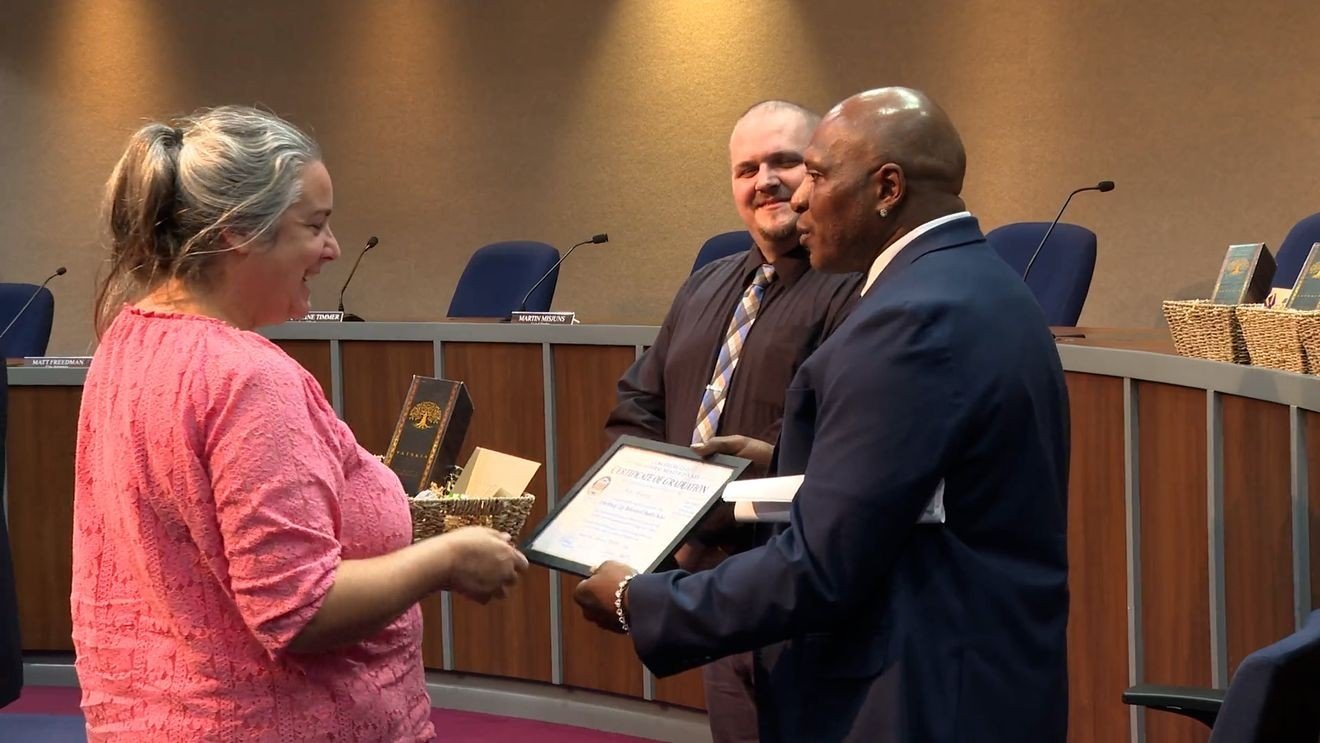
LYNCHBURG, Va. (WSET) — Several Lynchburg community leaders celebrated seven people who graduated as part of the first class of the Lynchburg City Behavioral Health Docket.
During the ceremony Wednesday night in City Hall, Lynchburg District Judge Randy Krantz, Horizon Behavioral Health, the Lynchburg Commonwealth’s Attorney’s Office, the Public Defender’s Office, and several other groups came together to mark the achievement of their first graduating class.
According to the Virginia Judicial System, behavioral health dockets address offenders with serious mental illness and substance use disorders that contribute to criminal behavior. Behavioral Health Dockets employ evidence-based practices to diagnose mental illness and provide appropriate treatment, enhance public safety, reduce recidivism, ensure offender accountability, and promote offender rehabilitation in the community. Local officials submit an application requesting approval to the Behavioral Health Docket Advisory Committee.
Below are the names of the seven graduates:
- Kim Mather
- Christine Sarandopolis
- Isaiah Leon-Brophy
- William Parr
- Charles Jenkins
- Tia Bass
- Brant Edgar
SEE ALSO: Sentencing delayed for man convicted in 2021 Lynchburg woman’s murder
Judge Krantz, who oversees the docket, shared that the program is changing lives.
“The participants have to accept their role in the recovery,” Judge Krantz said. “They have to take responsibility. We may be able to provide tools and resources, but ultimately, they must choose to use the tools and to take advantage of the resources. When we had the opportunity to help restore lives, build up characters, and give people the opportunity to commence the rest of their lives, I think that’s one of the greatest privileges we can have of any of us that are interested in public service and community service. To our graduates, let me say this: today is a celebration of how far you’ve come, but it is the beginning of where you can go. You have demonstrated courage, accountability, perseverance, and a commitment to building a healthy, more productive future. We are proud of you.”
Melissa Lucy, CEO of Horizon Behavioral Health, who also helped work with the graduates, reminded them to tackle their new chapters with the same amount of hard work they had doing this course.
“Please take your next steps forward with confidence”, Lucy said. “Believe in yourself, know that we believe in you. Surround yourself with others who believe it too, and I know in my heart that you can achieve whatever goal you set for yourself. If nothing else, please remember this one thing: this team in this room behind each of you knows that you can do it.”
SEE ALSO: Lamp & Post: Step back inside ‘Lynchburg’s living room’
Following her speech and those from several others, Judge Krantz and his team handed out the awards. While only three of the seven were in person, the others will receive their award as soon as possible.
One of the graduates, Isaiah, asked if he could speak at the ceremony. The graduate thanked people who helped him by name and shared that this program was what he needed.
“Judge Krantz, thank you for presiding with fairness in treating me as a person and not just a case number,” Isaiah said. “Miss Roberts, you kept this program running on schedule, which I now understand requires a small miracle. Thank you. Always knowing where I was supposed to be even when I didn’t. Commonwealth’s Attorney Harrison, thank you for supporting a program built on the idea that accountability and treatment work better together. I have learned firsthand that you are right. Mr. Boone in the public defender’s office, thank you for standing beside me and explaining legal matters in plain English. A rare, unappreciated skill. Mr. Adams and the team at Horizon Behavioral Health, thank you for your patience, your honesty, and your passive tolerance for most excuses. You gave me practical tools, and I still use them every day. Now to the people closest to me. Jerry Gibson, my mentor. Thank you for telling me what I need to hear and not just what I wanted to hear. Timothy Brophy Senior, thank you for your steady support, and my mother, Sarah Brophy, thank you for never giving up on me, even on the days that I made it difficult for my family and friends.”
Isaiah shared that he started the program in 2024 and finished it last year. He also said that because of them, he already has great plans for his future.
“This program has taught me three things: accountability and support are not opposites; I need both,” Isaiah said. “Progress is not perfect, and a bad day does not erase the good ones, and asking for help is not weakness; it is a strategy. To anyone beginning this docket, it is worth it. It will be uncomfortable at times. Keep showing up, letting people help you, and know that you are more capable than ever before. As for me, this November, I begin at Job Corps, and I am studying Aerial Systems Technology online, so you could say my future is looking up. Today is not the finish line; it is evidence that I can keep going, and I intend to.”