
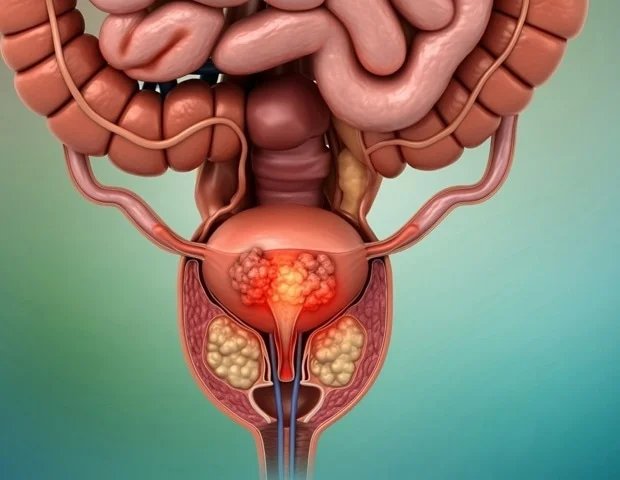
A multi-institutional collaborative study led by researchers at the University of Chicago and the Fred Hutchinson Cancer Center has identified a previously unknown biological mechanism that controls cell identity and treatment resistance in advanced prostate cancer.
Published in Nature, the study reveals that a specific transfer RNA (tRNA) named tRNAArg (UCU)-1 plays a central role in allowing prostate cancer cells to escape targeted therapies and transition into more aggressive and treatment-resistant forms of the disease. This finding could help researchers develop a way to re-sensitize resistant tumors to existing therapies.
Treatment resistance in prostate cancer
Prostate cancer, the second-leading cause of cancer death among men in the United States, often depends on androgen receptor signaling for tumor growth. Many tumors initially respond to androgen deprivation therapies and androgen receptor pathway inhibitors like enzalutamide, apalutamide, and darolutamide. Over time, some tumors adapt through a process known as lineage plasticity, where cancer cells lose their dependence on androgen signaling and acquire features of neuroendocrine prostate cancer, a form of cancer that is resistant to therapy.
The molecular cues that drive this kind of transformation have remained poorly understood. Using high-resolution RNA sequencing, the research team at the University of Chicago analyzed samples from patients, animal models and cells of prostate cancer and found that tRNAArg (UCU)-1, a small non-coding RNA molecule that helps cells make proteins, is consistently depleted as tumors transition from a therapy-responsive to a therapy-resistant state.
For a long time, tRNAs were considered basic housekeeping units, serving as static transfer vehicles of translating the genetic code during protein synthesis. In reality, tRNA levels are dynamically tuned to control cell fate, and the low levels of tRNAArg (UCU)-1 act as a molecular switch that allows prostate cancer cells to escape from the treatment and become a more aggressive type of cancer.”
Tao Pan, PhD, Study Co-Lead Author and Professor, Biochemistry and Molecular Biology, University of Chicago
Pan is also the co-founder of MesoRNA, a UChicago spinout company developing sequencing technologies for small non-coding RNA.
This discovery of the link between tRNAArg (UCU)-1 levels and the translational switch is important because treatment resistance remains one of the biggest challenges in advanced prostate cancer. To understand exactly how this switch works, the research team traced the pathway connecting tRNAArg (UCU)-1 to the cellular machinery that controls prostate cell identity.
Restoring treatment sensitivity
When researchers reduced levels of tRNAArg (UCU)-1 in prostate cancer cells, the cells quickly showed lower levels of androgen receptor, a key driver that many prostate cancer treatments are designed to block. The team looked at what controls tRNAArg (UCU)-1 and found that two proteins, TARDBP and ZSCAN29, help keep this tRNA active.
The researchers also found that tRNAArg (UCU)-1 helps control production of SMARCC2, an important part of cell machinery that helps organize DNA and maintain prostate cancer cells in a treatment-sensitive state. When tRNAArg (UCU)-1 levels drop, SMARCC2 also decreases, disrupting normal cells’ identity and making it easier for cancer cells to turn into a more aggressive, therapy-resistant form. Importantly, restoring tRNAArg (UCU)-1 or SMARCC2 successfully rescued androgen receptor activity and made resistant cells more responsive to treatment again.
Therapeutic implications and future research
Current treatment options for treatment-resistant neuroendocrine prostate cancer are largely limited to platinum-based chemotherapies, which offer modest survival benefits. The discovery that tRNA modulation can reverse lineage switching suggests that RNA-targeted therapeutics such as synthetic tRNA mimics or small molecules that enhance tRNAArg (UCU)-1 production, could re-sensitize hard-to-treat tumors to existing, widely available androgen receptor-targeted drugs.
“Unlike DNA mutations where changes are permanent, RNA regulated processes are reversible,” Pan said. “It opens up an unexplored therapeutic landscape focused on modulating RNA dosage and tRNA to overcome drug resistance.”
The study, “tRNA dosage regulates lineage dependency and resistance in prostate cancer,” was supported by the National Institutes of Health, DoD PCRP Idea Award, Prostate Cancer Foundation Challenge Award, Seattle Translational Tumor Research, the American Cancer Society, Pacific Northwest Prostate Cancer SPORE, the Richard M. Lucas Foundation, the Institute for Prostate Cancer Research, the Larry & Virginia Gordon Endowed Chair in Prostate and Bladder Cancer Research, the Nancy & Dick Bernheimer, Matthews Family, Stinchcomb Family, and Thomas & Patricia Wright Memorial Funds.