
New York Magazine’s recent Grub Street article, “When Eating Out Is Political,” tells a compelling story about the changing identity of Middle Eastern restaurants in New York. But the inaccuracies begin right at the start: the history of Israeli restaurants does not fit the narrative.
I am an Israeli-American and a longtime food writer who covers Jewish and Israeli food from around the world.
The article argues that for decades Arab, Iranian and North African restaurants obscured their identities behind terms like “Oriental” and later “Mediterranean,” while Israeli chefs were “happy to announce their connections to Israel and talk about the Tel Aviv food scene.”
In fact, Israeli restaurants spent decades doing much the same thing.
Israeli restaurateurs have been part of New York’s dining scene almost since the founding of Israel, but for much of that history their restaurants were routinely marketed as “Middle Eastern” or “Mediterranean.”
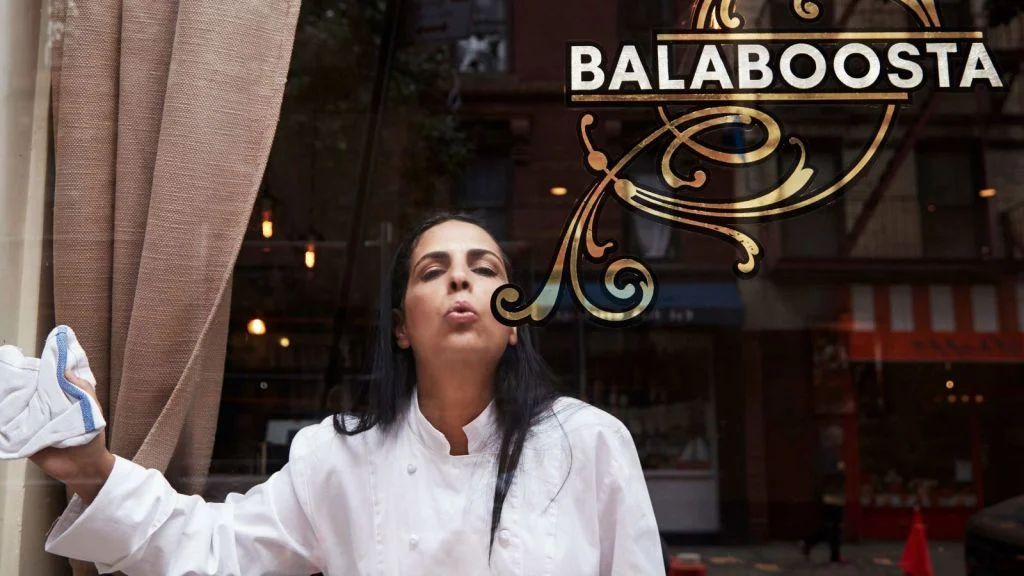
You don’t even have to go far back to see it. When Israeli chef Einat Admony opened Balaboosta in 2010, The New Yorker described her food as “nouveau-Mediterranean,” not Israeli. When I interviewed Einat about her cookbook, I had to search deep into its back cover to find the word “Israel” at all. Miriam, opened by Israeli chef Rafael Hasid in 2005, was similarly described in contemporary coverage as “Middle Eastern.”
What changed was that, beginning in the 2010s, Israeli cuisine became fashionable. A new generation of chefs finally put “Israeli” front and center, presenting a new cuisine shaped by the many populations that make up Israeli society, including Moroccan, Iraqi, Yemenite, Persian, Ethiopian, Eastern European and other cuisines brought to Israel by Jewish immigrants, as well as influences from Palestinian cuisine.
Ironically, the article later acknowledges that today some Israeli restaurants are once again avoiding the Israeli label. “Perhaps there’s a fear of being targeted,” the article suggests.
Perhaps?
In January 2025, Miriam was vandalized with “GENOCIDE CUISINE” and “ISRAEL STEALS CULTURE” painted across its storefront. Later that year, Israeli educator Rami Glickstein was assaulted while approaching a kosher restaurant in Midtown Manhattan after an attacker focused on his kippah. He was hospitalized, and the alleged attacker was subsequently charged with a hate crime.
I find it odd that an article written specifically about the politics surrounding Middle Eastern restaurants would neglect to mention the actual politically motivated assaults and antisemitic vandalism that Israeli – and Jewish – restaurants face, all while treating Israeli restaurateurs’ fear of being targeted as hypothetical. I assume this side of the story did not match the magazine’s narrative.
But let’s talk about the claim that Israel steals culture. More than half of Israelis are of Middle Eastern origin. That includes me: my family originated in Baghdad, and I grew up eating Iraqi food. This is true for Jews who came from North Africa, the Middle East and the Levant.
Those falafel balls? They’re Palestinian, but also Jordanian, Lebanese and definitely Egyptian. Hummus is part of the cuisine of the whole Levant as well, and in fact, the larger region of Greater Syria has long shared a culinary culture, with minor differences from one area to another.
Israeli cuisine became popular when it began developing its own language, combining the many Middle Eastern and North African cuisines that arrived in Israel with Jewish immigrants to create something nontraditional and modern. That’s why chefs like Eyal Shani became so popular: they offered something completely new – their own exciting, fresh interpretations mixing different Middle Eastern traditions, ingredients and flavors.
Then there is the claim that while Israeli chefs opened expensive, celebrated restaurants, “most Arab, Iranian, or North African restaurants were assigned their role: cheap, quick, outer-borough.” Assigned by whom? In context, the insinuation seems clear: Israeli success somehow came at the expense of their Arab and Middle Eastern counterparts. No evidence is offered for that claim, and framing the success of one group of Jews as something achieved by pushing others down carries an ugly implication.
But perhaps the article’s most revealing line comes in its description of the Palestinian restaurant Ayat, whose menu includes a map where “the land mass currently called Israel is titled ‘Discover Palestine.’”
The land mass currently called Israel?
Is New York Magazine aware of something we should know about?
Israel is a sovereign country and a member of the United Nations.
Its occupation of Palestinian territories, the daily Jewish terror in the West Bank, the horrors in Gaza—these are all things we should fight. Palestinians’ right to self-determination is unquestionable.
But describing Israel as a “land mass currently called Israel” suggests that its very existence is provisional. That is particularly striking in an article concerned with the harm caused when identities are erased.
There is an excellent story to be written about the flowering of Palestinian, Syrian, Iranian, Yemeni and other Middle Eastern restaurants in New York. Their chefs should be able to call their food by its name proudly, without hiding behind “Mediterranean.”
But that is not the vision this article offers. At a moment when New York Magazine could celebrate a dining scene where cultures meet, overlap and coexist, it offers a narrative in which one culture can flourish only by diminishing another, going so far as to describe Israel as a “land mass currently called Israel.”
I have met enough courageous peace activists from across the Middle East who, despite war and loss, still believe we can build a future that includes everyone, without erasing anyone’s identity, history or culture.
Surely the warriors of New York’s dining scene can manage the same.
Vered Guttman is an activist and organizer fighting for the release of hostages held by Hamas in Gaza. A chef and food writer by profession, Vered was motivated by the tragedy of October 7 to devote her time and energy to helping hostage families and advocating for the release of their loved ones. She serves as a Senior Adviser for Hostage Aid Worldwide.