
The Maya used so much red paint that they accidentally poisoned their lakes and waterways with mercury, a new study finds.
The problem was cinnabar, a vivid-red mercury-sulfide mineral that can be used as the pigment vermilion in red paint. The run-off from the paint can enter waterways, where anaerobic bacteria then transform cinnabar into highly toxic methylmercury in the sediments of lakes. Over time, the methylmercury accumulates to higher levels in the food chain.
The ancient Maya, a people who lived in what is now southern Mexico and Central America and whose descendants are still around today, painted almost everything red. Archaeologists have found countless artifacts that the Maya reddened, including sculptures, monuments, walls, plazas, pottery and the dead for ceremonial funerals. Cinnabar was a common pigment in the paint they made, along with red ocher, which gets its color from a nontoxic iron mineral called hematite.
Latest Videos FromLive Science
But the Maya passion for the color red — which to them represented the sun, blood and life — caused an environmental disaster when the nearby waters were poisoned by the cinnabar runoff, said study first author Matthew Waters, a paleolimnologist (a scientist who studies ancient waterways) at Auburn University in Alabama.
“They would have seen a strange color change in the water … and a drop in its productivity, such as fish for protein,” he told Live Science. The Maya depended heavily on freshwater fisheries, including for freshwater shellfish.
Previous studies had already found evidence for high levels of mercury in the Maya’s southern highlands and south-central lowlands, but no one had fully examined levels of the toxic mineral in Mexico’s Yucatán Peninsula.
To investigate, Waters and his colleagues studied mercury levels in Maya-era mud in the Yucatán, and found overwhelming signs of mercury poisoning, probably from cinnabar paint, they reported in their study, published Nov. 4 in the journal Science Advances.
Get the world’s most fascinating discoveries delivered straight to your inbox.
“We did not suspect [the Maya] used it in the quantities that we were seeing,” he said.
Troubled waters
The study found extreme levels of mercury in sediment cores from two Maya-era sites: Cobá Lake, a shallow lake beside the Maya city of that name, and Cenote Xcach (also spelled X-Canché), a flooded sinkhole beside a ruined city in the jungle that few have excavated.
The sediment cores chronicle the composition of earth and water over more than 2,000 years, and the times of mercury poisoning coincide with several periods during the Preclassic and Classic periods of the Maya civilization from about A.D. 40 to 820.
Waters explained that the Environmental Protection Agency in the U.S. has determined it is unsafe to drink water with mercury levels above 2 parts per billion, while the official limit for the level of mercury in fish, where it builds up over time, is 1 part per million — any number above that means the fish can be seized by authorities.
Severe poisoning occurs when the mercury levels in human blood exceed about 100 parts per billion, from drinking contaminated water or eating contaminated marine animals, such as fish. In humans, mercury poisoning can cause severe symptoms, including permanent lung damage, brain damage and death.
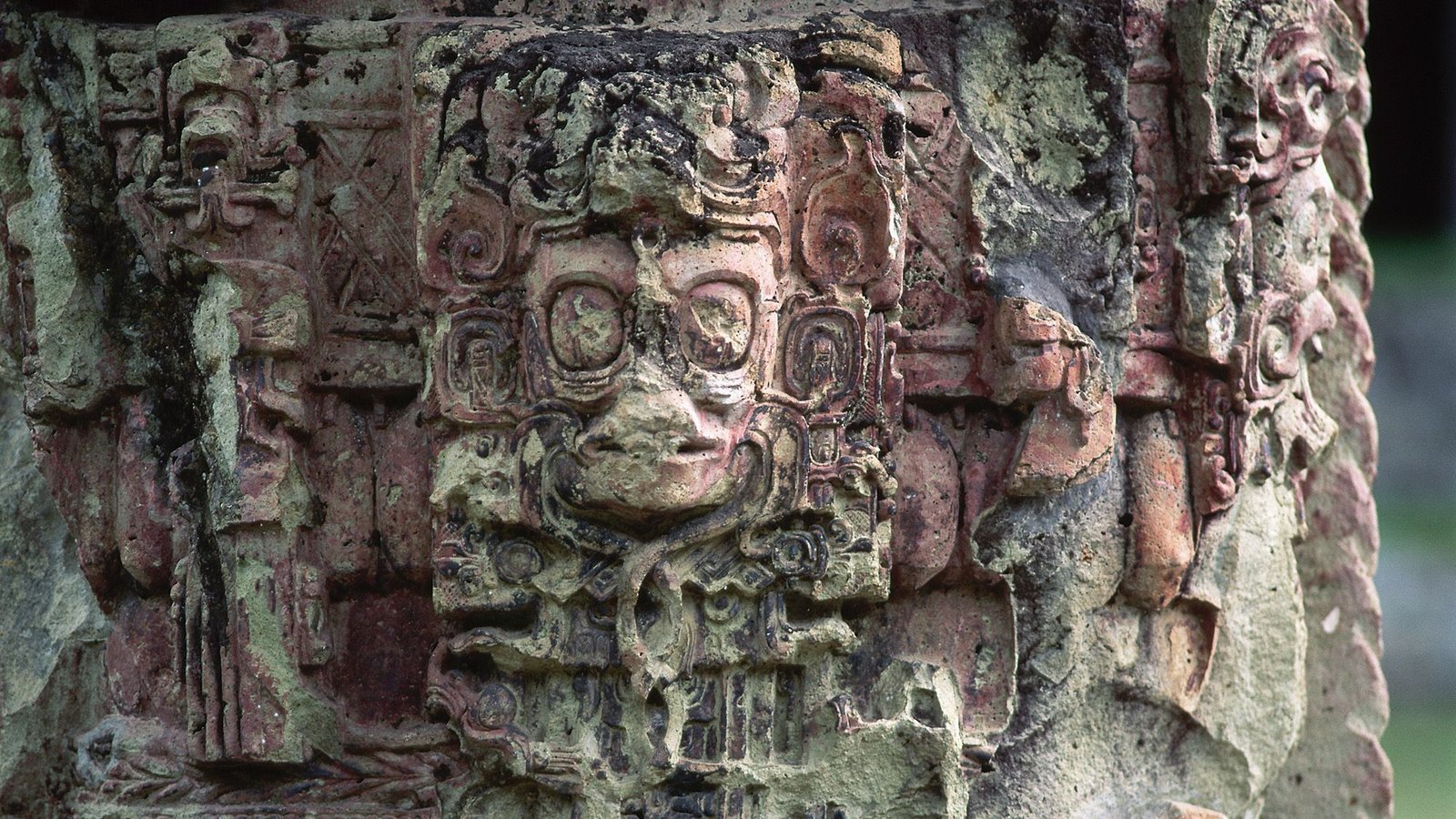
The reddish hue of the Maya sun god Kinich Ahau, made between the sixth and ninth centuries, now housed in Mexico’s National Museum of Anthropology, shows the Maya’s love for mercury.
(Image credit: DeAgostini/Getty Images)
The most polluted parts of the Yucatan cores had a mercury level of 2.3 parts per million, the team discovered. “They experienced this for decades and, in one case, for centuries,” Waters said.
The researchers then examined the sediment cores for signs of environmental damage caused by the mercury poisoning. They found that the cores lacked tiny fossils of freshwater shellfish, indicating that the high mercury levels were killing marine life. The team also noticed that the sediment cores had hardly any traces of algal blooms, which should have happened frequently, Waters said. That’s likely because algae could not survive in the poisoned water nutrients.
Maya collapse
Scholars debate why the Maya civilization collapsed in the eighth and ninth centuries, but a leading suspect is the disruption of food supplies caused by drought.
But although mercury levels were high during the Preclassic and Classic periods, the environmental damage caused by mercury levels had been falling in many places for hundreds of years by the time of the Maya collapse, Waters said, although it may have been a contributing factor.
Cinnabar does not occur naturally in the Yucatán, so it must have been imported there, probably from what’s now Honduras, the researchers said. It seems these cinnabar imports eventually stopped at Cobá Lake, and the poisoning there fell to a background level of about 20 parts per billion by A.D. 520. However, the sediment cores showed that the mercury poisoning continued at Cenote Xcach until the collapse, they said.
Waters, M. N., Wooten, S. L., Abrook, A. M., Brenner, M., Curtis, J. H., Langdon, P. G., Medina-Gonzalez, R. M., Paradeisis-Stathis, S., & Vachula, R. S. (2026). Toxic mercury, aquatic ecosystem collapse, and the ancient Lowland Maya. Science Advances, 12(45), eaeh3280. https://doi.org/10.1126/sciadv.aeh3280
What do you know about the civilization that built pyramids across Mesoamerica? Find out with our ancient Maya quiz.