
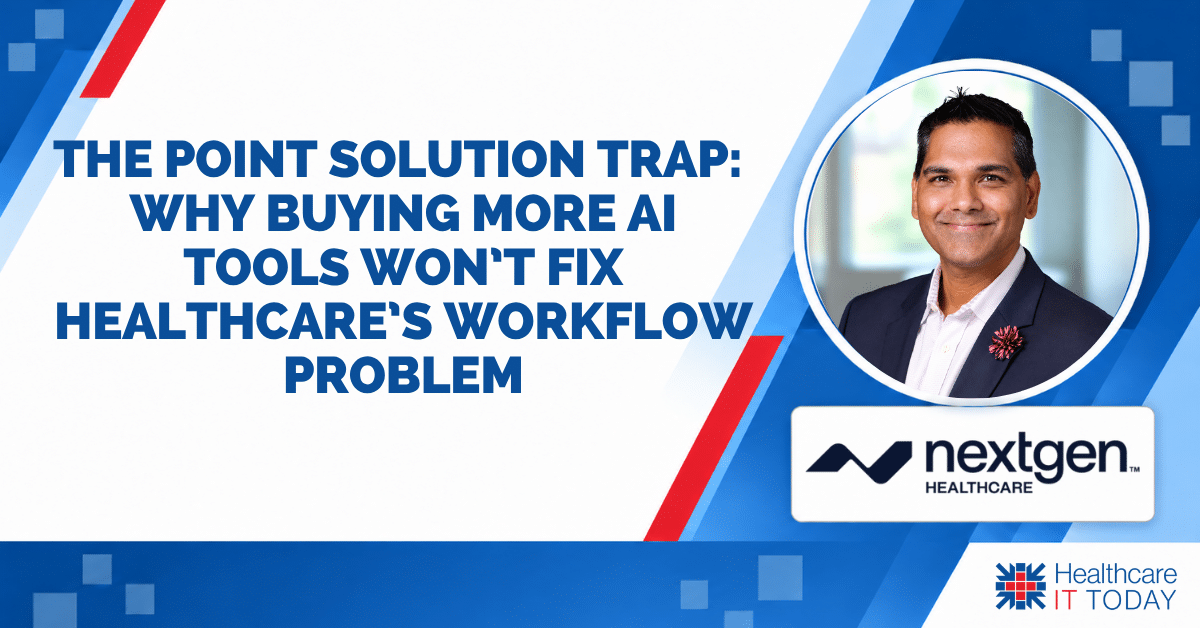
Healthcare IT leaders are drowning in point solutions. Over the past two years, practices bought AI scribes and other AI-powered widgets to “fix” pain points. While these tools offer quick relief, they are bandages over fundamentally broken workflows as recently shared by NextGen Healthcare’s newest executive.
Healthcare IT Today sat down with Gautam M. Shah, Chief Product and Strategy Officer at NextGen Healthcare, to discuss how the company is shifting its solution strategy. Shah made it clear that NextGen Healthcare is moving away from quick add-ons to rethink how technology supports end-to-end ambulatory care.
Here are three key shifts in NextGen’s strategy:
1. Stop bolting point solutions onto outdated workflows
Healthcare organizations spent millions over the last two years adding standalone software to their tech stacks. Shah views AI scribes as transformative for clinicians and patients, but cautions against using them as a template for fixing all of healthcare’s issues. In his experience, point solutions all too often simply speed up obsolete processes that were designed decades ago for a paper world.
“What did we do with the scribes? We bolted them on,” Shah said. “If every budget goes towards building out those types of point solutions, all we have done is taken these older workflows that were designed before we had this technology and spent a bunch of money. We built something in a way that no one would build today. As with many technology decisions, this made sense and was right for the time. But now we have the opportunity to step back and rethink the workflow.”
Shah pointed out that each extra tool also creates security, administrative, and clinical drag.
“Every time you have a point solution, you’re not just bringing in the solution itself,” Shah noted. “It also requires a new login, a new contract, a new interface, and a new set of credentials. All of this increases the cybersecurity attack surface.”
2. Measure technology by clinical capacity rather than vanity metrics
Digital health vendors often pitch their software by promising higher billing yields or immediate practice revenue. NextGen Healthcare is refocusing its product metrics around valuable clinical and operational outcome: creating capacity.
“You’ll sit with the CXOs and say, ‘Well, it’s revenue. It’s NPR. It’s EBITDA,’” Shah explained. “With our team I say – ‘It’s capacity that drives the clinical and financial outcomes.’ We are creating capacity.”
For Shah, “capacity” translates directly into expanding patient access and cutting administrative fatigue for staff.
“It is the capacity for patients to get care because the more efficient the practice is, the greater access they have,” Shah added. “The other piece is capacity for the provider. To go home and not spend an extra seven or eight hours a week charting.”
3. Convert the EHR from a filing cabinet into a system of context
Most EHR systems act as passive digital storage units that force clinicians to hunt for data during patient visits. NextGen Healthcare’s aim is to redesign the clinical interface so the system proactively gathers, synthesizes, and surfaces relevant patient history before the provider even steps into the room.
“The EHR should not be a mere system of record. It’s not a filing cabinet,” Shah said. “At its best, it is an intelligent system of context that surfaces information in the right way in the clinical encounter. It also surfaces information in the right way in the RCM workflow, and it helps make decisions by using that information to create context.”
Shah stressed that the system should do the preparatory work so providers can focus on patient care.
“Why aren’t we going to the clinician and saying, ‘You’re going to meet Colin in 15 minutes. Here is his last diagnosis, his last labs, everything you need to know,’” Shah stated. “Then the provider walks into the encounter and says, ‘Aha, Hi Colin, I know everything I need to know about you. What can we best spend our time together focusing on?’”
The Bottom Line
The next budget cycle will test whether healthcare IT leaders have learned the lesson of the scribe era. The question is no longer which AI tool to buy, it’s whether each dollar spent speeds up a workflow designed for paper or replaces it with one designed for how care is actually delivered today. Practices that redesign around capacity will see the gains compound: more patients seen, less after-hours charting, fewer disconnected systems to secure and support. Practices that keep bolting on point solutions will spend more and feel less of it. The trap isn’t the technology. It’s buying technology without rethinking the work.
Questions Healthcare IT Leaders are Asking
Why is bolting AI point solutions onto existing EHRs risky? Adding standalone AI tools often automates outdated, paper-era workflows rather than fixing underlying structural bottlenecks. Each disconnected tool also introduces separate logins, additional vendor contracts, workflow friction, and larger cybersecurity attack surfaces that threaten clinical operations.
How do capacity metrics differ from traditional health IT ROI? Traditional ROI metrics focus narrowly on short-term collections or billing volume. Capacity metrics measure whether technology frees up provider time, cuts after-hours charting, and opens clinic scheduling slots so more patients can receive timely care.
What does an intelligent system of context do differently than a standard EHR? A standard EHR forces clinicians to manually hunt through virtual filing cabinets of data during patient encounters. A system of context does the work upfront and automatically pulls together external records, recent labs, visit history, and relevant insights.
Get Fresh Healthcare & IT Stories Delivered Daily
Join thousands of your healthcare & HealthIT peers who subscribe to our daily newsletter.