

Korea is facing rapid population aging, rising healthcare costs and increasing pressure on hospitals. At the same time, the country has world-class physicians, advanced hospitals, strong digital infrastructure and significant government support for medical innovation. How do you see the role of medical technology companies in helping healthcare systems respond to these challenges?
Korea has many of the conditions required for medical technology to develop successfully. We have excellent physicians, advanced hospitals, strong government support and significant capabilities in areas such as artificial intelligence and manufacturing. This creates an environment where technologies and ideas developed in other industries can be adapted into healthcare to create new medical devices or improve existing ones.
At the same time, cost is extremely important. In Korea, because so much of healthcare is tied to the national insurance and reimbursement system, a new technology must demonstrate not only clinical benefit but also cost-effectiveness. Even if a technology performs very well clinically, it will be difficult to achieve broad adoption if it cannot show economic value.
For that reason, Korean medical-device companies are increasingly looking at the entire patient journey, from diagnosis to treatment, surgery, rehabilitation and follow-up care. The objective is to use technology and data to improve outcomes, reduce repeat hospital visits and ultimately lower the total cost of care. This is not unique to Korea. Major global medical-device companies are moving in the same direction, and Korean companies are also developing technologies with this broader ecosystem in mind, first proving their value in Korea and then expanding internationally.
Osteoarthritis and other age-related conditions are becoming increasingly common as populations live longer and demand a higher quality of life. What role can surgical robotics play in this environment?
Joint replacement is an elective procedure. As people live longer, become more financially secure and place greater importance on quality of life, demand for these procedures naturally increases.
The role of surgical robotics is to help improve the accuracy and consistency of surgery. Of course, robotic surgery itself is not necessarily cheaper at the point of treatment because hospitals must invest in expensive equipment. This is one reason why some physicians still question the economic value of robotics. However, the broader question is what happens after the surgery.
If greater accuracy can reduce complications, pain, repeat procedures or hospital revisits, then the total cost of treatment over time may decrease. That is where robotic surgery can potentially create economic value. Another important development is that surgical robotics is gradually becoming part of a wider healthcare-data ecosystem. Surgery should not be viewed as an isolated event. Patient information from diagnosis can be used for surgical planning, the procedure itself, rehabilitation and follow-up care. The industry is increasingly trying to connect these different stages around the surgical platform so that patient data can be used continuously throughout the treatment journey.
CUVIS-joint, CUREXO’s surgical robot for total knee arthroplasty, featuring 3D CT-based surgical planning and precise bone resection.
Robotic-assisted surgery has become increasingly common, while AI is now being introduced into surgical planning and decision-making. Which areas do you believe will benefit most from AI?
One of the biggest changes is simply that robots have become much more common. Twenty years ago, robotic surgery was considered something very special. A system could cost one or two million dollars, and the technology itself was unfamiliar to most hospitals. Today, robotics has become much more normal. As technology improves, components become cheaper and manufacturers continue working to reduce system costs, robots are increasingly seen simply as another clinical tool.
It is similar to automobiles. Driving a car is no longer considered something extraordinary. I believe robotics will increasingly develop in the same way. In terms of AI, the greatest immediate opportunity is patient-specific planning.
Orthopedic surgery involves many different surgical approaches and philosophies. Surgeons may prefer different alignment strategies or techniques depending on their own clinical experience. AI can use patient data together with the surgeon’s preferences to suggest an appropriate surgical plan in advance. This can significantly reduce the amount of time required for planning and decision-making.
Previously, surgeons relied primarily on experience. Later, systems began providing anatomical data and three-dimensional information. Now, with AI, the system can process that information more quickly and present a plan that reflects both the patient’s anatomy and the surgeon’s preferred approach. This can make the decision-making process much faster and more efficient.
There is considerable discussion today about generative AI, physical AI and autonomous surgery. How do you distinguish these concepts from the AI currently being used in medicine?
AI is a very broad concept, and I think it is important to distinguish between the different technologies. The AI that has traditionally been used in medicine is not the same as the generative AI that people commonly discuss today.
Medical AI has primarily been based on machine learning, particularly for image analysis. It can identify structures, interpret medical images and provide information that supports physicians in diagnosis or surgical planning. That is already widely used.
Physical AI is something different. It combines AI with physical movement so that a robotic system can perceive its environment, make decisions and act accordingly. This area is still largely experimental.
There are also two different forms of automation that should not be confused. One is physical AI-based automation. The other is conventional code-based automation, where the robot performs functions according to predetermined algorithms. CUREXO currently uses code-based automation. In our systems, the robot performs movements and functions that have been specifically programmed, tested and validated. We believe this approach provides a practical way to increase automation while maintaining predictability and safety.
How quickly do you believe fully autonomous surgical robotics will develop?
I believe it will develop much more slowly than many people currently expect. Medicine is very different from many other industries.
Every surgeon develops a personal surgical philosophy through many years of education and clinical experience. There are often several acceptable ways to perform the same procedure, depending on the physician’s training and judgment. That makes full automation much more complicated.
Regulation is another major factor. Highly autonomous AI systems can sometimes operate as black boxes, where it is difficult to explain precisely why a particular decision was made. In healthcare, regulators must be able to ensure patient safety. As new AI technologies develop, new regulations will also continue to emerge.
Before humanoid robots or fully autonomous physical AI systems can perform surgery independently, they will require extensive technical validation, clinical testing and regulatory approval. That process takes time. For these reasons, I expect automation in surgery to increase gradually rather than suddenly.
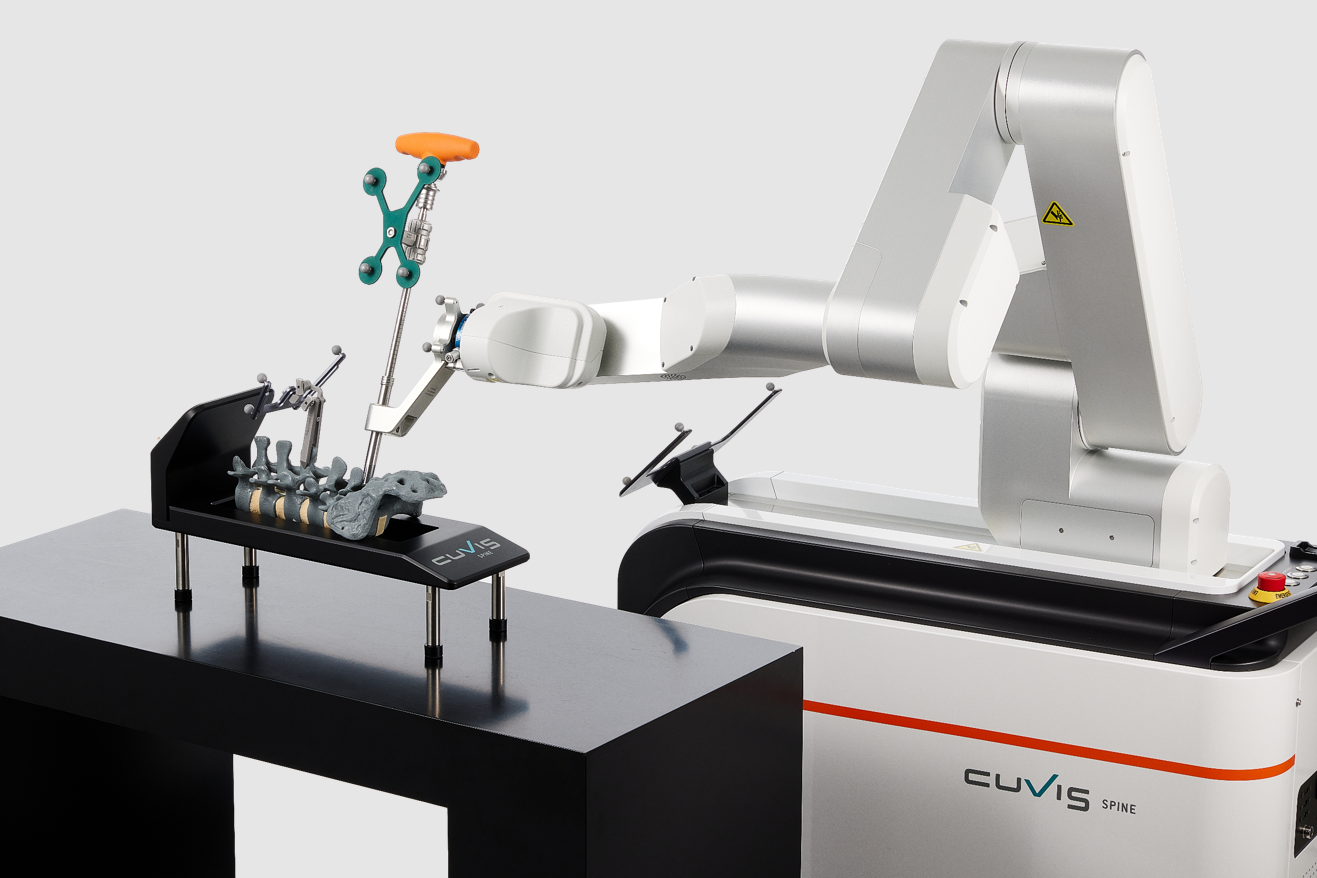
CUVIS-spine, CUREXO’s surgical robot for spine surgery.
Physical AI today relies heavily on cameras and visual information. How does this affect its application in different types of surgery, particularly compared with CUREXO’s orthopedic focus?
Companies such as NVIDIA are developing physical-AI technologies that allow robots to learn from visual information. A camera observes the environment, AI interprets what it sees and the robot learns how to translate that visual information into physical movement. This type of technology is naturally more applicable to surgical fields that already depend heavily on cameras.
Laparoscopic surgery is a good example. The surgeon performs the procedure while watching images from an endoscopic camera, so AI can potentially analyze those images continuously and support increasing levels of automation.
Our field is different. CUREXO primarily focuses on orthopedic procedures such as arthroplasty, which are generally open surgeries rather than camera-based minimally invasive procedures. That means the technical environment is different, and the same physical-AI solutions cannot simply be applied directly.
For orthopedic robotics, I therefore expect the development of physical AI to be somewhat slower and more conservative. However, we are already using automation, and we want to continue expanding it into new applications. For example, we currently use code-based automated robotic movement in knee surgery. In the future, we would like to apply similar automation technologies to other areas, including shoulder surgery.
Even the best technology will not succeed unless surgeons are willing to use it. How have attitudes toward robotic surgery changed during your career, and what has helped increase adoption?
I have been working in this field for more than 15 years. Around 2010, when I introduced robotic surgery to senior professors in Korea, some of them reacted very negatively. They would say, “Why should a surgeon use a robot? A surgeon should operate with his own hands.” At that time, this attitude was very common.
The biggest change since then has been the broader social environment. Robots and AI have become part of everyday life, so they are no longer perceived as something unusual or experimental. There has also been a generational change. Younger surgeons have grown up surrounded by technology, so they are generally more comfortable adopting new tools.
Of course, clinical evidence is still essential. We also need to educate physicians. We provide educational materials, dry-run demonstrations, cadaver training and opportunities for surgeons to observe procedures at hospitals where our systems are already being used. Adoption requires much more than simply selling a product. It requires education, evidence, practical experience and trust.
Looking back at CUREXO’s history, what was the most important turning point in the company’s transformation?
The most important turning point was 2017. CUREXO had been involved in medical robotics since 2006, but for many years we were essentially an investment company.
We invested in a US medical-robotics company, which was originally Curexo Technology Corporation and later became THINK Surgical. However, the management team was based in the United States, and we were not the controlling shareholder. That meant we could not always develop technology according to our own priorities.
In 2017, we acquired Hyundai Heavy Industries’ medical-robotics R&D organization. Hyundai Heavy Industries was widely known for shipbuilding, engines and industrial robotics, but it had also established a dedicated medical-robotics research group. By acquiring that organization, we gained something more important than the technology itself: we gained the ability to determine our own direction.
From that point, we could decide what we wanted to develop, establish our own R&D priorities and create products according to our own strategy. The acquisition process was completed around 2018, and we also raised additional capital during that period. That was when CUREXO truly transformed from an investment-oriented company into a medical-robotics R&D and commercialization company.
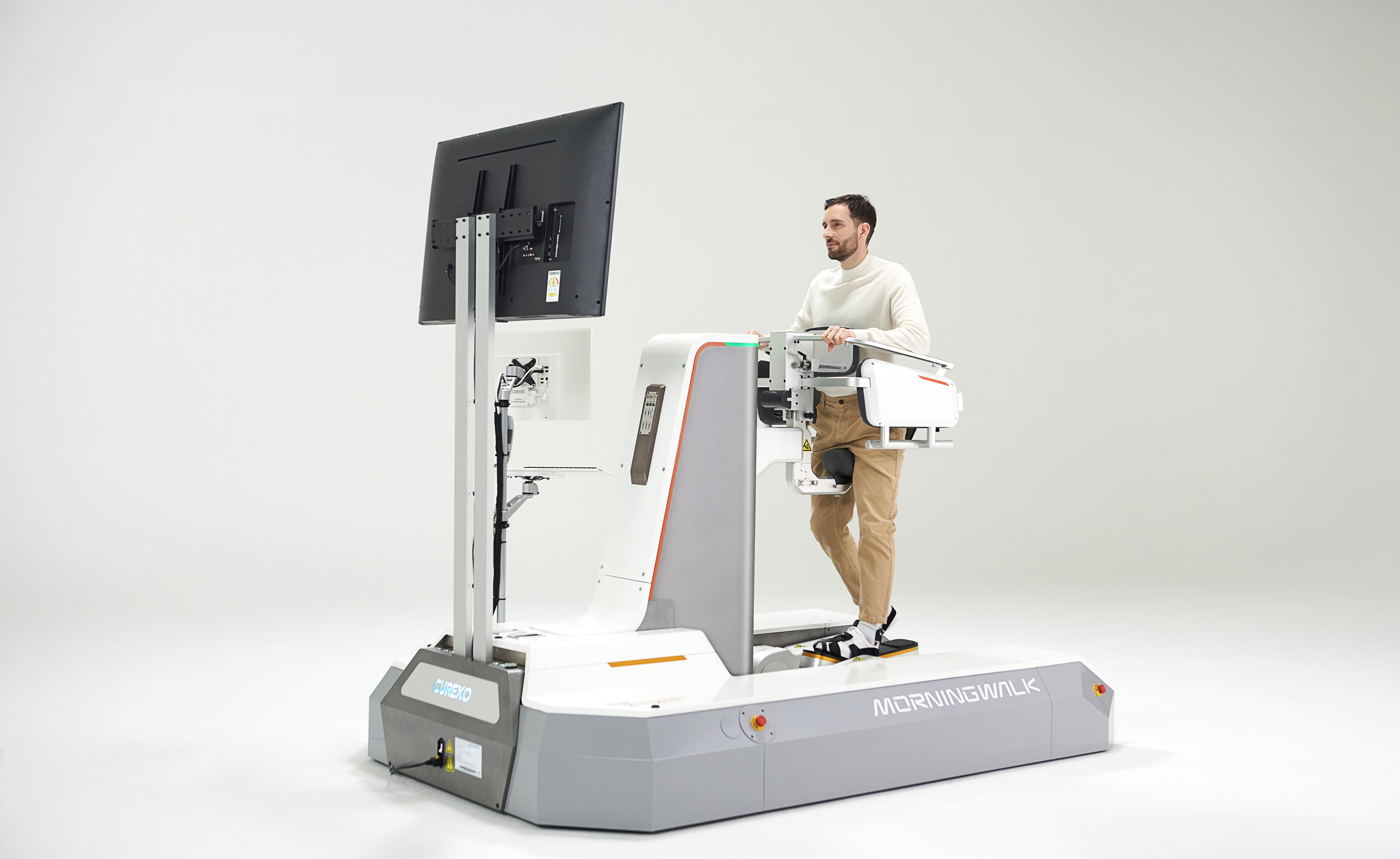
Morning Walk, CUREXO’s rehabilitation robot designed to support gait training and rehabilitation.
Today your portfolio includes CUVIS-joint, CUVIS-spine and Morning Walk. How are these platforms evolving, and why is continued platform development important?
Continuous platform development is essential because robotics technology changes very quickly. CUVIS-spine was one of the original platforms, and from there we expanded into other surgical robotics applications such as CUVIS-joint.
Morning Walk also came from the Hyundai technology we acquired. After the acquisition, we developed the second generation, and we are now working on the third generation.
At the same time, the technologies underlying these systems continue to evolve. Since 2017, control technologies, communication systems, processors and software-development methods have all changed significantly. Customers also expect more functionality and better performance at a lower cost.
If we simply continue using older platforms, eventually they become difficult to maintain and difficult for younger engineers to work with. So there are two objectives. The first is to develop more advanced versions of the platforms we already have. The second is to create new platforms that allow us to enter entirely new application areas.
Platform development is therefore not only about upgrading existing products. It is also about preparing the technological foundation for future applications.
Korea has excellent hospitals and physicians, but it is still a relatively small domestic market. Why has international expansion been so important for CUREXO?
For a Korean surgical-robot company, relying only on the domestic market is not sustainable. Surgical robotics requires enormous investment in R&D, but Korea’s market is relatively small.
This is particularly challenging because a surgical robot is capital equipment. A hospital purchases the system and uses it for many years. Products that generate recurring reimbursement revenue can operate differently, but with capital equipment, the number of potential customers is naturally limited.
The same issue exists in rehabilitation robotics. Even if the product performs well, the domestic market can become saturated relatively quickly. Therefore, for us, overseas expansion is essential.
When we first began expanding internationally, we focused on markets where regulatory approval could be obtained relatively quickly. We entered India first, followed by Southeast Asia. We also entered Russia and later Japan.
Markets such as Japan, Europe and the United States require much longer approval processes, so our strategy was to begin commercialization in markets where approval was faster while simultaneously preparing for the larger developed markets. Now that we have received approvals in Europe and the United States, our focus is naturally shifting toward those markets.
Regulatory approval for medical robots can take several years. What have you learned from pursuing approvals in Japan, Europe and the United States?
The regulatory process is extremely demanding. Japan took approximately two years. The FDA process took around three years, and the European MDR process also required several years.
The challenge is that the product itself does not stop developing while the regulator is reviewing the application. You submit a particular version of the product, but during the following years you continue fixing bugs, improving software, adding functions and responding to customer feedback.
By the time approval is granted, the commercial version of the product may already be significantly more advanced than the version originally submitted. That means additional submissions are required to close the gap.
Even after approval, regulatory work continues because meaningful product changes and software updates may require further review. The situation can also change depending on the commercial partner and the way the product is introduced into a particular market.
The first approval is usually the most difficult because there is no regulatory precedent. Once that history has been established, later submissions can sometimes proceed more efficiently. But regulatory work never truly ends.
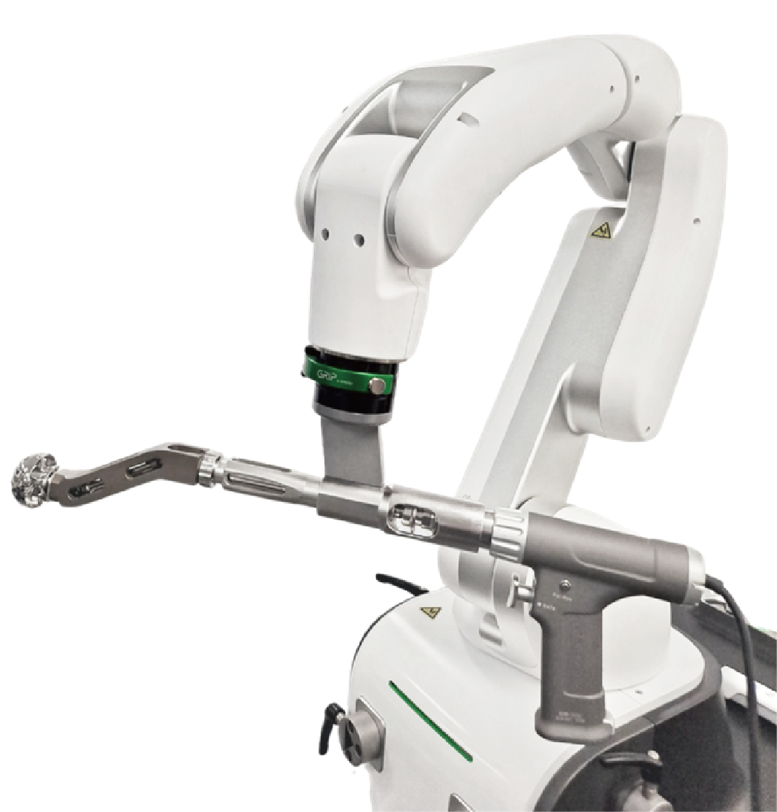
CUVIS-Joint THA robotic system for total hip arthroplasty.
Which international markets are your highest priorities today?
Our newest priority regions are Latin America, Europe and North America. In Latin America, we have already been building the market for some time and are establishing the necessary structure.
In Europe, Southern Europe is relatively advanced. We have already been active in Italy and Spain. Our teams have participated in conferences and live surgeries, and we are now also working to develop distributor and partnership networks in France.
In North America, we are currently discussing opportunities with potential partners. These markets represent the next major stage of our global expansion.
What type of partner are you looking for when entering a new market?
For our business, partnerships are essential. Our type of surgical robotics is what we call an enabling technology. The robot supports another medical device, such as an orthopedic implant. Because of that, we naturally work with companies that are already part of that ecosystem.
Our partners are often implant manufacturers themselves or distributors that already represent implant companies. We do not generally build large direct overseas sales organizations.
Even in India, where we have a subsidiary, the subsidiary’s main role is not direct sales. Its primary role is field service and support. Our local partners handle sales, while CUREXO provides clinical support, technical support and field service. This is also the model we are considering in the United States, where we are looking for appropriate implant-industry partners.
Why is the partner model particularly important in surgical robotics?
Surgical robotics is very different from selling many other medical devices. For example, with an ultrasound system, an aesthetic device or a laser system, a company can often sign a distributor and focus primarily on selling the product.
Surgical robotics requires a much longer process. You need to introduce the technology to key opinion leaders, participate in conferences, conduct demonstrations, provide cadaver-lab training and dry runs, install systems in hospitals and then support the generation of clinical evidence.
All of this takes significant time and resources. If we attempted to build all of that infrastructure ourselves in every country, the cost would be extremely high. That is why our main sales strategy is to work with strong local partners that already understand the medical ecosystem.
In a market dominated by much larger global players, how does CUREXO differentiate itself?
For CUVIS-joint, one of our most important differentiators is that we use an active robotic system. The robot performs automated bone resection according to the surgical plan. That gives us a clear technological distinction compared with systems that rely more heavily on manual surgeon control.
We want to continue building on this automation capability and applying it to additional applications. The second major point is affordability. Price competitiveness is extremely important.
We continuously work to reduce costs through design, engineering and manufacturing while maintaining the required quality. So I would describe our differentiation around two main ideas: active robotic technology and affordability.
Of course, continuous technological development is also fundamental. We want to introduce new technologies quickly, improve usability and respond rapidly when users provide feedback. If physicians identify an issue or suggest an improvement, we want to reflect that in the product as quickly as possible.
Korea is often associated with a “ppalli-ppalli,” or fast-moving, culture. Do you believe this gives Korean technology companies a competitive advantage?
I think it has been an important factor in Korea’s industrial development. When we work with European or American companies, we often notice that decision-making can take much longer. Korean companies are generally accustomed to responding and executing more quickly.
China also moves very quickly, and more recently India has shown similar characteristics in areas such as IT and technology. Speed alone is not enough, of course. In medical technology, you cannot sacrifice quality, clinical evidence or regulatory compliance simply to move faster.
But once those requirements are understood, the ability to make decisions quickly, respond to customer feedback and implement improvements rapidly can become a real advantage. That is something we try to reflect in our own development process.
Looking ahead over the next five years, what is your vision for CUREXO?
When we began building the company around 2017, our objective was to become a genuinely commercial surgical-robotics company. At that time, Korea had several surgical-robotics companies, but many were primarily R&D organizations supported by government projects. Commercialization was limited, and in many cases the products had not been designed from the beginning with commercialization as the objective.
Our goal was different. We wanted to build a company whose core business was actually selling and supporting surgical robots. I believe we have now achieved that first objective.
Looking ahead, our next goal is scale. In Korea, there are still very few service-robot companies that have generated KRW 100 billion in annual robot revenue. For us, reaching that level is an important long-term objective.
Surgical robotics is a difficult business, and survival matters. Once a company reaches a certain level of sustainable revenue, the business becomes much more stable. So our ambition is to continue growing until CUREXO becomes a company capable of generating around KRW 100 billion in annual robot revenue.
For more information, check their website: https://www.curexo.com/eng/