
Korea is entering a period of profound demographic change as the population ages and the number of older patients requiring medical care continues to increase. This transition will place greater pressure on a healthcare system that must manage more patients, control overall medical expenditure and provide access to increasingly sophisticated treatments. How do you see the role of medical technology and healthcare companies changing in response to these demographic pressures?
Korea has had a very strong healthcare system in many respects, particularly through its national health insurance system. Until now, that system has served as an important first line of protection for the population. However, as demographic pressures continue to increase, we are approaching a period in which the public health insurance system alone may no longer be sufficient to absorb all of the healthcare demands created by an aging society.
Under these circumstances, I think the role of medical and healthcare technology companies can broadly be considered in several areas.
The first responsibility is to address high-prevalence diseases while reducing the overall cost of treatment. For these conditions, companies need to find ways to reduce the production costs of existing medicines, medical devices and therapeutic approaches. This does not necessarily mean that every solution must come from an entirely new treatment. There is also considerable value in innovating manufacturing processes so that existing medical products and treatments can be produced more efficiently and supplied at a lower cost. If companies can achieve that, they can contribute directly to reducing the overall financial burden on the healthcare system.
The second area involves advanced and more expensive therapies. As people live longer, the objective of healthcare will increasingly move beyond simply extending lifespan. Research and product development will need to focus much more on well aging and slow aging, as well as on extending healthy life expectancy. In other words, what becomes important is not simply how many years a person lives, but how many of those years can be lived in good health.
The third area is cancer. As overall life expectancy increases, the expected lifespan of cancer patients can also increase. This creates another important responsibility for the medical industry. We need greater efforts to prevent cancer recurrence, but we also need therapies that can help people who have experienced cancer live the remainder of their expected lifespan in a healthier condition.
Ultimately, the role of medical companies in an aging society will become broader. We need to make frequently used treatments more economically sustainable, develop advanced therapies that support healthy aging and address the needs of patients who may live for many years after serious illnesses such as cancer.
Within this changing healthcare environment, regenerative medicine appears to be one area in which Korea has developed particularly meaningful capabilities. Where do you believe Korea has its strongest opportunity to compete globally in regenerative medicine, and what gives the country a sustainable advantage?
I believe the area in which Korea can make a particularly meaningful contribution to global regenerative medicine is cell therapy.
When we look at conventional chemical drugs or other areas involving technologies such as antibodies and peptides, the scientific infrastructure that a society has accumulated over time is extremely important. The same is true of accumulated scientific knowledge and the history of research in those fields. In those more established pharmaceutical areas, it is true that Korea has historically been behind advanced markets such as Europe, the United States and Japan.
Cell therapy is different. In the field of cell therapy, Korea did not begin significantly later than the leading countries. The difference between Korea’s starting point and that of advanced markets was relatively small. Because of that, Korea was able to develop its capabilities at a similar stage in the evolution of the technology and has remained within the leading group internationally.
There is also a somewhat ironic element in the history of stem cell research in Korea. The controversy surrounding Professor Hwang Woo Suk ultimately remained a serious scientific blemish in Korean scientific history. Nevertheless, that period generated extraordinary academic and public interest in stem cell research. As public attention became concentrated on the field, government research funding was also directed intensively toward cell therapy and stem cell research.
More importantly, a large number of very talented researchers entered the cell therapy field during that period. That became an extremely valuable asset for Korea. Research funding is important, and accumulated scientific knowledge is important, but ultimately a field also depends on the quality of the people conducting the research. Korea developed a substantial pool of highly capable researchers with experience in cell therapy, and that human capital continues to be one of the country’s major strengths.
Another important point is manufacturing. Compared with some other areas of advanced medicine, cell therapy still relies heavily on human skill in process work and quality control. It cannot yet be fully automated. Through our own efforts to enter the U.S. market, we worked with several leading local CDMOs, and we saw very clearly how important the human factor is. In our experience, Korean production personnel had extremely strong hands-on technical capabilities. I believe that will remain an important competitive factor for Korea in cell therapy and advanced regenerative medicine.
Osteoarthritis provides a clear example of why regenerative medicine is becoming increasingly relevant in an aging society. As average life expectancy increases, obesity becomes more prevalent, and patients expect to remain active for longer, how are expectations among patients and physicians changing?
As you mentioned, average life expectancy is increasing, but another important development is that the age at which osteoarthritis begins is becoming younger. At the same time, increasing levels of obesity within the population are contributing to a rise in the prevalence of osteoarthritis. When these factors are combined with longer average life expectancy, osteoarthritis becomes an increasingly serious burden.
In the past, artificial joint replacement surgery was regarded as the final and most definitive treatment for osteoarthritis. Once the disease had progressed sufficiently, joint replacement was essentially the ultimate solution. Historically, the period between the initial onset of osteoarthritis and the point at which a patient eventually received artificial joint replacement surgery was relatively short. Today, that period is becoming progressively longer.
There are several reasons for this. People simply live longer, but they also have different expectations about how they want to live during those additional years. Even at older ages, people increasingly want to exercise, participate in activities and maintain an active lifestyle. They want to preserve their own knees and their natural joints for as long as possible.
That creates a therapeutic need that was not as significant in the past. Patients increasingly want treatments that can help them preserve their own joints while extending the period during which they can live without significant symptoms before eventually requiring artificial joint replacement surgery. This is why simply administering pain medication or temporarily relieving symptoms is becoming insufficient.
What is increasingly needed are treatments that can slow or inhibit disease progression or, if possible, reverse at least some aspects of the disease process. In other words, there is growing demand for disease-modifying osteoarthritis therapies. This is one of the reasons regenerative medicine is attracting such significant attention. Among the approaches being considered, cell therapy and gene therapy are emerging as important candidates because they represent regenerative strategies that may potentially address more than symptoms alone.
Within cell therapy, one of the fundamental distinctions is between autologous treatment, which uses cells obtained from the individual patient, and allogeneic treatment, which uses donor-derived cells that can be manufactured and prepared in advance. From both a pharmaceutical and industrial perspective, what are the principal advantages of allogeneic cell therapy?
I think one of the most important characteristics of allogeneic therapy is that it corresponds very closely with the fundamental principles of pharmaceutical manufacturing.
The basic principle behind manufacturing a pharmaceutical product is that you produce the product in advance, conduct appropriate quality control and then identify and use the products that satisfy established standards. Allogeneic cell therapy can operate according to that principle.
This becomes particularly important when we compare it with autologous therapy, where cells are obtained directly from the individual patient. Cells have biological variability. There can be differences from batch to batch, differences from person to person and differences related to genetic variability. With autologous therapy, if the cells collected from a particular patient do not completely satisfy an ideal standard, there may be very limited alternatives because the treatment depends on material obtained from that individual.
Allogeneic therapy provides a different possibility. Cells can be obtained from multiple sources and manufactured in advance. Once they have been produced, they can undergo evaluation and quality control. Products that satisfy the appropriate predefined standards can then be selected for therapeutic use.
There is also a very important industrial advantage, which is the ability to manufacture products in advance. If a patient needs an allogeneic treatment, the product can potentially already be available. This is the major advantage of what we call an off-the-shelf approach.
Quality control provides another significant advantage. With an allogeneic therapy, a single manufacturing lot can potentially produce enough medicine to treat a large number of patients. Quality control can therefore be performed on that lot, while the resulting qualified products can subsequently be used for multiple patients. With autologous treatments, manufacturing and quality control must effectively be repeated for each individual patient.
For that reason, I believe allogeneic therapy has substantial advantages from an industrial perspective, particularly in manufacturing, quality control, availability and cost structure.
|

|
The scientific development of regenerative medicine is advancing rapidly, but regulation will ultimately play an equally important role in determining how efficiently these therapies can be developed and made available to patients. From an industry perspective, is the central regulatory challenge today the level of regulation itself, or the absence of greater international harmonization?
Internationally, we are already seeing significant movement toward policies intended to accelerate the development of regenerative medicine. In the United States, for example, there are regulatory systems designed to support advanced regenerative therapies, and Japan has also introduced systems intended to promote regenerative medicine. Korea has moved in the same direction, and legislation related to advanced regenerative medicine has also been revised in Korea.
However, from a regulatory perspective, I believe there is an additional issue that needs to be addressed at the global level. What is still lacking is sufficient international harmonization.
It is positive that individual countries are introducing regulatory reforms and developing standards intended to facilitate advanced regenerative medicine. The difficulty arises when each country develops different policies, standards and guidelines. For a company developing advanced regenerative medicine products for a global market, that creates a significant problem because it reduces predictability.
A company needs to understand what will be required during the development process. If one country’s regulatory framework requires a particular standard or type of evidence while another country’s framework has different requirements, it becomes much more difficult to design a development program that can efficiently support multiple markets.
In conventional pharmaceuticals, international efforts have already been made to harmonize regulatory standards. I believe advanced regenerative medicine needs a similar approach. Rather than having the United States, Japan, the European Union and Korea all move independently with entirely separate rules, regulatory authorities from these major markets should come together and work toward greater harmonization of the standards governing advanced regenerative medicine.
Therefore, I do not think the issue is simply whether regulation should be stronger or weaker. The lack of harmonization between regulatory systems is itself a major challenge. Greater cooperation among regulatory authorities could create a much clearer environment for companies and ultimately help support the development of advanced regenerative medicine internationally.
Regulatory approval alone does not guarantee adoption. Advanced therapies must also demonstrate value, secure reimbursement and fit clinical practice. What are the biggest barriers to wider adoption of regenerative treatments today?
There are many barriers, and it is difficult to say that only one is the most important. Manufacturing and supply costs for advanced regenerative medicines are inevitably higher than for many existing chemical drugs or conventional treatments. This creates an important access challenge for patients.
Reimbursement is another major issue. In many countries, reimbursement systems are not yet fully prepared for advanced regenerative medicine. In developed markets such as Korea, Japan and the United States, even if a therapy is clinically meaningful, it also needs to demonstrate economic value before reimbursement can become easier.
Physician adoption is also important. Doctors are often conservative, and they naturally tend to prefer the medicines or treatment methods they have used for a long time. When a new advanced therapy emerges, many physicians may hesitate to use it widely until enough clinical evidence and real-world experience have accumulated.
The relative importance of these barriers differs by country. In developing countries, the high price of regenerative medicine can be the largest obstacle because it directly affects patient accessibility. In advanced countries, reimbursement, regulation and conservative physician attitudes can all become major challenges.
For companies like ours, this means that approval alone is not enough. We need to build evidence, demonstrate economic value, educate physicians and establish systems that allow patients to actually access the treatment.
For MEDIPOST specifically, how do you approach physician education and build confidence among doctors and medical professionals?
Ultimately, the most important tool for persuading or educating doctors is academic evidence.
Physicians need peer-reviewed papers. Those papers may include clinical trial results, evidence related to mechanism of action and data from actual clinical use. When evidence has gone through peer review and is presented in a scientific form, it becomes much more persuasive for doctors.
This is particularly important in a field such as regenerative medicine, where doctors may have conservative views or may not yet be familiar with a new treatment. Strong academic publications are essential for changing perceptions and building confidence.
Having joined MEDIPOST in 2004 and become CEO in 2022, you have seen the company evolve from cord-blood banking into a broader regenerative medicine business. What have been the defining moments in MEDIPOST’s transformation, and how have they shaped your vision as CEO?
When I look back, the most important turning point for MEDIPOST was when we expanded from cord-blood banking into stem cell therapy R&D. That decision shaped the destiny of the company and led to what MEDIPOST is today.
The most memorable and decisive moment for me personally was in 2012, when CARTISTEM®, the product whose research and development I had led, completed clinical trials and received product approval in Korea. It was the world’s first approved allogeneic stem cell therapy, and that moment represented a major turning point for our company.
For me personally, it was also the moment when a dream became reality. I often tell our employees, “If you can dream it, you can do it.” My own dream had been to see stem cells recognized as real medicine and to provide new treatment opportunities to patients. CARTISTEM®’s approval in 2012 was the first time that dream became real.
Before that time, stem cell therapy had received a lot of academic attention, but it was still often regarded as a kind of alternative medicine or something closer to science fiction that might only become possible in the distant future. The approval of CARTISTEM® showed that stem cells could actually be recognized and used as a medicine.
For MEDIPOST, this was extremely important because it demonstrated the industrial value of cell therapy within advanced regenerative medicine. CARTISTEM® became a model showing that stem cell regenerative medicine could become a real part of the pharmaceutical industry, not just a research concept.
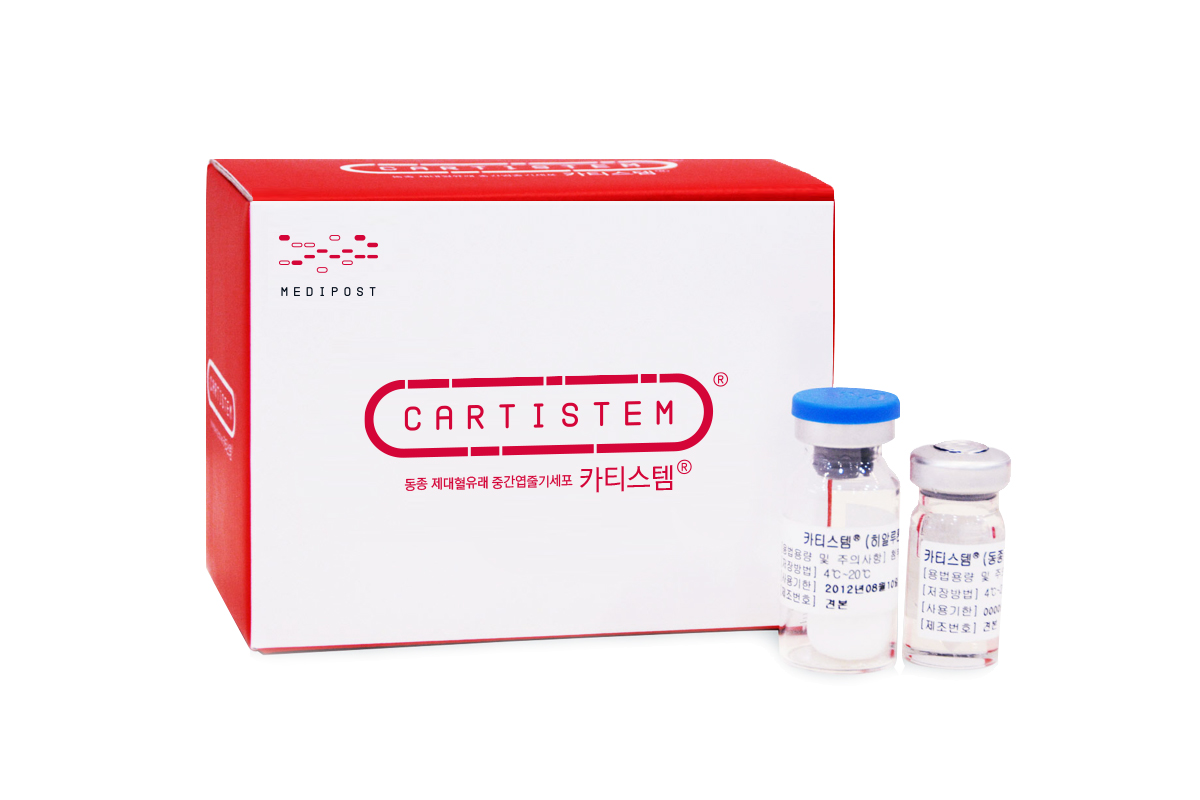
Since its approval in Korea in 2012, CARTISTEM® has been used in tens of thousands of patients. What most differentiates CARTISTEM® from competing osteoarthritis and cartilage-repair treatments, and what has MEDIPOST learned from its long-term use in Korea?
The most important point is that CARTISTEM® can regenerate hyaline cartilage, which is the type of cartilage closest to the original cartilage structure of the knee joint.
Existing approaches such as autologous chondrocyte implantation, including products such as MACI or JACC, can be described as repair rather than true regeneration. The cartilage tissue produced in those approaches is often closer to fibrous cartilage.
Fibrous cartilage can be weaker and may be more vulnerable to breakdown or recurrent damage. CARTISTEM® is differentiated because it aims to regenerate hyaline-like cartilage, which is much closer to the biological cartilage in the joint.
The second differentiating factor is the source of the cells. CARTISTEM® uses stem cells derived from umbilical cord blood from healthy newborns. As people live, their cells can be affected by external environmental factors such as radiation, viral infection and air pollution, all of which can contribute to genetic changes. Umbilical cord blood-derived stem cells come from healthy newborns, so they are more primitive, less affected by those external factors and have strong stem cell performance.
The third differentiating factor is experience. Cell therapy and advanced regenerative medicine cannot be mastered through a short period of experience. MEDIPOST has accumulated more than 20 years of experience from development through manufacturing, quality control, transport and supply. Since its launch in 2012, CARTISTEM® has also been used in tens of thousands of patients, allowing us to build long-term confidence in its efficacy, safety and consistency.
From its broad real-world use in Korea, we have learned many things. Of course, the most important lessons relate to long-term efficacy and safety. But we also learned that transport and supply systems, reimbursement and cost reduction are all extremely important for market expansion.
Osteoarthritis is a complex market. It includes everything from low-cost painkillers and medical devices to expensive treatments and surgical approaches. Although patient choice is very important, CARTISTEM® is a prescription medicine, which means that direct advertising to patients is limited. That has shown us how important it is to build trust through physicians, clinical evidence and appropriate education.
CARTISTEM® has completed its Phase III program in Japan and its U.S. Phase III trial is now underway. Which international markets represent the greatest commercial opportunities for CARTISTEM® over the next five to ten years?
For us, the most important markets over the next five to ten years are the United States and Japan. In fact, they will probably remain our most important markets beyond that period as well.
The United States is the largest pharmaceutical market in the world, and for CARTISTEM® we also expect it to become the largest market. The prevalence of osteoarthritis is high in the United States, partly because of factors such as obesity, and there is also a large population with the economic capacity to access advanced regenerative treatments.
Japan is also an extremely important market. It is one of the largest pharmaceutical markets globally, and in osteoarthritis specifically it has very strong market potential. Japan has one of the longest average life expectancies in the world. It also has cultural and lifestyle factors, including floor-sitting habits and agricultural work, that can increase the burden on the knees. As a result, Japan has a large number of patients with symptomatic knee osteoarthritis.
These two markets are important not only because of patient numbers, but also because they have healthcare systems and patient populations that can potentially support high-value regenerative medicines. Therefore, we believe the United States and Japan will be the key markets for CARTISTEM®’s global commercialization.
In these markets, will MEDIPOST continue to expand through partners such as Teikoku Seiyaku and OmniaBio, or do you also plan to build direct relationships with hospitals, surgeons and medical practitioners?
We are preparing several approaches.
In Korea, we have accumulated extensive experience through our own sales activities and direct communication with doctors and surgeons. Based on that experience, we believe that MEDIPOST has the capability to conduct direct sales activities in major overseas markets as well.
However, in very large markets such as the United States and Japan, there are clear limitations in terms of the time and cost required to build a sales organization capable of covering wide geographic areas and reaching large numbers of physicians directly within a short period of time.
Therefore, as we have done in Japan through our agreement with Teikoku Seiyaku, our priority strategy is to pursue commercialization through strong local pharmaceutical partners that already have established sales organizations and market access capabilities.
At the same time, our partnering strategy is not limited only to sales rights. We remain open to broader licensing and partnership structures. We are currently holding business development discussions with potential partners in several major markets, including the United States and China.
Looking at the United States, Japan and Canada together, how do these three overseas bases support CARTISTEM®’s global commercialization and commercial-scale supply?
Each base has a distinct role within our global strategy.
MEDIPOST USA (Medipost Inc.) and MEDIPOST Japan (MEDIPOST K.K.) will each serve as local entities that hold, or support, Marketing Authorization Holder (MAH) responsibilities in their respective markets. They are important for regulatory approval, clinical development and future commercialization in the United States and Japan.
OmniaBio in Canada will serve as the production hub for CARTISTEM®. Its role is to support supply not only for North America, but also potentially for Central and South America, Europe and other regions.
MEDIPOST Korea will act as the coordinating headquarters. Our role in Korea will be to harmonize and coordinate the activities of the U.S., Japanese and Canadian bases so that clinical development, approval, manufacturing and commercial supply can be connected as part of one global strategy.
Regenerative medicine is also moving beyond what could be considered the first generation of cell therapy. Looking at the next stage of the field, what technological developments do you believe will define the future of cell therapy and regenerative medicine?
I think there are two important directions that we need to pursue.
The first concerns the evolution of the cells themselves and the way we develop cell therapies. Until now, what we could describe as the first generation of cell therapies has largely focused on the cells themselves. These therapies generally involved relatively conventional cells or cells that had undergone a certain degree of priming during the manufacturing process.
Going forward, however, I believe we will need additional methods that can further activate or enhance the function of those cells. Rather than simply culturing cells and administering them, the next stage will involve finding ways to increase their therapeutic capabilities. This could include different methods of modifying cellular function and technologies involving the introduction of genetic elements into cells.
The second important direction concerns accessibility and the way these treatments are administered to patients. When patients receive cell therapy, we should try to make that treatment experience less invasive and more convenient. If regenerative medicine is going to develop further, we need to consider not only whether a therapy works, but also how it is delivered.
One possibility is that we may not always need to administer the cells themselves. Cells produce therapeutic effects through various factors. During the cell culture process, for example, cells release different substances into the surrounding culture environment. If we can identify and extract the factors responsible for those therapeutic effects, it may be possible to develop treatments based on those components.
There are already various approaches being investigated in this area, including exosomes. If those substances can be developed into forms that are easier to administer, such as fluid-based treatments or products involving exosomes, it could potentially allow some regenerative treatments to be delivered in a much less invasive manner than administering the cells themselves.
Both directions will be important as regenerative medicine progresses beyond its first generation: making cell therapy itself more advanced, and improving how regenerative therapies reach the patient.

You spoke about CARTISTEM®’s approval in 2012 as the moment when your dream became real. Looking approximately five years ahead, what is your dream and ultimate ambition for MEDIPOST?
Our ultimate objective is to establish an integrated regenerative medicine platform.
MEDIPOST began with umbilical cord blood banking. That represents the starting point of our company and our involvement in this field. From there, we expanded our activities and developed a stem cell therapy pipeline, including CARTISTEM® and other regenerative medicine programs.
We are now broadening that perspective further. As society ages, there is increasing interest in longevity and in approaches associated with healthy aging and slow aging. In response to that change, we have established research activities focused on anti-aging and slow-aging areas.
In addition, since last year, we have begun a business involving the storage of patients’ adipose cells and immune cells so that those biological resources can potentially be available for regenerative treatment at a later stage.
When you look at these businesses individually, they may appear to address different stages or different needs. However, our intention is to bring them together within a broader concept. The overall vision is to create a platform capable of providing regenerative medicine in an integrated way throughout the human life cycle.
Our origins in umbilical cord blood banking, our stem cell therapy pipeline, our work related to aging and longevity, and our newer activities involving the storage of cells for potential future regenerative applications can all become components of that broader platform.
Rather than viewing regenerative medicine only as a treatment that a patient receives after a particular disease develops, we are looking at how regenerative medicine can potentially be connected to different stages of an individual’s life. That is the direction in which we want to position MEDIPOST.
Over approximately the next five years, we expect these individual businesses to become more firmly established. As they develop, we hope to build the system that connects them more comprehensively. Ultimately, our goal is for MEDIPOST to become an integrated regenerative medicine platform company capable of addressing regenerative healthcare across the human life cycle.
For more information, please check out their website: https://en.medi-post.co.kr/