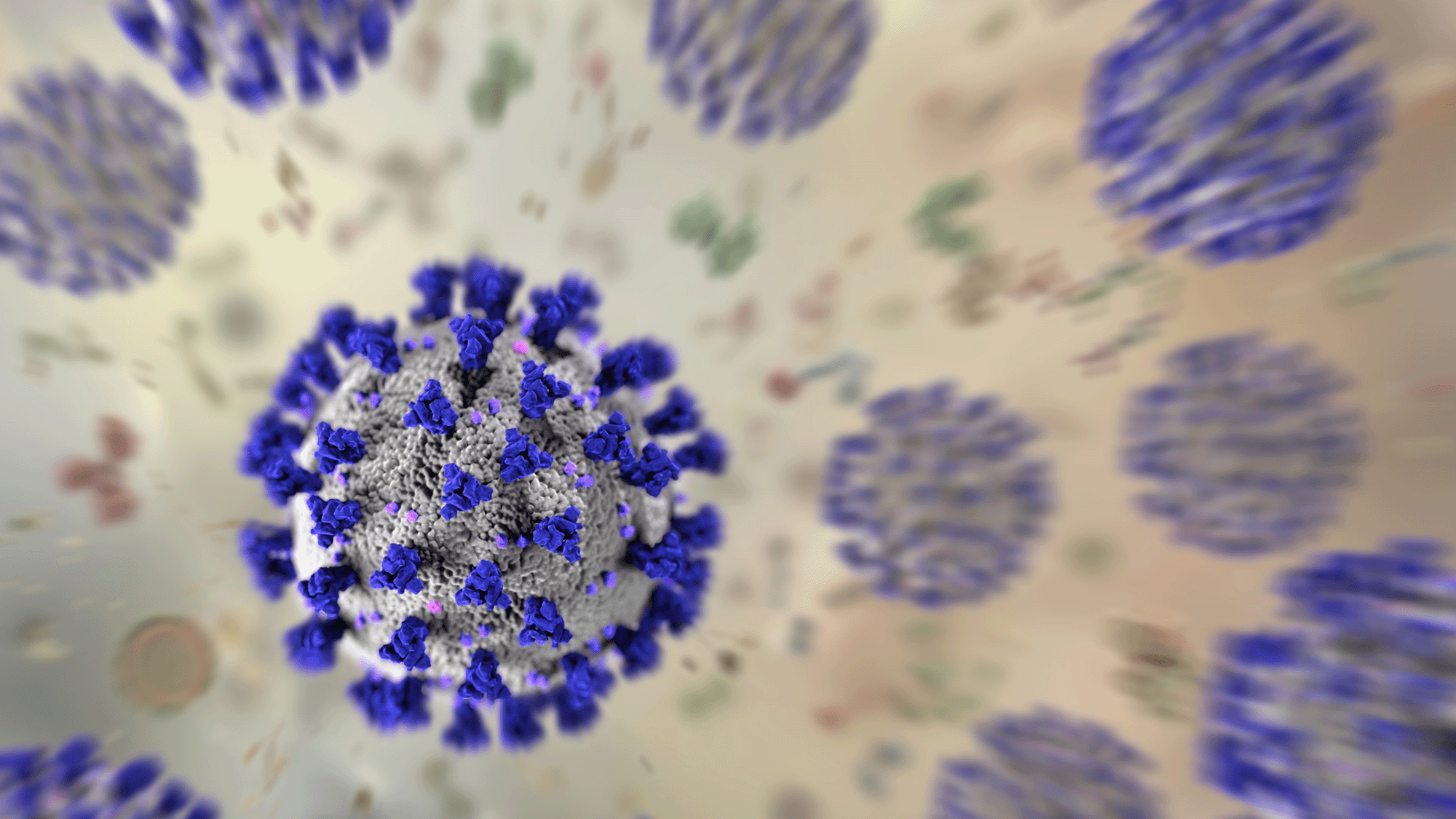
A severe case of COVID-19 can “reawaken” dormant viruses in the body, even in people with otherwise healthy immune systems, a new study finds.
These reactivated viruses include Epstein-Barr virus (the “mono” virus, or EBV), cytomegalovirus (CMV), herpes simplex virus (HSV) and anelloviruses. That final group of viruses can be found in the vast majority of people, but they have never been definitively shown to cause human disease.
However, in this study, the reactivation of these seemingly benign anelloviruses was linked to persistent physical disability from long COVID, researchers reported Aug. 5 in the journal Nature.
Latest Videos FromLive Science
Anna Cliffe, an associate professor of microbiology, immunology and cancer biology at the University of Virginia who wasn’t involved in this study, praised the work as “one of the largest and most carefully done studies of its kind.”
The findings suggest that severe COVID-19 may wake up dormant viruses, and “once awake, they may add to the inflammation that makes COVID-19 worse,” Cliffe told Live Science in an email.
What’s more, “if our findings on Anelloviridae and long COVID are validated, then it would really create a lot of urgency around better understanding these viruses and developing antivirals for them,” study co-author Dr. Esther Melamed, a neuroimmunologist at the University of Texas at Austin, told Live Science.
Viral reactivation
The study tracked 1,154 adults who’d been hospitalized with COVID-19 cases of varying severity, following them for a year. The researchers gathered blood samples and nasal swabs, as well as lung fluid samples from the ventilated patients. These samples were taken at six time points during the first month, and then at three, six, nine and 12 months.
Get the world’s most fascinating discoveries delivered straight to your inbox.
The team ran tests to look for viral RNA, a genetic cousin of DNA, as a sign that these lingering viruses were reactivating during and after their infection with SARS-CoV-2, the virus that causes COVID-19. The results showed that many dormant viruses awakened during the acute infection, particularly members of the herpes family — EBV, CMV and HSV — and anelloviruses.
Each virus followed its own timeline of reactivation, with EBV and anelloviruses appearing early, and CMV and HSV later. And each was linked to its own set of immune and metabolic changes and clinical complications in the patients.
This widespread viral reactivation occurred even in people whose immune systems were not weakened. Nearly half of the patients in the study — 550 out of 1,148 — had at least one virus reactivate.
After the acute infection had passed, a percentage of the patients developed debilitating symptoms of long COVID, including fatigue and a reduced ability to complete everyday tasks, like dressing or walking. In these patients, anelloviruses were more likely to remain active after the acute phase of the COVID-19 infection.
Cliffe said the study had several strengths, including the year-long follow-up with repeated sampling. She highlighted that the team also replicated their main findings in a separate group of patients whose blood samples were included in a Mount Sinai biobank.
Long COVID has a range of symptoms, including racing or irregular heart beat, sleep issues, brain fog, fatigue and post-exertional malaise, in which symptoms grow significantly worse after physical or mental exertion.
(Image credit: Guido Mieth via Getty Images)
How COVID could reawaken viruses
The idea that herpesviruses can reactivate in healthy people, not just in those with weakened immune systems, is not new, Cliffe said. Previous research has shown that astronauts and Antarctic researchers, “who are about as healthy and rigorously screened as people get,” can experience this reactivation and then shed multiple herpesviruses during periods of acute physical and psychological stress.
Viral reactivation may happen when the immune system lets down its guard, Melamed thinks. Viruses from past infections hide in different cells across the body, and usually, the immune system “sort of stands as the guard at the door, preventing them from waking up and getting out of those cells,” she said.
But when the body encounters a huge stressor — such as a severe infection, an important exam, sleep deprivation or surgery — the immune system has to redirect its attention, Melamed explained. “When the guard walks away from the cell, then these viruses have the opportunity to wake up and do whatever they want,” she said.
Cliffe suggested another possible mechanism. “For HSV-1 [which mostly causes cold sores], our own lab’s work has shown that inflammatory signals the body produces during illness can directly wake the virus up from latency in neurons,” she said. They’ve found that a molecule that signals the immune system, called IL-1, triggers HSV-1 activation in neurons by making the cells super excitable.
“Other groups have separately shown that IL-6,” another immune-signaling molecule, “can do something similar in animal models,” she said.
Cliffe cautioned that detecting viral RNA shows that a gene in the virus is switching on, but that metric isn’t as convincing as finding whole new infectious particles in the body. That said, she noted that the authors did try to address this limitation with additional layers of evidence. For instance, they found both RNA of EBV and antibodies against it, as well as higher quantities of specific immune cells the virus is known to hide in, she said.
The other major caveat of the study, which the authors acknowledged, is that the link between virus reactivation and worse clinical outcomes is a correlation, not proof of the cause.
“The next step is to do prospective interventional trials to test whether antiviral medications for these reactivating viruses could help improve outcomes for people,” Melamed said. They would explore this in both severe COVID-19 and long COVID.
This article is for informational purposes only and is not meant to offer medical advice.
Maguire, C., Chen, J., Rouphael, N., Morse, B. A., Hoch, A., Pickering, H., Van Phan, H., Glascock, A., Chu, V., Dandekar, R., Network, I., Holland, S. M., Rosen, L. B., Lee, S., Vaysman, T., Diray-Arce, J., Chen, J., Kho, A. T., Milliren, C. E., . . . Melamed, E. (2026). Virus reactivation in acute and long COVID-19. Nature. https://doi.org/10.1038/s41586-026-10740-z