
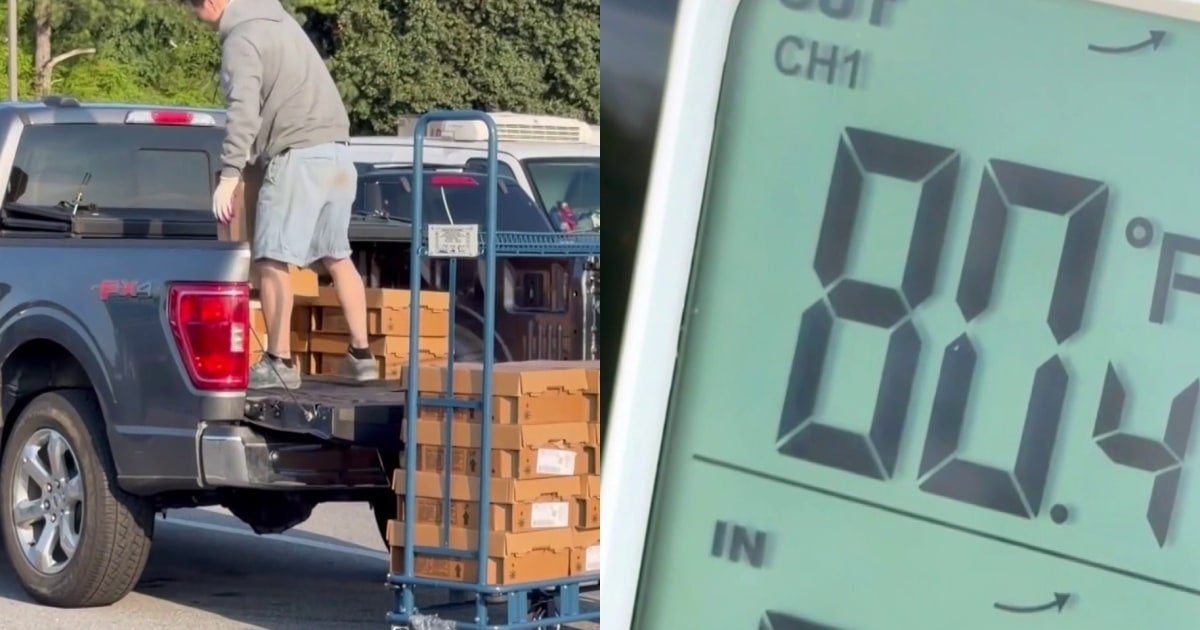
A slew of foodborne illness outbreaks and recalls this summer has many Americans questioning the safety of the U.S. food supply.
The journey from farm to table is often long and winding. Mishaps can occur during any step — harvesting, packaging or shipping — which allow germs to contaminate foods.
Every year, at least 48 million Americans get sick from foodborne diseases, and 3,000 die, per the U.S. Centers for Disease Control and Prevention.
Federal agencies implement regulations to prevent outbreaks, including requirements to keep perishable items at 41 degrees Fahrenheit or lower in transit to prevent harmful germs from growing to levels that can cause illness even after cooking.
But a TODAY investigation suggests there may be holes in this safety net during the final step of getting food to U.S. consumers.
The hidden camera investigation found that some perishable foods are being transported from distributors to restaurants and schools in unrefrigerated trucks, even on hot summer days.
“Our investigation is revealing a critical link of the food supply chain sometimes overlooked by regulators, that could be putting diners at risk,” NBC News chief consumer investigative correspondent Vicky Nguyen said in a TODAY segment aired Sept. 10.
Cameras Capture Unrefrigerated Trucks
“On some of Atlanta’s hottest summer days, our hidden cameras spotted foods like raw chicken and meat being loaded into unrefrigerated vehicles at major food distributors, then delivered to restaurants and other dining spots,” said Nguyen.
A tip led Nguyen to set up watch at an Atlanta area Restaurant Depot, a wholesale food supplier.
The footage shows employees on an 80-degree day loading raw meat and vegetables into customer vehicles without any refrigeration, or even ice packs.
NBC’s crew followed one vehicle carrying two dozen boxes of raw chicken wings as it made multiple stops, sitting in the hot sun for over an hour until it unloaded at a restaurant, said Nguyen.
“At 80 degrees, (pathogens) double in size every 20 minutes. They’re increasing the risk that someone is going to get food poisoning,” Dr. Lewis Ziska, a former U.S. Department of Agriculture official and associate professor of Environmental Health Sciences at Columbia University Mailman School of Public Health, told TODAY.
Another day, the crew followed an unrefrigerated van carrying raw poultry and shrimp, which later broke down. After sitting for over two and a half hours on a 90-degree day, the van was towed to a local restaurant, where the food was delivered, said Nguyen.
The restaurant’s owner told TODAY the delivery was an exception and sent a video of staff throwing away the food.
Federal and state health officials told TODAY no agency regularly inspects these “last mile” deliveries, which may allow violators to get away with cutting costs by skipping refrigeration.
TODAY’s investigation also took Nguyen to Sysco, the largest food distributor in America.
At an Atlanta area Sysco “will call” warehouse where restaurants pick up food, cameras captured employees loading unrefrigerated trucks with raw chicken.
“We followed it to Clayton State University, where the food was carted into a student dining facility — after sitting unrefrigerated for nearly two hours on a hot day,” says Nguyen.
In a statement, the university said it addresses “food safety concerns promptly.”
“Clayton State University prioritizes the safety and well-being of our students, faculty and staff. We are committed to upholding health and safety standards across campus and addressing food safety concerns promptly. The university is working with our vendor to review the matter and take any necessary action.”
TODAY also notified the university’s dining vendor, Elior Collegiate Dining, which sent the following statement:
“We take any allegation involving food safety seriously and are committed to reviewing this matter thoroughly, transparently, and responsibly. The health and safety of the students, faculty, and campus communities we serve is our highest priority. We are conducting a detailed investigation into this matter, including a review of the still images you provided. To date, we have received no reports of illnesses or complaints. Because our investigation is ongoing, we do not want to speculate or reach conclusions before all available information has been considered. If we identify any gaps or failures, we will address them promptly and take appropriate corrective action.”
Earlier this year, Sysco bought Restaurant Depot, giving the company more market share in the food service industry, says Nguyen.
Both Restaurant Depot and Sysco declined to go on-camera.
In a statement, Restaurant Depot emphasized that it doesn’t deliver food to clients, but does sell insulated bags and coolers.
“Restaurant Depot is a cash-and-carry wholesaler, where customers transport their purchases back to their own businesses, much like any consumer bringing groceries home from the supermarket. Restaurant Depot does not transport purchases for its customers. Transport is an important part of food safety and Restaurant Depot provides customers with specific guidance and a range of solutions through our “Keep It Kool” program, including insulated transport bags and coolers, thermal blankets, and millions of frozen gel packs provided to customers free of charge at its warehouses, all of which are designed to help maintain appropriate temperatures for perishable products.”
Sysco told TODAY it handles most deliveries to its customers in temperature-controlled trucks, but that restaurants can pick up food themselves outside of the normal delivery schedule, and that customers are responsible for proper food handling.
“Sysco is committed to food safety and maintaining the integrity of the cold chain throughout our distribution network. We maintain robust food safety and quality assurance programs designed to ensure products are properly stored, handled, and distributed while under our control. Some customers choose to pick up their own products from a Sysco facility, where those products are maintained within required temperature specifications before they are released. As with food purchased from grocery stores, warehouse clubs, and other food suppliers, customers who choose this option are responsible for proper handling, storage and transportation after pick up, and they acknowledge this responsibility as part of the process. Sysco remains committed to providing safe, high-quality products and its customer pickup process adheres to applicable food safety requirements.”
Tips for Consumers
When asked how consumers can stay safe, food safety experts offered Nguyen several tips:
- Check county health inspections online to see if a restaurant has a good food safety record.
- Ask restaurants if food is delivered in refrigerated trucks.
- If you get food poisoning, report it to your local health department.
- When grocery shopping, transport perishable food home in insulated bags of coolers.