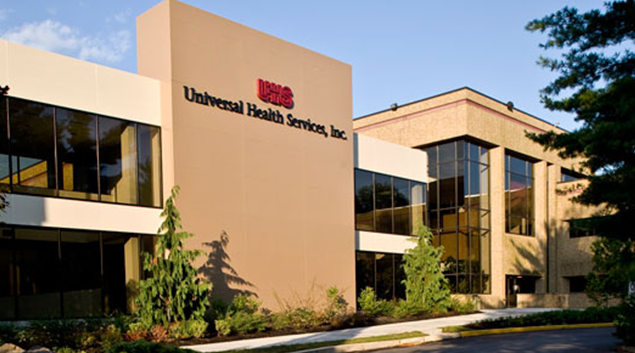
Universal Health Services notched a solid second quarter and has raised its revenue guidance for the year, though it now expects earnings per share to drag due to individual facilities’ performance drags and increased professional and general liability expenses.
Senior executives at the acute and behavioral hospital operator, in a Tuesday morning earnings call, said they were heartened by a general bounceback in demand after a surprisingly soft first quarter, but still slightly lowered the full-year volume guidance to reflect the company’s slow start.
The $200 million adjusted EBITDA hit UHS brought into its updated guidance was largely offset by about $150 million of additional net benefit from Medicaid supplemental funding, reflecting program approvals in states like Florida ($100 million of the net benefit, recognized in Q2) and Texas ($25 million expected to be recorded in Q3) that were not considered in the initial guidance. On a longer term view, Chief Financial Officer Steve Filton noted that over a fifth of the $1.5 billion Medicaid supplemental funding total UHS projects for the year will remain unaffected by coming years’ reductions under the One Big Beautiful Bill Act.
The new guidance generally outlines a ramp-up in earnings during the back half of the year, which Filton told analysts was reflective of 177 newly added acute care beds (a 2.5% increase), newly opened facilities finding their footing and a rebound in the Nevada market from softness that began last year.
As for performance impacts tied to the Affordable Care Act health insurance exchange markets, which have roiled peer for-profit systems like HCA Healthcare and Community Health Services, executives raised their projected pre-tax hit by just $10 million, to a total $85 million.
That tally as well as the quarter’s $20 million impact were in line with the upper half of UHS’ original estimates, Filton said. Adjusted admissions among exchange patients dropped about 15% year over year in the second quarter, and along with the first quarter’s 5% was actually below the company’s estimate of 25% plus, though the impact is being pulled up into UHS’ estimated range due to higher, “one-to-one” conversions into self pay and other dynamics such as shifts in metal tiers, Filton said.
“It felt like virtually everyone who lost their exchange coverage became an uninsured patient,” he said. “We had assumed in our original assumptions that a small percentage of those folks, maybe 10% to 20% of them, would replace their exchange coverage with other commercial coverage—more likely, coverage through their employers. That didn’t seem to be true. Probably that phenomena is what gave rise to the $10 million increase in our exchange impact projection.”
The company’s guidance now outlines net revenues between $18.50 billion and $18.76 billion (previously $18.42 billion to $18.79 billion), adjusted EBITDA net of non-controlling interest between $2.61 billion and $2.72 billion (previously $2.64 billion and $2.79 billion) and adjusted earnings per diluted share between $22.28 and $23.65 (previously $22.53 and $24.52). Same-facility acute care adjusted admissions fell from a 2% to 3% range to a 1.5% to 2.5% range, while expected same-facility behavioral health adjusted patient day growth was pulled back from a 2% to 3% range to a 1% to 2% range.
As for the quarter, UHS announced $358.4 million of net income, or $5.98 per diluted share, during the quarter, beating Wall Street’s consensus estimate and topping the prior year’s $353.2 million, or $5.43 per diluted share. Net revenues also came in ahead of market expectations at $4.64 billion, an 8.3% year-over-year increase.
Within the acute segment, same-facility admissions rose 2.9% and adjusted patient days increased by 3.1%. Same-facility net revenue per adjusted admission increased by 3%, and same-facility net revenues generated from the unit grew 8.2%.
One headwind noted here by executives and analysts was an inflationary increase in professional fees, which had moderated somewhat after spiking in 2023 and 2024. Filton said the company had baked in a 7% to 9% annual inflationary increase in its latest guidance.
“We’re getting that pressure, and we feel that pressure,” he said. “We’re responding to it in many different ways, in some cases by hiring the hospital-based physicians, in putting those contracts out to bid, and trying to control the amount of locums coverage we have to use, which is very expensive. It is a challenge for our operators, but I think they’ve responded well [and] are keeping the increase to a manageable level in the upper single digits.”
Among the behavioral business, same-facility adjusted admissions rose 0.5% and adjusted patient days by 1.4%. Same-facility net revenue per adjusted admission rose 7.1%, and total same-facility net revenues grew 7.4%.
Also on the behavioral side, executives said they’re expecting a mid-August close for their pending acquisition of virtual behavioral care platform Talkspace, a move they expect to help capture referrals and create a hybrid care model that will improve overall capacity. They added that UHS may again revisit its outlook for investors on behavioral outpatient growth sometime after the deal closes.
Executives also noted that share repurchases accelerated to $320 million during the quarter, up from the first quarter’s $127 million. That activity, plus the quarter’s numbers and revised guidance, had shares trading over 2.5% above open as of early Tuesday afternoon.