
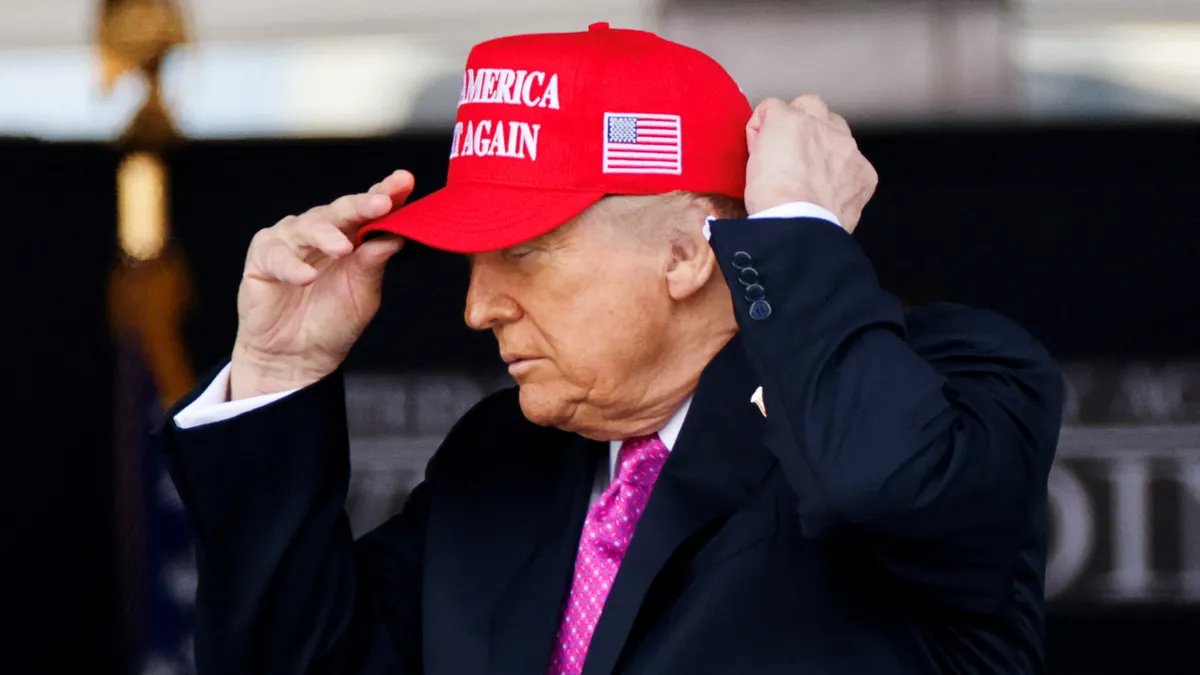

Unhappy Trump voters may stay home in the midterms
Frustrated Trump voters may not back Democrats, but lower turnout could still threaten Republican majorities in the midterms.
President Donald Trump’s allies have stockpiled more than $400 million in a fund that can run advertisements ahead of November’s elections, according to the newest information filed with the Federal Election Commission.
That’s as much as the Republican and Democratic parties have combined, and could transform an election season that has been dominated so far by the president’s waning popularity with the American people.
The account in question, MAGA Inc., is a super PAC that can raise and spend unlimited amounts of money on political advertisements. It’s been operating since just after Trump’s 2024 victory and raised about three-quarters of its money in 2025. Since then, most of it’s been sitting.
“That’s a massive amount of money to have,” said Brendan Glavin, director of insights for Open Secrets, a nonprofit that tracks political spending. “And there’s no corollary on the other side for the Democrats.”
Meanwhile, election forecasters have widely predicted that the Democrats will win enough seats in November to take over the House of Representatives. They also say that while Republicans can probably win enough Senate seats to maintain control of the upper chamber, the Democrats are within striking distance.
“The president is going to expend substantial resources to win the midterms,” James Blair, who runs MAGA Inc., said June 24 on “The Sean Spicer Show.” “He cares deeply about the party winning and anything he can do to support that he’s going to do.”
Blair did not say how MAGA Inc. would spend the money or when, just that spending would start “very soon.”
How MAGA Inc. raised $400 million
Billionaires and owners of successful companies are the main source of money for MAGA Inc., not small donors who make up Trump’s base. Miriam Adelson, the widow of the Las Vegas casino magnate Sheldon Adelson, and Diane Hendricks, a major conservative donor in Wisconsin, each gave $25 million.
An additional $21.3 million came from Securing American Greatness, Inc., a Trump-aligned dark money group that does not have to disclose its donors. Trump’s previous super PAC, Make America Great Again, Inc., transferred $10.6 million before effectively shutting down.
But one of the largest sources of money is the cryptocurrency industry. Trump’s administration has weakened oversight of the industry, and Trump, in his personal capacity, made $1.4 billion from crypto investments in 2025.
Foris Dax, owner of Crypto.com, is the largest donor to MAGA, Inc., at $35 million. Blockchain.com gave $5 million, and the Gemini Trust Co., which runs a cryptocurrency exchange, gave $4.4 million.
In June, MAGA Inc. raised $28.7 million, according to records from July 20. More than a third of that came from Tyler and Cameron Winklevoss, twins who own a venture capital company.
In June, the Winklevoss twins each donated Bitcoin worth about $5 million. MAGA, Inc., then converted those to cash through the Gemini Trust Co., another donor, and paid the company about $300,000 in exchange fees.
“Crypto spent a lot of money in 2024,” Glavin said. “It was seen as a success. Trump went from being kind of very dismissive of it to being on board with it, which is certainly seen as a big win for the industry.”
Konstantin Sokolov, an investor and philanthropist, gave $1 million in June, after a previous $11 million donation. He is also the founder and chairman of a $201 million fund that is designed to drive private investment in the South Caucasus and Central Asia, according to the State Department.
Jared Isaacman, Trump’s current NASA administrator, also gave $1 million in June.
MAGA, Inc. has more than Republican Party accounts
The money in MAGA, Inc. is in addition to the accounts for the Republican National Committee, the party’s Senate campaign arm, and the party’s House campaign arm. Those three party entities combined had $277 million at the end of June, according to documents filed July 20.
“Republicans already have a substantial cash advantage within that ecosystem, and then you enter in the MAGA, Inc. with its $400 million and … there’s nothing really counteracting that,” Glavin said.
Some Democratic candidates, however, are pulling in major money. Sen. Jon Ossoff in Georgia had $42.6 million at the end of June, a significant advantage over his GOP opponent, Michael Collins, who had $20.4 million. But the Democratic Party as a whole is trailing the Republican Party.
The account for the Democratic National Committee plus the party’s Senate and House campaign arms had $136 million at the end of June. That’s less than half of the Republican Party’s three comparable accounts and about a third of MAGA Inc.’s $400 million in cash.
“Our party is doing a really good job raising money, and that’s because we’re doing what we promised our supporters,” said Blair, who runs MAGA, Inc. “I think that all bodes really well for us and is going to let us spend earlier and let us be loud at the end.”
Can money fix Trump’s popularity issue?
Kyle Kondik, managing editor of the Crystal Ball newsletter at the University of Virginia, cautioned that money isn’t the only way to win a race. He said it might provide an advantage, but Trump is still lacking popularity.
Kondik said Trump was able to pull in votes in 2016 and 2024 from voters who weren’t passionate about him but preferred him to his opponent. However, this year they may be less motivated to vote for his party.
“I think some of those people are probably turned off now because of the state of the economy or his antics,” Kondik said. “The public just felt better about the economy this time eight years ago than they do now.”
While a super PAC can run advertisements to help change voters’ minds, MAGA, Inc. officials are staying tight-lipped about what it will do and when. The statement spokesperson Alex Pfeiffer provided USA TODAY declined to go into detail.
“While MAGA Inc. is committed to retaining and building the GOP majorities in the House and Senate, we are not in the habit of sharing our battle plans with the opposition through their co-conspirators in the legacy media,” Pfeiffer said.