
Voting rights advocates closely watch race for secretary of state, as leading candidate supports president’s rejection of 2020 election results.

What happens to your ballot in Arizona after you have voted?
Arizona Republic politics reporter Stephanie Murray explains what happens to your ballot after you have voted.
The most consequential election in Arizona this year may not be for governor or Congress, but for a statewide office that rarely makes national headlines but helps decide who wins the races that do.
A candidate who denies the legitimacy of President Donald Trump’s election loss to Joe Biden in 2020 is heavily favored to win the Republican nomination for secretary of state in the July 21 primary.
GOP candidate Alex Kolodin has a wide 44-20 lead over Gina Swoboda in the race for who will take on incumbent Democrat Adrian Fontes to be Arizona’s top election official in November, according to a recent NextGen Polling poll.
Kolodin, a state representative from Scottsdale, is a lawyer who has garnered widespread attention for claiming that U.S. elections, including those in Arizona, are unfair and “rigged.”
Swoboda worked in the secretary of state’s office under a Republican and a Democrat and headed the state Republican Party with Trump’s blessing. A former Democrat, she casts Kolodin as an unelectable option who wants to do away with Arizona’s mail-in voting system.
Kolodin, in return, casts Swoboda as “carrying water” for Fontes, The Arizona Republic, a USA TODAY Co. newspaper, reported on June 10.
Swoboda announced last October that she would seek the Republican Party’s nomination in Arizona’s 1st Congressional District and had Trump’s endorsement for that race. But soon after she announced her candidacy for secretary of state four months later, she told the Arizona’s Family news outlet she was “running as Gina with no endorsement because I think that’s what the people of Arizona want.”
As is typical in most states, the Arizona secretary of state is primarily responsible for maintaining the statewide voter registration database, writing the state’s Elections Procedures Manual that translates elections statutes into a practical “how‑to” guide, and certifying election equipment.
But the job has become a “bully pulpit” of sorts since 2020, when then-Secretary of State Katie Hobbs, a Democrat, used it to push back on claims by Trump and his Arizona supporters that the election in the state was rigged against him, said former elected Maricopa County Recorder Stephen Richer.
“I think the secretary does have a powerful role now, in terms of being the ostensible chief spokesperson for election administration,” Richer, a Republican who now analyzes election administration and democracy as a senior fellow at the Harvard Kennedy School, told USA TODAY. “And I think that it could undermine the process if your chief spokesperson is peddling some of the nonsense that Alex has peddled over the last now-almost six years.”
A key figure in the ‘kraken’ lawsuits to overturn the 2020 election
Kolodin was part of the so-called “kraken” lawsuits involving Trump ally Sidney Powell that claimed “massive election fraud” in 2020. He also represented some of the Republican “fake electors” who hoped to set aside Arizona’s 2020 certified election results as part of Trump’s effort to overturn his election loss.
After the Arizona “kraken” case was dismissed, along with those filed in other states, Kolodin faced formal admonishment from the state bar and was required to take legal ethics classes for filing suits lacking merit.
At the statehouse, Kolodin – now a sophomore lawmaker – has sponsored a state constitutional amendment that would allow counties to use hand-counted voting tallies, a method experts view as more error-prone than electronic counting.
It’s also a method being pushed by Trump and his supporters on a national level.
Kolodin’s “Arizona Secure Elections Act” would also require voters to present government-issued identification to cast a ballot.
Last month, the GOP-run legislature voted to place Kolodin’s plan on the fall general election ballot, avoiding a veto from Hobbs.
‘Facilitate the continued lawful, fair execution of elections in Arizona’
One of the most important aspects of the job is in ensuring that Arizona’s 15 counties are in compliance with state election laws and how they are administered, and in assuring the public that the system works, is free of fraud and that citizens’ votes are counted, according to Richer.
It’s also critical that the state’s county elections officials, who administer a patchwork of different election machines and system, know that the secretary of state “has their back” when there are challenges to elections, Richer said.
“I think that would be true of Gina Swoboda. She would do a different job” as a Republican than Fontes would, Richer said. “But she would still do a fine job … and responsibly lead that office and facilitate the continued lawful, fair execution of elections in Arizona.”
Richer is not nearly as supportive of Kolodin, he said.
“I think if Alex behaves in any way consistent with how he’s behaved over the last few years, it would make the process, at the very least, less pleasant for election administrators,” Richer said. “And it could damage confidence and make coordination between the counties and the state more challenging.”
Richer’s campaign did not respond to requests for comment.
Trading barbs about who could beat the Democratic incumbent
Swoboda briefly ran for Congress in 2025 before quitting that race to instead run for the secretary of state, which she describes as her true interest. She ran voter integrity operations for the Trump campaign in Arizona in 2020.
Before she took over the state party, Swoboda ran the Voter Reference Foundation, a Trump-aligned nonprofit that hunted and said it found “large” discrepancies with voter files in other states, between the number of voters and the number of ballots cast in the Nov. 3, 2020 election, according to a ProPublica investigation.
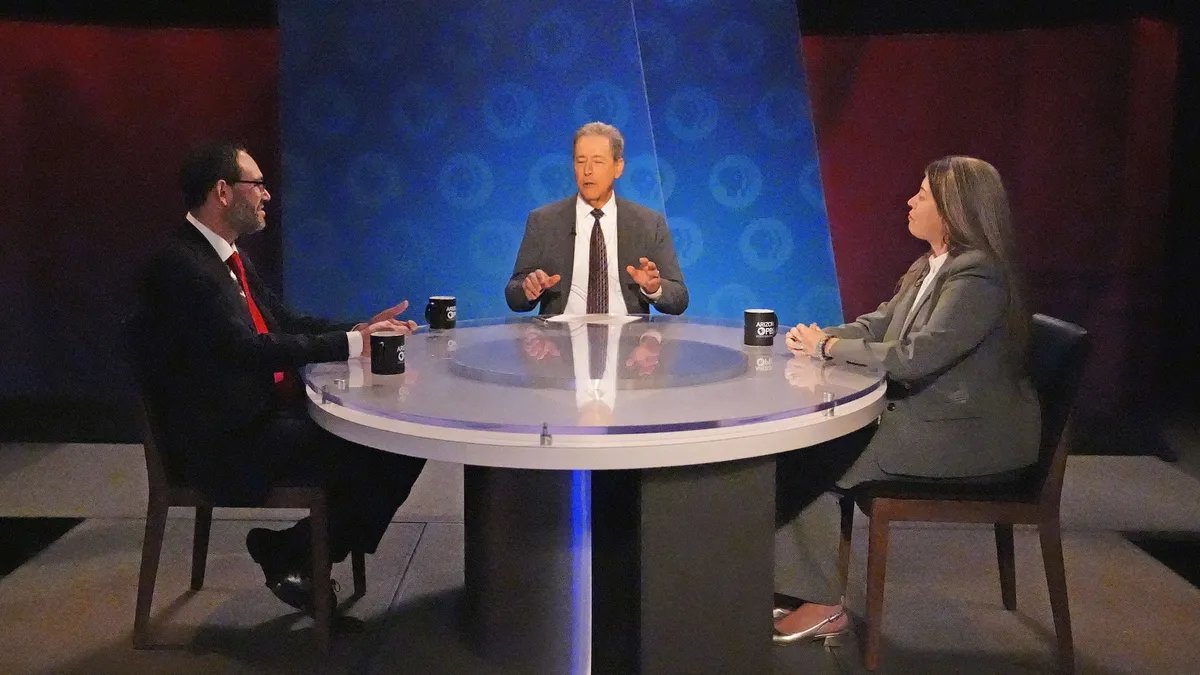
During a 30-minute candidate forum on May 14 on Arizona PBS, Kolodin and Swoboda traded barbs about each other’s background and their work on ensuring election integrity.
The discussion delved into details of whether party observers can monitor election results in person, but Swoboda focused on electability.
“I just want to ask everybody out there: Do you seriously think that my opponent could possibly beat Adrian Fontes in the general election?” Swoboda said. “The answer is no.”
For his part, Kolodin cited Swoboda’s background as a Democrat and former aide to Hobbs when she headed the office that oversees the state’s elections.
“This is definitely not someone stable enough to be our chief elections officer,” he said.
An agreement on how to jointly oversee the November vote
Election officials in Maricopa County, Arizona’s most populous county, reached an agreement last week on how to jointly oversee the vote, ending a prolonged legal battle.
That decision came as Trump gave a nationwide address to claim that America’s elections cannot be trusted.
Trump’s address and his debunked claims of massive election fraud in 2020 have put him sharply at odds with Fontes, an outspoken critic of the president, as have Trump’s stated intentions to intervene in state election processes by assuming federal control of some aspects of the voting.
Just before Trump’s July 16 address, Fontes again vowed to stand up for Arizonans’ voting rights.
“Election administration is hard enough without threats from the federal government,” Fontes said.
Contributing: Staff of The Arizona Republic