
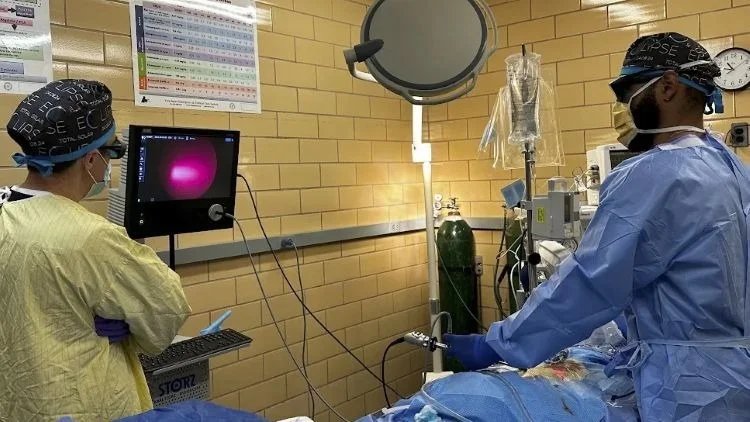
Children whose appendix has burst often develop serious abdominal infections that are hard to treat and increasingly resistant to antibiotics. In a recent study, researchers tested whether a light-activated blue dye, activated by a laser inside the abdomen during minimally invasive surgery, could safely kill those bacteria.
Timothy M. Baran, PhD & Korry T. Wirth, MD, MS. Image Credit: American Society for Laser Medicine and Surgery, Inc.
The preclinical study led by Nicole A. Wilson, MD, PhD, FACS; Timothy M. Baran, PhD; and Korry T. Wirth, MD, MS, is titled, “Laparoscopic Methylene Blue Photodynamic Therapy for Intraabdominal Infection: A Preclinical Feasibility Study in a Rabbit Model of Perforated Appendicitis.” The report, published in Lasers in Surgery and Medicine (LSM), the official journal of the American Society for Laser Medicine and Surgery, Inc. (ASLMS), was selected as the September 2026 Editor’s Choice.
The study evaluated antimicrobial photodynamic therapy (PDT), a light-activated approach in which methylene blue dye produces bacteria-killing reactive oxygen species when illuminated with a laser, as a potential intraoperative adjunct.
“As a pediatric surgeon, I care for many children with a perforated appendix, and I have seen firsthand how the resulting abdominal infection can lead to prolonged antibiotics, additional procedures, and long hospital stays,” Wilson stated.
With antibiotic resistance rising, we urgently need ways to kill bacteria that don’t depend on the very drugs those bacteria are learning to evade. Photodynamic therapy, using a light-activated dye to generate bacteria-killing molecules, is exactly that kind of targeted, resistance-independent approach. We wanted to know whether it could be delivered safely inside the abdomen during a routine minimally invasive operation, and this study is an important first step showing that it can. Our hope is that, with improved light-delivery tools, this could one day become a simple adjunct a surgeon adds during an operation to attack infection at its source.”
Nicole A. Wilson, MD, PhD, FACS, Section of Pediatric Surgery, Department of Surgery, University of Oklahoma Health Campus
Working in a newly developed rabbit model of perforated appendicitis with peritonitis, the team delivered methylene blue PDT (MB-PDT) entirely through a laparoscopic (minimally invasive) approach: the peritoneal cavity was bathed in dilute methylene blue and then illuminated with 665-nm laser light. MB-PDT proved technically feasible and safe, with no histologic evidence of off-target injury to abdominal organs, and the team developed a prototype device to stabilize the laser fiber and prevent inadvertent thermal injury to the bowel.
Although this small, exploratory in vivo cohort did not show a statistically significant reduction in bacterial burden (most likely reflecting the difficulty of delivering uniform light throughout the complex, open peritoneal cavity), MB-PDT produced strong, statistically significant killing of every bacterial species isolated from the infected animals when tested in vitro, including antibiotic-resistant organisms. The study establishes a preclinical technical platform for intra-abdominal MB-PDT and identifies optimized light delivery as the key next step toward a clinically useful, resistance-independent tool for treating intra-abdominal infection.