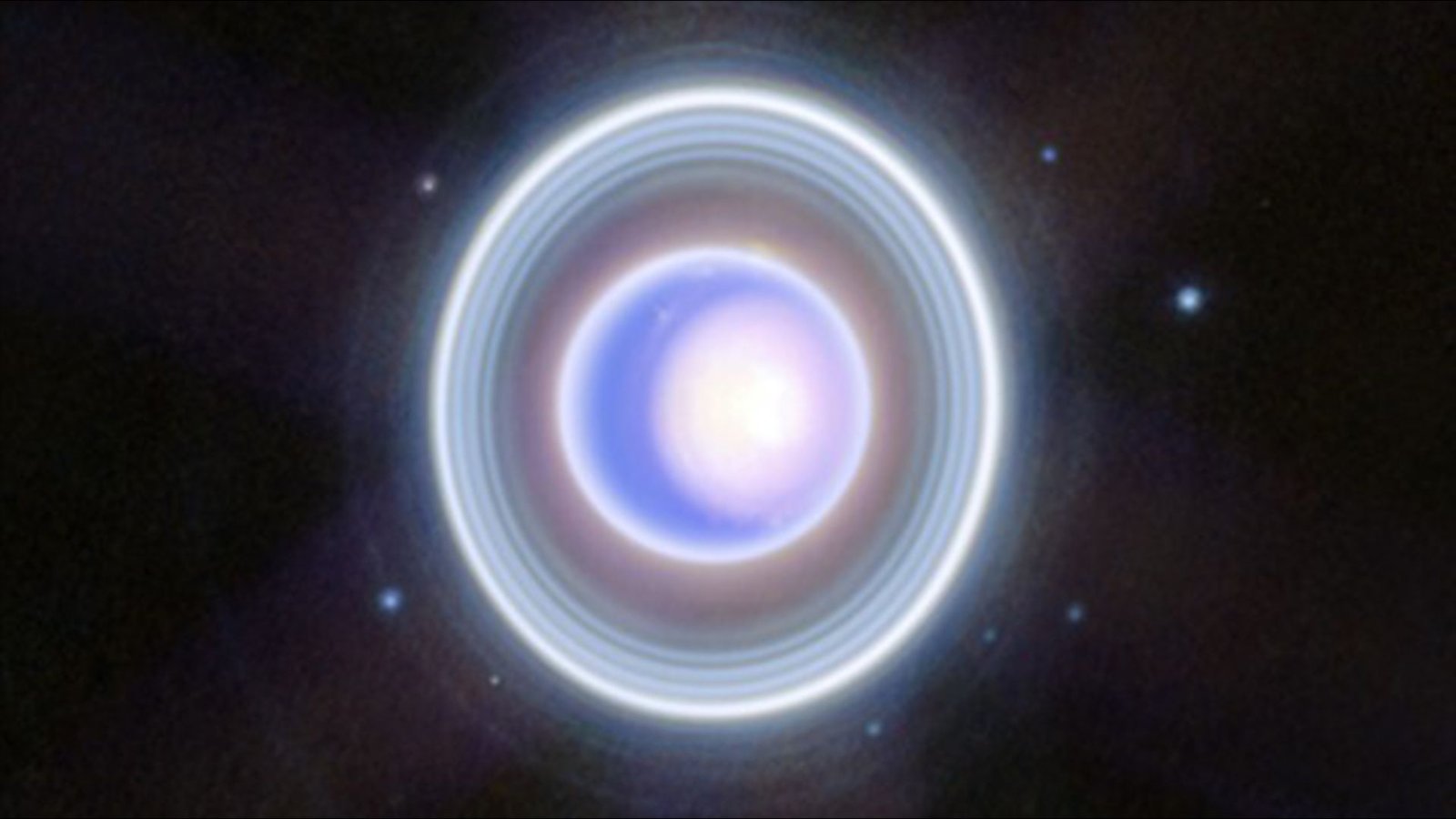
One of the hardest planets to see in the solar system — the distant ice giant Uranus — reaches its annual opposition on Wednesday (Nov. 25), just a day after the Beaver Supermoon. It’s the best time to see the seventh planet from the sun, but you’ll need to use stargazing binoculars or a good backyard telescope to find it.
Uranus is faint, slow-moving and rarely a target for casual stargazers. However, on Nov. 25, and, for a few weeks on either side, it will be at its closest point to Earth this year and will appear at its brightest, making it possible to spot.
Opposition occurs when Earth passes between Uranus and the sun; Uranus will be “opposite” the sun, hence, “opposition.” The moment of opposition will happen at 6 p.m. ET on Nov. 25, according to EarthSky. Consequently, Uranus will rise in the east around sunset, reach its highest point in the sky around midnight and set in the west around sunrise.
Latest Videos FromLive Science
You can find it in the constellation Taurus, close to the Pleiades open star cluster, also known as the Seven Sisters and M45. Uranus will be a few degrees southeast of the cluster, appearing as a faint point of light, about two-fifths of the distance between the Pleiades and Aldebaran, the brightest star in Taurus.
At magnitude +5.6, Uranus is technically visible to the naked eye under very dark skies. However, binoculars or a telescope will make it much easier to find.
Uranus as seen by NASA’s Hubble Space Telescope.
(Image credit: NASA/ESA and Erich Karkoschka, University of Arizona)
At opposition, Uranus will be 18.4 astronomical units (AU) from Earth — about 1.7 billion miles (2.7 billion kilometers) away. Through a telescope, it will appear as a tiny blue-green disk. Its color comes from methane in its atmosphere, which absorbs red wavelengths of sunlight.
Named after Ouranos, the ancient Greek god of the sky and the heavens, according to the Planetary Society , Uranus is one of the least understood planets in the solar system. A day on Uranus lasts for about 17 hours, and the planet rotates sideways, according to NASA. It takes 84 Earth years to orbit the sun.
Sign up for the Live Science daily newsletter now
Get the world’s most fascinating discoveries delivered straight to your inbox.
Uranus also has 13 faint rings and at least 29 known moons, the most recent of which was found in 2025 by the James Webb Space Telescope. It was named Uranus XXVIII and orbits between the moons Ophelia and Bianca. Many of Uranus’ moons are named after characters from the works of William Shakespeare and Alexander Pope.
The distant planet has been visited only once, by NASA‘s Voyager 2 spacecraft on Jan. 24, 1986. However, contrary to what the probe found, scientists now think the planet emits its own internal heat. That could increase pressure on NASA to prepare a Uranus Orbiter and Probe (UOP), a mission concept the National Academy of Sciences recommended in 2022 as a high-priority planetary science mission for the next decade.
Uranus will next come to opposition on Nov. 30, 2027.